
All Major Rally Car Classes Explained
A comprehensive guide to the FIA’s international rally categories, from Groups 1-4 and Group B through Group A, Group N, World Rally Cars, Super 2000, Group R and the modern Rally1-Rally6 pyramid.

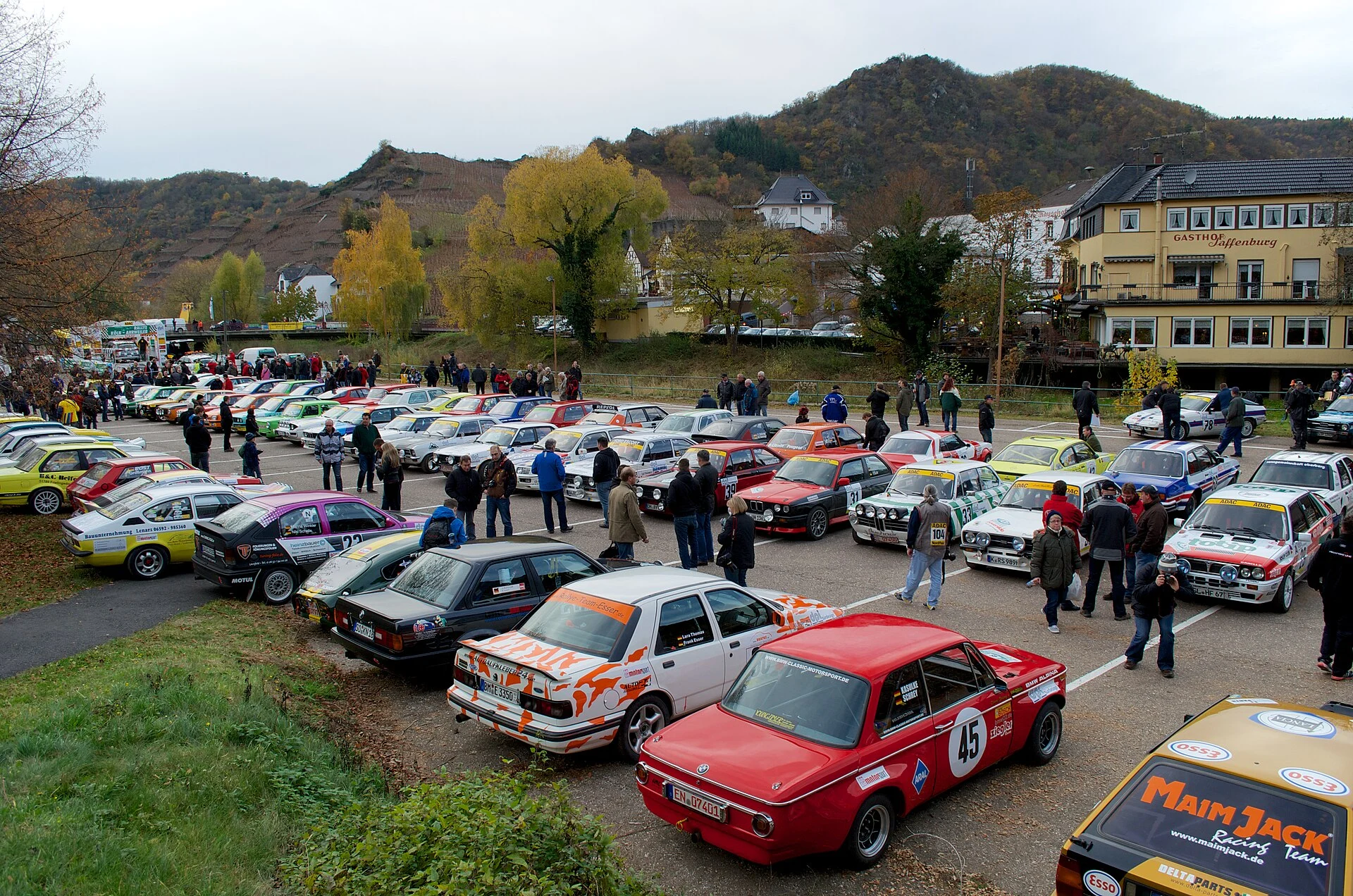
Rallying has never had one permanent class structure. The FIA has repeatedly replaced its regulations as road-car technology, safety standards, manufacturing volumes and competition costs have changed.
The word class can also mean several different things. Group A was a technical group, while A6 and A8 were capacity classes within that group. World Rally Car was a technical formula, while WRC2 was a sporting championship for cars from another technical category. RC1, RC2 and RC3 are modern event-classification buckets rather than vehicle designs.
This article covers the major international FIA stage-rally groups and formulas that formed the recognised global ladder. It includes the main capacity subdivisions where those labels became widely used in results and regulations.
It does not attempt to list every local class created by every national sporting authority. Names such as Open, Modified, Clubman, Group F, Group H, Proto, NR4 and National 4WD can describe very different vehicles in different countries.
Historic rallying also allows old cars to compete today, but its modern age categories are eligibility periods rather than new technical formulas. A Group 4 car remains a Group 4 car even when it appears in a modern FIA historic category.
The FIA Historic Database preserves period Appendix J regulations reaching back through the original Groups 1-6 system and the later N, A and B era.
The complete FIA rally timeline
| Period | Major classes introduced or dominant | What changed |
|---|---|---|
| 1960s-1981 | Groups 1, 2, 3 and 4 | Production touring and GT cars were separated by production volume and modification freedom. |
| 1982 | Groups N, A and B | The old numbered production groups were replaced by a new three-group system. |
| 1982-1986 | Group B | Low-volume, highly modified cars became the fastest WRC machinery. |
| 1987-1996 | Group A | High-volume production cars replaced Group B at the top of the World Rally Championship. |
| 1980s-2000s | Group N | Near-production cars provided a lower-cost international category, with N4 becoming the leading four-wheel-drive class. |
| 1993-1999 | Formula 2 Rally | Two-wheel-drive, naturally aspirated cars received an international championship and strong manufacturer support. |
| Mid-1990s-2000s | Kit Car | Wider, lighter and more powerful Group A two-wheel-drive cars appeared in A6 and A7. |
| 1997-2021 | World Rally Car | The top class moved away from requiring a manufacturer to sell a direct four-wheel-drive turbo road homologation model. |
| 2001-2010 | Super 1600 | A cost-controlled 1.6-litre two-wheel-drive category became the Junior WRC formula. |
| 2006-2013 | Super 2000 | Naturally aspirated 2.0-litre four-wheel-drive customer cars became a major international class. |
| 2008 onward | Group R | R1, R2, R3, R4 and later R5 created a clearer development ladder. |
| 2011-2013 | Regional Rally Car | Restricted 1.6-litre turbo versions of contemporary World Rally Cars formed a short-lived regional formula. |
| 2013 onward | R5 | A new cost-capped 1.6-litre turbo four-wheel-drive customer formula replaced Super 2000. |
| 2018 onward | R4 Kit | A common four-wheel-drive kit allowed regional constructors to build cars below R5 performance. |
| 2019-2021 | Rally pyramid renaming | R1 became Rally5, R2 became Rally4 and R5 became Rally2; Rally3 was created as a new class. |
| 2022 onward | Rally1 | Rally1 replaced World Rally Car as the WRC’s premier technical category. |
| 2022-2024 | Hybrid Rally1 | A standard plug-in hybrid system raised combined output beyond 500 bhp. |
| 2025-2026 | Non-hybrid Rally1 | The hybrid unit was removed, minimum weight fell and the engine restrictor became smaller. |
| 2024 onward | Rally5-Kit | ASNs gained a lower-cost route for creating safe entry-level cars from suitable production models. |
| 2026 onward | E-Rally5 and Rally6 | Electric and very low-cost combustion-engine entry formulas expanded the base of the ladder. |
The dates indicate the main period of international use. Older cars often remained eligible for national, regional or historic competition long after their category stopped being the FIA’s current formula.
The original numbered production groups
From the 1960s through 1981, the FIA’s Appendix J divided recognised production cars into numbered groups.
In the 1971 regulations, Group 1 required 5,000 cars in 12 months, Group 2 required 1,000, Group 3 required 1,000 and Group 4 required 500. The exact production thresholds and technical freedoms changed during the long life of the system.
Groups 1 and 2 were principally touring-car categories. Groups 3 and 4 were intended for grand touring cars, although rally homologation practice eventually included some models that did not resemble a traditional two-seat GT.
Group 5 and Group 6 also existed, but neither formed the normal foundation of top-level international stage rallying. Group 5 changed meaning between periods, while Group 6 was a prototype-sports category.
Group 1: series-production touring cars
Group 1 was the closest major international category to a showroom touring car.
The manufacturer had to produce the required large number of essentially identical vehicles. Modification freedom was limited, and many components had to remain as supplied on the homologated production model.
Safety equipment, competition seats, harnesses, lighting and certain suspension or engine adjustments were permitted as the rules evolved, but the category was not intended to create a highly specialised rally prototype.
Most Group 1 cars were two-wheel drive because that reflected the production market of the period. Front- and rear-wheel-drive models both appeared.
| Group 1 area | Representative specification |
|---|---|
| Main era | 1960s-1981 |
| Production requirement | 5,000 identical cars in 12 months under the 1971 rules |
| Typical engine | Production-derived naturally aspirated petrol engine |
| Representative power | Approximately 50-200 bhp / 37-149 kW |
| Weight | Usually close to the homologated production weight; approximately 700-1,400 kg across all capacities |
| Driven wheels | Usually front- or rear-wheel drive |
| Modification level | Low |
| Later replacement | Most valid Group 1 homologations transferred into Group A or the new production structure from 1982 |
Group 2: special touring cars
Group 2 used touring-car bodies but allowed substantially more preparation than Group 1.
Engines could receive greater internal development, carburation or fuel-injection changes, competition exhausts and other homologated parts. Suspension, brakes, wheels and transmission components could also be upgraded more extensively.
The lower production threshold allowed manufacturers to create more specialised road versions as a basis for competition.
Group 2 became a popular class for Ford Escorts, BMWs, Fiats, Opels, Saabs and other widely available touring models.
| Group 2 area | Representative specification |
|---|---|
| Main era | 1960s-1981 |
| Production requirement | 1,000 identical cars in 12 months under the 1971 rules |
| Typical engine | Modified production engine, usually naturally aspirated |
| Representative power | Approximately 90-300 bhp / 67-224 kW |
| Weight | Approximately 700-1,200 kg depending on model and capacity |
| Driven wheels | Predominantly front- or rear-wheel drive |
| Modification level | Medium to high |
| 1982 transition | Eligible old homologations could transfer into Group B |
Group 3: series-production grand touring cars
Group 3 was the grand-touring counterpart to Group 1. It contained lower-volume sports and GT cars with relatively limited modification freedom.
These cars generally had two seats or a compact 2+2 cabin, although the precise seating and dimensional definitions came from Appendix J.
Rear-wheel drive was the most common layout because it dominated the contemporary sports-car market.
| Group 3 area | Representative specification |
|---|---|
| Main era | 1960s-1981 |
| Production requirement | 1,000 identical cars in 12 months under the 1971 rules |
| Typical engine | Production sports-car engine |
| Representative power | Approximately 70-250 bhp / 52-186 kW |
| Weight | Approximately 700-1,300 kg |
| Driven wheels | Usually rear-wheel drive |
| Modification level | Low to medium |
| 1982 transition | Eligible homologations could transfer into Group B |
Group 4: special grand touring cars
_(52867829933).webp)
A Lancia Stratos HF Group 4.
Group 4 became the defining top rally category of the 1970s and early 1980s.
It allowed a low-volume production basis and considerably more competition development than Group 3. The engine, brakes, suspension, bodywork and transmission could be altered through the permitted homologation system.
Famous Group 4 cars included the Alpine A110, Lancia Stratos, Fiat 131 Abarth, Ford Escort RS1800, Porsche 911, Renault 5 Turbo and early Audi quattro.
Rear-wheel drive dominated most of the period. Four-wheel drive became decisive at the end of the Group 4 era when Audi demonstrated its traction advantage.
| Group 4 area | Representative specification |
|---|---|
| Main international era | 1960s-1981, with transferred cars continuing after 1982 |
| Production requirement | 500 cars under the 1971 rules; requirements varied later |
| Typical engine | Naturally aspirated or turbocharged production-derived competition engine |
| Representative power | Approximately 180-350 bhp / 134-261 kW |
| Weight | Approximately 700-1,200 kg depending on model and capacity |
| Driven wheels | Usually rear-wheel drive; four-wheel drive also permitted and increasingly important |
| Modification level | High |
| Replacement | Group B |
Group 5: an important name, but not a central rally formula
Group 5 changed meaning during its existence. In the early Appendix J structure it referred to production-based sports cars with an extremely low minimum production number. In the later 1976-1981 system, it became the famous Special Production Car category associated mainly with circuit racing.
Group 5 cars could be extremely powerful and heavily modified. They appeared in occasional mixed-discipline events and are relevant to rally history, but Group 5 never became the normal top World Rally Championship class in the way that Group 4, Group B, Group A or World Rally Car did.
| Group 5 area | Representative specification |
|---|---|
| Main era | Several definitions between the 1960s and 1981 |
| Representative power | Approximately 150-500+ bhp / 112-373+ kW |
| Later minimum-weight scale | Approximately 500-850 kg according to capacity |
| Driven wheels | Model dependent |
| Rally importance | Peripheral rather than a standard international stage-rally category |
Group 6 covered prototypes and is not treated as a normal production rally class in this guide.
Groups 1-4 compared
| Group | Production concept | Representative power | Typical weight | Common drive | Freedom |
|---|---|---|---|---|---|
| Group 1 | Large-volume touring car | 50-200 bhp / 37-149 kW | 700-1,400 kg | FWD or RWD | Low |
| Group 2 | Special touring car | 90-300 bhp / 67-224 kW | 700-1,200 kg | FWD or RWD | Medium to high |
| Group 3 | Series-production GT | 70-250 bhp / 52-186 kW | 700-1,300 kg | Usually RWD | Low to medium |
| Group 4 | Special GT | 180-350 bhp / 134-261 kW | 700-1,200 kg | Mostly RWD; some 4WD | High |
Group 1 and Group 3 were the relatively standard categories. Group 2 and Group 4 were their more highly developed equivalents.
The 1982 reset: Group N, Group A and Group B
Appendix J was reorganised for 1982. The old numbered production groups were replaced by Groups N, A and B.
Group N covered large-scale series-production touring cars with limited modifications. Group A covered large-scale production cars with substantially greater development freedom. Group B covered lower-volume series-production grand touring cars with the greatest freedom.
At introduction, Group N and Group A were linked to a 5,000-car production requirement. Group B required only 200 identical units in 12 months.
Older Group 1 cars could transfer into Group A, while valid Groups 2, 3 and 4 homologations could transfer into Group B under the transitional provisions.
Group B: the low-volume high-performance category
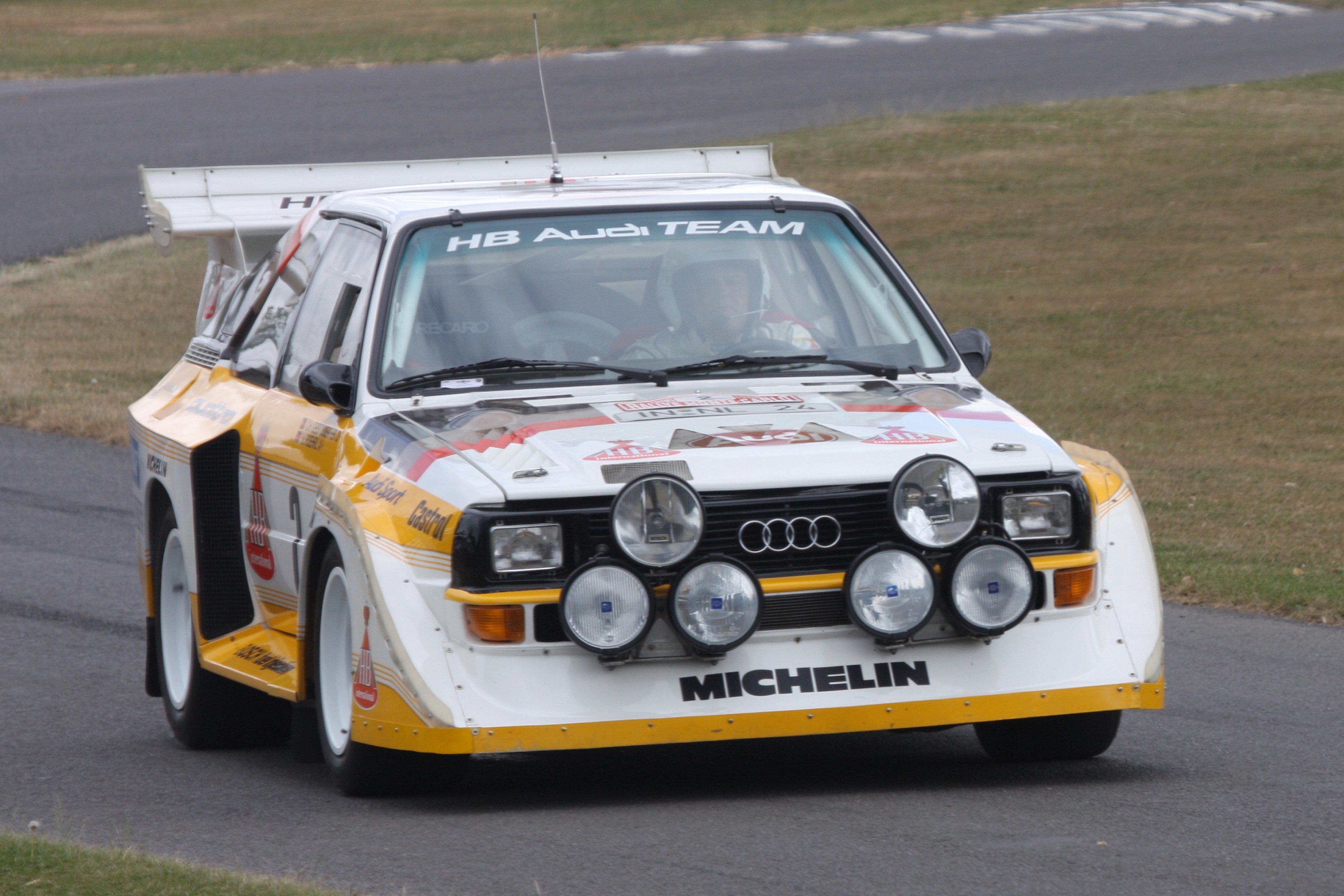
An Audi Sport quattro S1 from the Group B era.
Group B became the World Rally Championship’s top category between 1982 and 1986.
The low 200-car homologation requirement made it possible to create specialised road-going models whose main purpose was to legalise a competition car.
Manufacturers could homologate further evolution components in small batches. Engines, turbochargers, bodywork, suspension and transmissions developed rapidly.
Group B did not require four-wheel drive. The Lancia 037 won the 1983 manufacturers’ championship with rear-wheel drive. Four-wheel drive nevertheless became the dominant solution because it could transfer far more power to loose surfaces.
Top cars progressed from approximately 300-400 bhp in the early period to more than 500 bhp. Some final developments approached or exceeded 600 bhp in short-duration configurations.
Group B was removed from the World Rally Championship after the 1986 season following a series of fatal accidents. The cars continued in rallycross, hill climbs and some national or historic events.
| Group B area | Specification |
|---|---|
| Main WRC era | 1982-1986 |
| Production requirement | 200 identical cars in 12 months at introduction |
| Evolution requirement | Small additional production batches under period homologation rules |
| Engine | Naturally aspirated, turbocharged or supercharged; model dependent |
| Representative top-class power | Approximately 350-600 bhp / 261-447 kW |
| Weight | Capacity-linked; roughly 580-1,300 kg under the original scale |
| Driven wheels | Rear-wheel drive or four-wheel drive |
| Common top-car weight | Approximately 890-1,100 kg depending on corrected capacity |
| Replacement | Group A became the WRC’s top category in 1987 |
The original 1982 Group B weight scale began at 580 kg for cars up to 1,000 cc corrected capacity, reached 890 kg at 2,500 cc, 960 kg at 3,000 cc and 1,100 kg at 4,000 cc.
The commonly used Group B capacity classes
Period results often used class numbers rather than listing only “Group B.” The commonly encountered upper classes were B/9, B/10, B/11 and B/12.
| Class | Corrected capacity | Representative power | 1982 minimum-weight region | Common drive |
|---|---|---|---|---|
| B/9 | Up to approximately 1,300 cc | 100-180 bhp / 75-134 kW | 580-675 kg | Usually 2WD |
| B/10 | More than 1,300 to 1,600 cc | 140-220 bhp / 104-164 kW | 750 kg | Usually 2WD |
| B/11 | More than 1,600 to 2,000 cc | 180-300 bhp / 134-224 kW | 820 kg | 2WD or 4WD |
| B/12 | More than 2,000 cc corrected | 250-600 bhp / 186-447 kW | 890-1,300 kg according to corrected capacity | RWD or 4WD; 4WD dominated the final era |
Not every country or event displayed the labels identically, and turbo-equivalence calculations could move a relatively small physical engine into B/12.
Group A: high-volume but highly developed
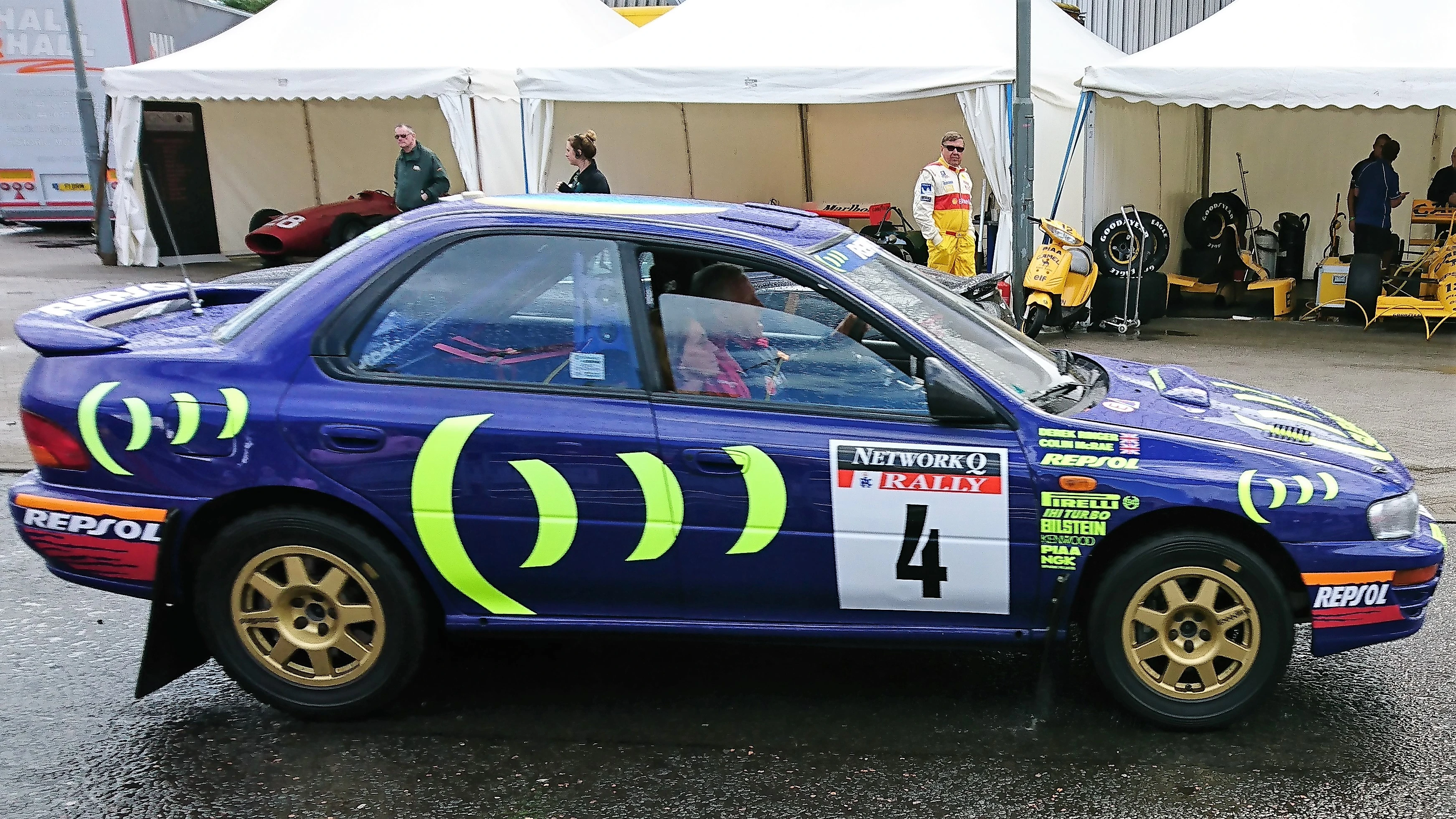
A 1995 Subaru Impreza 555 from the Group A era.
Group A was introduced in 1982 and became the World Rally Championship’s top formula after Group B was removed.
It required a much larger production basis than Group B. Manufacturers therefore had to develop a road car containing the fundamental engine, transmission and body architecture needed for competition.
That requirement created famous homologation specials including the Lancia Delta Integrale, Toyota Celica GT-Four, Mitsubishi Lancer Evolution, Subaru Impreza WRX STI, Ford Escort RS Cosworth and Mazda 323 4WD.
Group A still allowed extensive racing development. Manufacturers homologated competition gearboxes, turbochargers, suspension parts, body components and evolution models.
Top WRC Group A cars were limited to approximately 300 bhp by intake restrictors during the mature era. Their real advantage came from torque, four-wheel-drive systems, differentials, suspension and continuous development.
Although World Rally Car replaced Group A as the premier formula in 1997, some manufacturers continued using Group A cars afterward. Mitsubishi famously won top-level events and championships with Lancer Evolutions that remained Group A based.
Group A minimum weights at introduction
| Corrected capacity | 1982 Group A minimum weight |
|---|---|
| Up to 1,000 cc | 620 kg |
| Up to 1,300 cc | 720 kg |
| Up to 1,600 cc | 800 kg |
| Up to 2,000 cc | 880 kg |
| Up to 2,500 cc | 960 kg |
| Up to 3,000 cc | 1,035 kg |
| Up to 4,000 cc | 1,185 kg |
| Up to 5,000 cc | 1,325 kg |
| Over 5,000 cc | 1,400 kg |
The rules changed after 1982. By the mature WRC period, top turbocharged four-wheel-drive Group A cars commonly competed around 1,230 kg under the applicable championship rules.
The main Group A rally classes
The labels A5, A6, A7 and A8 became the most familiar mature-era Group A rally divisions. Exact class presentation could vary by year and championship.
| Class | Common capacity band | Representative power | Representative weight | Common drive |
|---|---|---|---|---|
| A5 | Up to 1,400 cc | 80-150 bhp / 60-112 kW | Approximately 750-950 kg | Usually FWD |
| A6 | More than 1,400 to 1,600 cc | 140-230 bhp / 104-172 kW | Approximately 850-1,000 kg | Usually FWD |
| A7 | More than 1,600 to 2,000 cc | 180-300 bhp / 134-224 kW | Approximately 900-1,100 kg | Usually FWD or RWD |
| A8 | More than 2,000 cc corrected | 250-320 bhp / 186-239 kW | Approximately 1,100-1,300 kg; top WRC cars commonly around 1,230 kg | Usually 4WD at international level |
A7 included the most powerful two-litre naturally aspirated Kit Cars. A8 contained the familiar turbocharged four-wheel-drive championship contenders because forced-induction equivalence placed their corrected capacity above two litres.
Group N: the production category
Group N was introduced alongside Group A but allowed much less modification.
A Group N car had to derive from a model homologated in Group A. Group A competition options were generally not valid unless the Group N rules or homologation form specifically allowed them.
The body shell, engine block, cylinder head, intake system, gearbox type and suspension concept remained much closer to production specification.
Safety equipment, dampers, springs, brake pads, exhaust components and limited engine-management changes were allowed within the rules.
Group N became one of international rallying’s most important privateer categories. Mitsubishi Lancer Evolutions and Subaru Impreza WRXs dominated N4, while smaller front-wheel-drive hatchbacks populated N1, N2 and N3.
The original 1982 rules required the base model to have 5,000 identical examples and to be homologated in Group A.
The main Group N classes
| Class | Common capacity band | Representative power | Representative weight | Common drive |
|---|---|---|---|---|
| N1 | Up to 1,400 cc | 70-110 bhp / 52-82 kW | Approximately 800-1,000 kg | Usually FWD |
| N2 | More than 1,400 to 1,600 cc | 100-170 bhp / 75-127 kW | Approximately 900-1,100 kg | Usually FWD |
| N3 | More than 1,600 to 2,000 cc | 140-220 bhp / 104-164 kW | Approximately 1,050-1,250 kg | Usually FWD, with some RWD models |
| N4 | More than 2,000 cc corrected | 260-300 bhp / 194-224 kW | Approximately 1,300-1,430 kg depending on model and period | Usually 4WD |
The N4 label became almost synonymous with 2.0-litre turbocharged four-wheel-drive Japanese homologation cars, although the class definition was based on corrected capacity rather than a requirement to use one particular engine layout.
Group N vs Group A
| Area | Group N | Group A |
|---|---|---|
| Underlying model | Derived from a Group A-homologated production car | Production model homologated directly in Group A |
| Engine freedom | Limited; many production parts retained | Much greater internal development and homologated options |
| Turbocharger | Generally production or tightly controlled | Competition variants could be homologated |
| Gearbox | Closer to production architecture | Competition gearsets and sequential systems could be homologated |
| Suspension | Production mounting points and limited parts freedom | Greater use of homologated competition components |
| Body and weight | Closer to the road car and normally heavier | More lightening and body options permitted |
| Cost | Lower | Higher |
| Typical top 4WD output | 260-300 bhp / 194-224 kW | Approximately 300 bhp / 224 kW in the restricted WRC era |
| Driving character | Heavier, softer and more production-like | Sharper, more adjustable and more specialised |
Group N was not simply a low-power version of Group A. It was a different preparation philosophy built around retaining more production components.
Group A vs Group B
| Area | Group A | Group B |
|---|---|---|
| Initial production requirement | 5,000 cars | 200 cars |
| Road-car relationship | High-volume production car with competition development | Low-volume homologation model that could be designed around racing |
| Top-era power | Approximately 300 bhp / 224 kW | Approximately 350-600 bhp / 261-447 kW |
| Top-era weight | Commonly around 1,230 kg | Often approximately 890-1,100 kg |
| Driven wheels | 2WD or 4WD; top WRC cars became 4WD | 2WD or 4WD; top late-era cars became 4WD |
| Development freedom | High | Very high |
| Top WRC period | 1987-1996 | 1982-1986 |
Group A reduced performance and forced manufacturers to connect the competition vehicle to a much larger production programme. It did not eliminate engineering development.
Group S: the planned Group B successor that never raced
Group S was proposed as a replacement or evolution of Group B for 1987.
The concept would have reduced the number of cars required for homologation and targeted approximately 300 bhp, while allowing manufacturers to develop highly specialised vehicles.
Several manufacturers began prototypes or design studies. Examples associated with the proposed formula include the Lancia ECV, Toyota 222D, Audi Group S concepts and Opel Kadett 4S.
The programme was cancelled before the category entered the World Rally Championship. Group A became the top class instead.
Group S should therefore be described as a proposed formula, not a rally class that completed an official international championship season.
Formula 2 Rally: the two-wheel-drive international category
Formula 2 Rally was primarily a sporting category rather than one independent homologation group.
It gathered high-performance two-wheel-drive cars, usually with naturally aspirated engines of no more than two litres. Group A cars and later Kit Cars formed the core of the field.
Manufacturers supported Formula 2 because it offered a lower-cost alternative to four-wheel-drive Group A machinery. On dry asphalt, the lightest two-litre cars could challenge or occasionally defeat the leading four-wheel-drive entries.
| Formula 2 area | Representative specification |
|---|---|
| Main international era | Approximately 1993-1999 |
| Engine | Naturally aspirated, normally up to 2.0 litres |
| Representative power | 250-300 bhp / 186-224 kW for the leading cars |
| Weight | Approximately 960-1,100 kg |
| Driven wheels | Two-wheel drive, usually front-wheel drive |
| Typical cars | Peugeot 306 Maxi, Citroën Xsara Kit Car, Renault Maxi Mégane and Seat Ibiza Kit Car |
Group A Kit Cars
A Kit Car was an extensively developed Group A variant created through homologated competition components.
The cars used two-wheel drive and naturally aspirated engines. Wider tracks, larger wheel arches, competition transmissions, highly developed suspension and lightweight body parts separated them from ordinary Group A cars.
The most famous were the two-litre A7 Kit Cars, but smaller A6 Kit Cars also existed.
| Kit Car type | Engine | Representative power | Representative weight | Drive |
|---|---|---|---|---|
| A6 Kit Car | Up to 1.6 litres, naturally aspirated | 200-230 bhp / 149-172 kW | Approximately 920-980 kg | Usually FWD |
| A7 Kit Car | Up to 2.0 litres, naturally aspirated | 270-300 bhp / 201-224 kW | Approximately 960-1,000 kg | Usually FWD |
The leading two-litre Kit Cars were exceptionally fast on smooth asphalt because they combined close to Group A turbo power with lower weight and low drivetrain losses.
Super 1600
Super 1600 was introduced as a more controlled junior formula below the two-litre Kit Cars.
The cars used 1.6-litre naturally aspirated engines, two-wheel drive and sequential gearboxes. They became the basis of the Junior World Rally Championship from 2001.
Super 1600 retained the high-revving character of the Kit Car era while controlling cost and performance more tightly.
| Super 1600 area | Specification |
|---|---|
| Main era | 2001-2010 at the centre of Junior WRC; continued elsewhere afterward |
| Engine | 1.6-litre naturally aspirated |
| Representative power | 210-230 bhp / 157-172 kW |
| Minimum weight | Typically approximately 980 kg, with period variations |
| Driven wheels | Two-wheel drive, normally front-wheel drive |
| Transmission | Six-speed sequential |
| Examples | Citroën C2 S1600, Renault Clio S1600, Suzuki Swift S1600, Ford Fiesta S1600 |
Kit Car vs Super 1600
| Area | Two-litre Kit Car | Super 1600 |
|---|---|---|
| Engine | 2.0-litre naturally aspirated | 1.6-litre naturally aspirated |
| Power | 270-300 bhp / 201-224 kW | 210-230 bhp / 157-172 kW |
| Weight | Approximately 960-1,000 kg | Approximately 980 kg |
| Drive | Usually FWD | Usually FWD |
| Main role | Manufacturer-supported Formula 2 and outright asphalt competition | Junior and driver-development formula |
| Cost and complexity | Higher | More controlled |
World Rally Car: the first generation, 1997-2010
World Rally Car regulations were introduced for 1997.
A manufacturer no longer had to sell a road car containing the complete turbocharged four-wheel-drive system needed for the rally version. A suitable production model could be converted through the homologated World Rally Car package.
This expanded the field beyond manufacturers selling direct Group A-style homologation specials.
The early World Rally Cars retained 2.0-litre turbocharged engines. Air restrictors held output near 300 bhp, but torque, aerodynamics, active differentials and suspension technology developed rapidly.
| 1997-2010 World Rally Car area | Specification |
|---|---|
| Engine | 2.0-litre turbocharged |
| Representative power | Approximately 300 bhp / 224 kW |
| Minimum weight | Approximately 1,230 kg during the mature period |
| Driven wheels | Four-wheel drive |
| Turbo restrictor | Typically 34 mm in much of the era |
| Transmission | Sequential; active differential technology varied by year |
| Examples | Subaru Impreza WRC, Ford Focus RS WRC, Peugeot 206 WRC, Citroën Xsara WRC |
World Rally Car: the 1.6-litre generation, 2011-2016
The WRC moved from 2.0-litre engines to smaller 1.6-litre direct-injection turbo engines in 2011.
The cars became shorter and lighter than many of their predecessors. Mechanical regulations simplified some of the active systems used during the earlier era.
| 2011-2016 World Rally Car area | Specification |
|---|---|
| Engine | 1.6-litre direct-injection turbocharged |
| Representative power | 300-320 bhp / 224-239 kW |
| Minimum weight | 1,200 kg |
| Driven wheels | Four-wheel drive |
| Turbo restrictor | 33 mm |
| Transmission | Six-speed sequential with controlled four-wheel-drive system |
| Examples | Citroën DS3 WRC, Volkswagen Polo R WRC, Ford Fiesta RS WRC, Hyundai i20 WRC |
World Rally Car: the 2017-2021 generation
The 2017 regulations produced the fastest and most aerodynamically developed World Rally Cars.
A larger turbo restrictor increased power to approximately 380 bhp. Wider bodies, large rear wings, front aerodynamic devices and a more developed centre differential improved performance further.
| 2017-2021 World Rally Car area | Specification |
|---|---|
| Engine | 1.6-litre direct-injection turbocharged |
| Representative power | Approximately 380 bhp / 283 kW |
| Minimum weight | Approximately 1,190 kg |
| Driven wheels | Four-wheel drive |
| Turbo restrictor | 36 mm |
| Aerodynamics | Wide body, large rear wing, diffuser and extensive front devices |
| Examples | Toyota Yaris WRC, Hyundai i20 Coupe WRC, Ford Fiesta WRC, Citroën C3 WRC |
The official WRC history divides the modern top category into the Group A, original World Rally Car, 2017 World Rally Car and Rally1 periods.
All World Rally Car generations compared
| Generation | Engine | Power | Weight | Drive | Main character |
|---|---|---|---|---|---|
| 1997-2010 | 2.0 turbo | About 300 bhp / 224 kW | About 1,230 kg | 4WD | High torque and increasingly sophisticated differentials |
| 2011-2016 | 1.6 turbo | 300-320 bhp / 224-239 kW | 1,200 kg | 4WD | Smaller, lighter and mechanically simplified |
| 2017-2021 | 1.6 turbo | About 380 bhp / 283 kW | About 1,190 kg | 4WD | Greater power, width and aerodynamic performance |
Super 2000: naturally aspirated four-wheel-drive customer cars
Super 2000 Rally created a four-wheel-drive international category below World Rally Car.
The classic S2000 formula used a 2.0-litre naturally aspirated engine, a six-speed sequential gearbox and mechanical differentials.
The absence of a turbocharger gave the cars a high-revving character. They produced less torque than a World Rally Car but were effective customer machines in the Intercontinental Rally Challenge, European Rally Championship, SWRC and national championships.
| Super 2000 area | Specification |
|---|---|
| Main era | Approximately 2006-2013 |
| Engine | 2.0-litre naturally aspirated |
| Representative power | 270-285 bhp / 201-213 kW |
| Minimum weight | 1,200 kg in the late official formula; some earlier references use lower period figures |
| Driven wheels | Four-wheel drive |
| Transmission | Six-speed sequential |
| Differentials | Mechanical |
| Examples | Peugeot 207 S2000, Škoda Fabia S2000, Ford Fiesta S2000, Fiat Grande Punto S2000 |
Super 2000 1.6 turbo and Regional Rally Car
When World Rally Cars changed to 1.6-litre turbo engines, the Super 2000 framework was also used for turbocharged regional cars.
A Regional Rally Car, normally shortened to RRC, was closely related to a contemporary 2011-generation World Rally Car but used a smaller restrictor and reduced aerodynamic specification.
An RRC could sometimes be converted between regional and WRC specification through the appropriate homologated kit.
| RRC area | Representative specification |
|---|---|
| Main era | Approximately 2011-2013 |
| Engine | 1.6-litre turbocharged |
| Representative power | 275-300 bhp / 205-224 kW |
| Minimum weight | Approximately 1,200 kg |
| Driven wheels | Four-wheel drive |
| Regional restrictor | Typically 30 mm |
| Examples | Ford Fiesta RRC and Mini John Cooper Works S2000/RRC |
RRC was quickly overshadowed by R5, which was created specifically as a customer-racing formula.
The original Group R ladder
Group R began appearing from 2008 as a new production-based rally ladder.
R1 was the entry category. R2 offered faster two-wheel-drive cars. R3 added greater performance and modification freedom. R4 upgraded production four-wheel-drive Group N machinery. R5 was added later as a modern purpose-built four-wheel-drive customer class.
The number did not always indicate a simple linear performance increase. R3 remained two-wheel drive, while old R4 was based on a very different N4 four-wheel-drive concept.
R1A and R1B
R1 cars were lightly modified production hatchbacks intended for entry-level rallying.
They retained much of the standard engine and transmission while adding an FIA safety cage, competition suspension, seats, harnesses and other essential equipment.
| Class | Engine capacity | Representative power | Exact late-era minimum weight | Drive |
|---|---|---|---|---|
| R1A | NA up to 1,390 cc or turbo up to 927 cc | 75-110 bhp / 56-82 kW | 980 kg | 2WD |
| R1B | NA over 1,390 to 1,600 cc or turbo over 927 to 1,067 cc | 100-140 bhp / 75-104 kW | 1,030 kg | 2WD |
R1 was renamed Rally5 under the modern pyramid. The current category is an evolution of the concept rather than a guarantee that every old R1 car automatically matches every new Rally5 requirement.
R2B and R2C
R2 became one of the most successful international two-wheel-drive formulas.
R2 cars offered specialised engines, sequential gearboxes, improved suspension and stronger brakes while remaining accessible to junior and privateer teams.
| Class | Engine capacity | Representative power | Exact late-era minimum weight | Drive |
|---|---|---|---|---|
| R2B | NA over 1,390 to 1,600 cc or turbo over 927 to 1,067 cc | 160-210 bhp / 119-157 kW | 1,030 kg | 2WD, usually FWD |
| R2C | NA over 1,600 to 2,000 cc or turbo over 1,067 to 1,333 cc | 190-230 bhp / 142-172 kW | 1,080 kg | 2WD, usually FWD |
R2 was renamed Rally4. The FIA describes current Rally4 as the highest-performance front-wheel-drive layer of the modern pyramid and identifies R2 as its previous name.
R3C, R3T and R3D
R3 was a higher-performance two-wheel-drive group above R2.
R3C became the most prominent version. It used petrol engines and included cars such as the Renault Clio R3, Citroën DS3 R3 and Toyota GT86 CS-R3.
R3T identified turbocharged petrol variants under earlier versions of the Group R structure. R3D covered diesel cars, although it remained rare and disappeared as diesel performance programmes declined.
| Class | Engine concept | Representative power | Representative weight | Drive |
|---|---|---|---|---|
| R3C | NA 1.6-2.0 litres or equivalent turbo capacity under later rules | 220-250 bhp / 164-186 kW | 1,080 kg in the late regulations | 2WD |
| R3T | Turbocharged petrol | 230-260 bhp / 172-194 kW | Approximately 1,080-1,230 kg depending on model and regulation period | 2WD |
| R3D | Turbocharged diesel | 180-230 bhp / 134-172 kW | Model and period dependent | 2WD |
The final R3C regulations defined two-wheel-drive petrol cars, a 1,080 kg minimum and a capacity band above 1,600 to 2,000 cc naturally aspirated or above 1,067 to 1,333 cc turbocharged.
Old Group R4: the N4 evolution class
Original Group R4 was introduced as a development of Group N4.
The base car had to be a turbocharged petrol Group N model with corrected capacity above two litres and four-wheel drive.
A homologated VR4 extension allowed improved suspension, reduced weight, transmission components and other competition parts beyond the normal Group N rules.
Mitsubishi Lancer Evolutions and Subaru Imprezas formed the main R4 population.
| Old Group R4 area | Representative specification |
|---|---|
| Main era | Introduced around 2011; later absorbed into legacy eligibility |
| Base car | Group N4 production car |
| Engine | Normally 2.0-litre turbocharged petrol |
| Representative power | 280-300 bhp / 209-224 kW |
| Representative minimum weight | Approximately 1,300 kg |
| Driven wheels | Four-wheel drive |
| Main advantage over N4 | Lighter and more adjustable with homologated competition parts |
The FIA’s final legacy regulations explicitly defined Group R4 as previously Group N-homologated turbo petrol cars with corrected capacity above two litres and four-wheel drive.
Group N4 vs old Group R4
| Area | Group N4 | Old Group R4 |
|---|---|---|
| Base vehicle | Production turbocharged four-wheel-drive car | The same type of N4 production base |
| Engine | Close to production specification | Still production based but with additional VR4 freedoms |
| Power | 260-300 bhp / 194-224 kW | 280-300 bhp / 209-224 kW |
| Weight | Often approximately 1,350-1,430 kg | Approximately 1,300 kg |
| Suspension | More restricted | Greater homologated adjustment and competition components |
| Transmission | Closer to production | Improved through VR4 homologation |
| Cost | Lower | Higher |
| Performance | Slower and more road-car-like | Sharper and generally faster |
R5: the class now called Rally2
R5 was created as the successor to Super 2000 for customer four-wheel-drive rallying.
The formula used a 1.6-litre turbocharged engine, five-speed sequential gearbox, mechanical differentials and a cost-controlled construction based on a high-volume production model.
R5 became one of the most successful rally regulations ever created. The cars could compete in WRC2, the European Rally Championship and national championships with essentially the same technical package.
The category was renamed Rally2 as part of the modern FIA pyramid. Current regulations state that VRa2 should be understood as the replacement nomenclature for VR5.
R-GT
R-GT provides a rally category for production grand-touring and sports cars.
Typical examples include the Porsche 911 GT3, Abarth 124 Rally and Alpine A110 R-GT.
R-GT does not have one universal engine, power figure or minimum weight. Each model receives an FIA technical passport and performance conditions controlling areas such as weight, restrictors and permitted equipment.
Most R-GT cars use two-wheel drive. Rear-wheel drive is common because the category is built around sports and GT models.
| R-GT area | Representative specification |
|---|---|
| Engine | Model specific; naturally aspirated or turbocharged |
| Representative power | Approximately 300-500 bhp / 224-373 kW |
| Representative weight | Approximately 1,200-1,500+ kg depending on the technical passport |
| Driven wheels | Usually rear-wheel drive |
| Main use | Specialist GT entries in eligible international and national rallies |
The standalone FIA R-GT Cup ended after a limited run, but R-GT remains an FIA-regulated vehicle category.
R4 Kit and Rally2 Kit
R4 Kit is completely different from the older N4-based Group R4.
The R4 Kit concept uses a standard FIA-approved package containing a 1.6-litre turbo engine, four-wheel-drive transmission, suspension and supporting parts.
A regional constructor can install the package into an eligible production body, allowing a locally represented model to compete without a manufacturer developing a complete Rally2 car.
The formula has sometimes been described as Rally2 Kit within the modern pyramid because its performance sits below full Rally2. The technical regulations and historical material continue to use R4 Kit terminology in many places.
| R4 Kit area | Representative specification |
|---|---|
| Engine | 1.6-litre turbocharged kit engine |
| Representative power | 263-280 bhp / 196-209 kW |
| Minimum weight | Approximately 1,230 kg |
| Driven wheels | Four-wheel drive |
| Transmission | Sequential kit transmission |
| Performance position | Below full Rally2/R5 |
| Purpose | Regional and national manufacturer representation at controlled cost |
Super 2000 vs R5/Rally2
| Area | Super 2000 | R5/Rally2 |
|---|---|---|
| Engine | 2.0-litre naturally aspirated | 1.6-litre turbocharged |
| Power | 270-285 bhp / 201-213 kW | 280-300 bhp / 209-224 kW |
| Weight | Approximately 1,200 kg | 1,230 kg |
| Drive | 4WD | 4WD |
| Gearbox | Six-speed sequential | Five-speed sequential |
| Torque | Lower and delivered at high engine speed | Greater turbocharged torque |
| Customer-racing focus | Important but comparatively expensive | Designed around capped cost and widespread customer supply |
R5 was not merely Super 2000 with a turbocharger. Its complete cost, transmission, suspension and customer-support philosophy was revised.
N4 and old R4 vs R5/Rally2
| Area | N4 | Old R4 | R5/Rally2 |
|---|---|---|---|
| Base concept | Modified road homologation car | N4 car with VR4 competition upgrade | Purpose-designed customer rally car based on production architecture |
| Engine | Usually 2.0 turbo | Usually 2.0 turbo | 1.6 turbo |
| Power | 260-300 bhp / 194-224 kW | 280-300 bhp / 209-224 kW | 280-300 bhp / 209-224 kW |
| Weight | Often 1,350-1,430 kg | Approximately 1,300 kg | 1,230 kg |
| Drive | 4WD | 4WD | 4WD |
| Gearbox | Production-derived | Improved production-derived package | Five-speed sequential competition gearbox |
| Handling | Heaviest and most road-car-like | Sharper than N4 | Lightest and most purpose-developed |
| Current equivalent | No direct new homologation tier | No direct equivalent | Current Rally2 |
Peak power alone understates the difference. Rally2’s lower weight, transmission, geometry and suspension give it a much greater overall performance level than a typical N4 car.
The modern FIA Rally Car Pyramid
The modern pyramid simplified the principal customer categories into Rally1 through Rally5.
Rally5 and Rally4 are the two-wheel-drive levels. Rally3 introduced an accessible four-wheel-drive step. Rally2 is the leading customer category. Rally1 is the top World Rally Championship formula.
The FIA began the reorganisation in 2018. R5 became Rally2, R2 became Rally4 and R1 became Rally5. Rally3 was new rather than a renamed version of old R3.
Rally6: the newest low-cost combustion category
Rally6 was approved as a new entry-level FIA group for 2026.
The concept uses four-seat two-wheel-drive production cars with either a standard 1.6-litre turbo engine or a 2.0-litre naturally aspirated engine.
A competition ECU controls the engine, while the target power-to-weight ratio is 7.5 kg per horsepower.
The FIA’s example is a 1,050 kg car producing 140 bhp.
| Rally6 area | Specification |
|---|---|
| Status | New FIA entry formula approved for 2026 |
| Engine | Standard 1.6 turbo or 2.0 naturally aspirated |
| Target power-to-weight ratio | 7.5 kg per bhp |
| Example power | 140 bhp / 104 kW |
| Example weight | 1,050 kg |
| Driven wheels | Two-wheel drive |
| Gearbox | Production H-pattern |
| Brakes and tyres | Production based |
| Dampers | Non-adjustable competition units |
| Safety | Equivalent in principle to Rally5-Kit |
Rally6 is intended to reduce purchase and operating costs rather than outperform Rally5.
Rally5-Kit
Rally5-Kit provides national sporting authorities with a route for homologating suitable production cars without requiring a manufacturer to create a full global Rally5 programme.
The kit defines safety-critical and performance-related components such as the roll cage, seat and harness mountings, fuel-system parts, intake restrictor and minimum ground clearance.
The car remains two-wheel drive. Naturally aspirated engines can have capacities up to two litres, while turbocharged engines can have capacities up to 1.62 litres under the detailed eligibility rules.
| Rally5-Kit area | Specification |
|---|---|
| Vehicle concept | Large-series production touring car adapted through an FIA/ASN kit variant |
| Engine | NA up to 2.0 litres or turbo up to 1.62 litres |
| Representative power | Approximately 140-180 bhp / 104-134 kW, homologation dependent |
| Minimum weight | 1,030 kg for naturally aspirated cars; turbo weight declared in the homologated variant |
| Driven wheels | Front- or rear-wheel drive |
| Gravel wheels | 6 x 15 inches |
| Asphalt wheels | 6.5 x 16 inches |
| Main purpose | Low-cost national and regional entry competition |
The 2026 regulations define Rally5-Kit as two-wheel drive and set 1,030 kg for naturally aspirated cars, while the turbocharged minimum is model specific.
Rally5
Rally5 is the base of the established five-tier FIA pyramid and the successor to R1.
The cars are production-based, two-wheel drive and relatively lightly modified compared with Rally4.
They commonly use small turbocharged engines and five-speed sequential gearboxes, although the exact homologated equipment depends on the model.
| Rally5 area | Specification |
|---|---|
| Previous name | R1 |
| Engine capacity | NA up to 1,600 cc or turbo up to 1,333 cc, with weight subdivisions |
| Representative power | 150-180 bhp / 112-134 kW |
| Minimum weight | 1,030 kg for NA or smaller turbo specifications; 1,080 kg for the larger turbo band |
| Driven wheels | Two-wheel drive, normally front-wheel drive |
| Typical gearbox | Five-speed sequential |
| Examples | Renault Clio Rally5, Ford Fiesta Rally5 and Peugeot 208 Rally5 |
E-Rally5
E-Rally5 is the electric counterpart at the lower end of the FIA rally structure.
The regulations cover large-series production cars with at least four seats, an electric powertrain and two-wheel drive.
Cars are divided by usable battery capacity. E-Rally5-1 covers up to 60 kWh, while E-Rally5-2 covers larger batteries.
Unlike an internal-combustion class defined by one capacity and restrictor, motor output is homologation specific.
| E-Rally5 area | Specification |
|---|---|
| Powertrain | Production-derived electric motor and inverter |
| Representative power | Model specific; approximately 136 bhp / 100 kW for a typical existing entry-level electric rally car |
| Battery classes | E-Rally5-1 up to 60 kWh usable; E-Rally5-2 over 60 kWh |
| E-Rally5-1 minimum weight | 1,540 kg without crew and with no more than one spare wheel |
| E-Rally5-2 minimum weight | To be confirmed in the June 2026 regulation publication |
| Driven wheels | Front- or rear-wheel drive |
| Driver aids | Production systems can remain when homologated and can be recalibrated or disconnected |
The June 2026 Article 260A defines E-Rally5 as a four-seat two-wheel-drive electric production category and sets the E-Rally5-1 minimum at 1,540 kg.
Rally4
Rally4 is the modern high-performance two-wheel-drive category and the successor to R2.
Current cars normally use small turbocharged engines, five-speed sequential gearboxes and mechanical limited-slip differentials.
The front tyres must steer, brake and transmit engine torque, making momentum and throttle discipline essential.
| Rally4 area | Specification |
|---|---|
| Previous name | R2 |
| Engine | NA or turbocharged within Rally4 capacity subdivisions; modern cars normally use small turbo engines |
| Representative power | 200-215 bhp / 149-160 kW |
| Minimum weight | 1,080 kg without crew and with no more than one spare wheel |
| Driven wheels | Two-wheel drive, normally front-wheel drive |
| Transmission | Normally five-speed sequential |
| Examples | Peugeot 208 Rally4, Opel Corsa Rally4, Renault Clio Rally4 and Lancia Ypsilon Rally4 HF |
The FIA describes Rally4 output as being in the region of 210 hp and identifies R2 as the category’s former name.
Rally3
Rally3 was introduced as a new affordable four-wheel-drive level between Rally4 and Rally2.
It was not a renaming of old R3. Old R3 was two-wheel drive; current Rally3 is four-wheel drive.
Rally3 gives drivers an opportunity to learn four-wheel-drive braking, rotation and acceleration before moving into Rally2.
| Rally3 area | Specification |
|---|---|
| Introduced | First homologation for the 2021 era |
| Engine | Turbocharged petrol within the Rally3 capacity subdivisions |
| Representative power | 235-260 bhp / 175-194 kW |
| Minimum weight | 1,210 kg for the main B/C/D subdivisions; 1,260 kg for Rally3E |
| Driven wheels | Four-wheel drive |
| Transmission | Five-speed sequential |
| Examples | Ford Fiesta Rally3 and Renault Clio Rally3 |
The FIA completed its five-tier pyramid when the first Rally3 car was homologated and explicitly described Rally3 as a new accessible four-wheel-drive platform.
Rally2
Rally2 is the current name for the R5 formula and the highest level intended for widespread customer racing.
The cars use a 1.6-litre turbo engine, five-speed sequential gearbox, four-wheel drive and mechanical front and rear differentials.
They fight for WRC2, European Rally Championship and many national outright titles.
| Rally2 area | Specification |
|---|---|
| Previous name | R5 |
| Engine | Turbocharged petrol, up to 1,620 cc and four cylinders |
| Representative power | 280-300 bhp / 209-224 kW |
| Turbo restrictor | 32 mm |
| Maximum boost | 2.5 bar absolute under the current regulation |
| Minimum car weight | 1,230 kg with no more than one spare wheel |
| Combined car-and-crew minimum | 1,390 kg |
| Driven wheels | Four-wheel drive |
| Transmission | Five-speed sequential |
| Examples | Toyota GR Yaris Rally2, Škoda Fabia RS Rally2, Citroën C3 Rally2, Ford Fiesta Rally2 and Hyundai i20 N Rally2 |
Current FIA regulations apply to both earlier VR5 homologations and later VRa2 cars, while Toyota’s official category history records the S2000-to-R5-to-Rally2 succession.
Rally1 Hybrid, 2022-2024
Rally1 replaced World Rally Car at the beginning of 2022.
The first version used a 1.6-litre turbo engine and a standard plug-in hybrid unit. The electric motor could add substantial power during approved deployment zones.
The cars used purpose-built safety structures rather than relying on the complete production bodyshell in the same way as Rally2.
| 2022-2024 Rally1 area | Specification |
|---|---|
| Engine | 1.6-litre turbocharged direct-injection petrol |
| Hybrid system | Standard plug-in motor, battery and control package |
| Combined power | More than 500 bhp / more than 373 kW when hybrid assistance was deployed |
| Minimum weight | 1,260 kg |
| Turbo restrictor | 36 mm |
| Driven wheels | Four-wheel drive |
| Transmission | Five-speed sequential |
| Examples | Toyota GR Yaris Rally1 Hybrid, Hyundai i20 N Rally1 Hybrid and Ford Puma Rally1 Hybrid |
Non-hybrid Rally1, 2025-2026
.webp)
A Toyota GR Yaris Rally1.
The plug-in hybrid unit was removed for 2025.
To compensate, minimum weight fell from 1,260 to 1,180 kg. The turbo restrictor decreased from 36 to 35 mm so the power-to-weight ratio remained close to that of the hybrid car.
The cars continue using fully sustainable fuel and the same broad Rally1 architecture.
| 2025-2026 Rally1 area | Specification |
|---|---|
| Engine | 1.6-litre turbocharged direct-injection petrol |
| Hybrid system | None |
| Representative power | 370-380 bhp / 276-283 kW |
| Minimum weight | 1,180 kg |
| Turbo restrictor | 35 mm |
| Driven wheels | Four-wheel drive |
| Transmission | Five-speed sequential |
| Fuel | 100% sustainable FIA-compliant racing fuel |
The FIA confirmed the removal of hybrid power, the 80 kg weight reduction and the restrictor change for 2025. The non-hybrid structure remained the basis of the 2026 category.
The complete current rally pyramid compared
| Class | Representative power | Main minimum weight | Driven wheels | Typical engine | Main role |
|---|---|---|---|---|---|
| Rally6 | Example 140 bhp / 104 kW | Example 1,050 kg | 2WD | 1.6 turbo or 2.0 NA production engine | Lowest-cost entry formula |
| Rally5-Kit | 140-180 bhp / 104-134 kW | 1,030 kg NA; turbo model specific | 2WD | Production NA or turbo petrol | ASN-developed entry car |
| Rally5 | 150-180 bhp / 112-134 kW | 1,030 or 1,080 kg | 2WD | Small NA or turbo petrol | Established entry category |
| E-Rally5 | Model specific; representative 136 bhp / 100 kW | 1,540 kg for E-Rally5-1 | 2WD | Electric | Entry electric category |
| Rally4 | 200-215 bhp / 149-160 kW | 1,080 kg | 2WD | Normally small turbo petrol | Top junior and 2WD category |
| Rally3 | 235-260 bhp / 175-194 kW | 1,210 or 1,260 kg | 4WD | Turbo petrol | Entry four-wheel-drive category |
| Rally2 Kit | 263-280 bhp / 196-209 kW | About 1,230 kg | 4WD | Standard 1.6 turbo kit | Regional formula below full Rally2 |
| Rally2 | 280-300 bhp / 209-224 kW | 1,230 kg | 4WD | 1.6 turbo petrol | Leading customer category |
| Rally1 | 370-380 bhp / 276-283 kW | 1,180 kg | 4WD | 1.6 turbo petrol | Top WRC category |
| R-GT | 300-500 bhp / 224-373 kW | Model specific | Usually RWD | GT-car engine | Specialist sports-car category |
Rally1 vs Rally2
| Area | Rally1 | Rally2 |
|---|---|---|
| Competitive position | Top WRC class | Leading customer class and WRC2 machinery |
| Engine | 1.6 turbo | 1.6 turbo |
| Power | 370-380 bhp / 276-283 kW | 280-300 bhp / 209-224 kW |
| Weight | 1,180 kg | 1,230 kg |
| Restrictor | 35 mm | 32 mm |
| Drive | 4WD | 4WD |
| Chassis | Specialised competition safety structure | Production-model shell and Group A foundation with Rally2 variant |
| Aerodynamics | More developed | More restricted |
| Cost | Factory-level top-category budget | Price-controlled customer-racing programme |
| Availability | Limited top-team programmes | Sold to professional and private customer teams worldwide |
The major rally name changes
| Old name | Later or current name | Was it a direct rename? | Important explanation |
|---|---|---|---|
| R1 | Rally5 | Broadly yes | Rally5 continues the entry-level two-wheel-drive position. |
| R2 | Rally4 | Yes | Modern Rally4 is the high-performance two-wheel-drive category. |
| R3 | No direct modern rename | No | Old R3 was two-wheel drive. Current Rally3 is a newly created four-wheel-drive class. |
| Old Group R4 | No direct modern rename | No | It was an upgraded N4-based 4WD class and is unrelated to modern Rally4. |
| R5 | Rally2 | Yes | Current regulations include both VR5 and VRa2 homologations. |
| World Rally Car | Rally1 | Replacement rather than simple rename | Rally1 introduced a new chassis and powertrain framework in 2022. |
| R4 Kit | Sometimes called Rally2 Kit | Partial terminology change | FIA documents and regional rules can still use R4 Kit. |
| Group 4 | Not Rally4 | No | Group 4 was the pre-1982 special-GT category. |
| N4 | Not Rally4 | No | N4 was the large-capacity Group N class, commonly using 4WD turbo cars. |
| Super 2000 | Replaced by R5/Rally2 | Replacement | The engine and gearbox formula changed substantially. |
The three “Rally4” meanings that should never be confused
| Name | Era | Power | Weight | Drive | What it actually was |
|---|---|---|---|---|---|
| Group 4 | Pre-1982 | 180-350 bhp / 134-261 kW | About 700-1,200 kg | Mostly RWD; some 4WD | Special grand touring category |
| Old Group R4 | 2010s | 280-300 bhp / 209-224 kW | About 1,300 kg | 4WD | N4 production car upgraded with a VR4 kit |
| Modern Rally4 | 2020s | 200-215 bhp / 149-160 kW | 1,080 kg | 2WD | Renamed successor to R2 |
The shared number does not indicate a technical relationship.
Old R3 vs current Rally3
| Area | Old Group R3 | Current Rally3 |
|---|---|---|
| Technical relationship | Original Group R category | New category created for the modern pyramid |
| Drive | Two-wheel drive | Four-wheel drive |
| Power | About 220-260 bhp / 164-194 kW | About 235-260 bhp / 175-194 kW |
| Weight | Approximately 1,080 kg for R3C | 1,210-1,260 kg |
| Primary purpose | Top production-based two-wheel-drive category | Affordable first step into four-wheel drive |
The similar power figures conceal completely different traction and handling characteristics.
WRC2, WRC3 and RC classes are not car formulas
WRC2 is a championship contested with eligible Rally2 machinery. It is not the technical name of the car.
WRC3 has been used for different sporting structures over time. Depending on the season, it has involved Rally2 or Rally3-related eligibility. The championship name should not be assumed to describe one permanent technical category.
RC1, RC2, RC3, RC4 and RC5 are sporting classification groups used to arrange eligible cars in rally results.
RC2 can contain more than one technical generation, including Rally2, older R5 and in some regulations legacy S2000 or RRC machinery.
Similarly, RC4 can group current Rally4 cars with eligible older R2 machinery.
Historic rally categories today
Modern FIA historic competition divides cars by age, period and original specification.
Those modern historic categories do not replace the original technical identities. A car homologated as Group 2 remains Group 2, and a Group B car remains Group B.
Appendix K defines how an old vehicle can be prepared, documented and used today. Period Appendix J defines what the vehicle was allowed to be when it originally competed.
A Historic Technical Passport records the accepted specification and helps prevent a car from combining components that never existed together during its original period.
Important national and regional formulas
National sporting authorities have created many formulas to fill gaps in the FIA ladder or support local manufacturers.
The following categories are influential, but their regulations are not universal across world rallying.
| Formula | Main region | Representative power | Representative weight | Drive | Basic idea |
|---|---|---|---|---|---|
| AP4 | Australia, New Zealand and Asia-Pacific | Approximately 280-320 bhp / 209-239 kW | Approximately 1,230 kg | 4WD | Regional production-body formula broadly comparable with R5-level concepts |
| Maxi Rally | Argentina and parts of South America | Approximately 280-320 bhp / 209-239 kW | Approximately 1,230-1,350 kg | 2WD or 4WD depending on generation | Locally constructed cars representing production models |
| Proto or N4 Proto | Several European and regional championships | Approximately 280-330 bhp / 209-246 kW | Approximately 1,230-1,350 kg | 4WD | Modern body shell combined with N4, R4 or related mechanical components |
| NR4 or National R4 | ASN specific | Approximately 280-320 bhp / 209-239 kW | ASN specific | Usually 4WD | National continuation or modification of N4/R4 concepts |
| Group F | Several European countries | Very broad | National class dependent | 2WD or 4WD | Modified production cars under national rules |
| Group H | Several European countries | Very broad | National class dependent | 2WD or 4WD | Older or extensively modified cars that no longer fit current FIA homologation |
| Open or Modified | Worldwide national use | Very broad | National class dependent | 2WD or 4WD | Catch-all names whose meaning changes between championships |
A car described as “Group F” in Finland cannot automatically be assumed legal in a Group F class elsewhere. The local rulebook is always the controlling document.
Master quick-reference table
| Class | Main era | Representative power | Representative or exact weight | Drive | Successor or status |
|---|---|---|---|---|---|
| Group 1 | 1960s-1981 | 50-200 bhp / 37-149 kW | 700-1,400 kg | FWD or RWD | Transferred into the 1982 structure |
| Group 2 | 1960s-1981 | 90-300 bhp / 67-224 kW | 700-1,200 kg | FWD or RWD | Transferred toward Group B |
| Group 3 | 1960s-1981 | 70-250 bhp / 52-186 kW | 700-1,300 kg | Usually RWD | Transferred toward Group B |
| Group 4 | 1960s-1981 | 180-350 bhp / 134-261 kW | 700-1,200 kg | Mostly RWD; some 4WD | Replaced by Group B |
| Group 5 | Several pre-1982 definitions | 150-500+ bhp / 112-373+ kW | About 500-850 kg in the late special-production scale | Varied | Peripheral to stage rallying |
| Group B | 1982-1986 WRC | 350-600 bhp / 261-447 kW at the top | 580-1,300 kg by corrected capacity | RWD or 4WD | Replaced by Group A at WRC level |
| Group A | 1982 onward; top WRC 1987-1996 | Up to about 300 bhp / 224 kW at the top | Capacity based; mature top cars around 1,230 kg | 2WD or 4WD | Legacy category; top role replaced by WRC |
| Group N | 1982-2010s | 70-300 bhp / 52-224 kW | Model and class dependent | 2WD or 4WD | Legacy production category |
| N4 | 1980s-2010s | 260-300 bhp / 194-224 kW | About 1,300-1,430 kg | Usually 4WD | Developed into old R4; later displaced by R5 |
| Group S | Proposed for 1987 | Target around 300 bhp / 224 kW | Proposed-formula dependent | 2WD or 4WD concepts | Cancelled before competition |
| Formula 2 Rally | 1990s | 250-300 bhp / 186-224 kW | About 960-1,100 kg | 2WD | Sporting category containing Group A and Kit Cars |
| A6 Kit Car | 1990s-2000s | 200-230 bhp / 149-172 kW | About 920-980 kg | Usually FWD | Superseded by newer junior formulas |
| A7 Kit Car | 1990s-2000s | 270-300 bhp / 201-224 kW | About 960-1,000 kg | Usually FWD | No direct current equivalent |
| Super 1600 | 2001-2010 peak era | 210-230 bhp / 157-172 kW | About 980 kg | 2WD | Junior role later passed to R2/Rally4 |
| WRC 1997 | 1997-2010 | About 300 bhp / 224 kW | About 1,230 kg | 4WD | Replaced by 1.6-litre WRC |
| WRC 2011 | 2011-2016 | 300-320 bhp / 224-239 kW | 1,200 kg | 4WD | Replaced by 2017 WRC |
| WRC 2017 | 2017-2021 | About 380 bhp / 283 kW | About 1,190 kg | 4WD | Replaced by Rally1 |
| Super 2000 | 2006-2013 | 270-285 bhp / 201-213 kW | About 1,200 kg | 4WD | Replaced by R5 |
| RRC | 2011-2013 | 275-300 bhp / 205-224 kW | About 1,200 kg | 4WD | Short-lived transitional formula |
| R1A | 2008-2019 homologation era | 75-110 bhp / 56-82 kW | 980 kg | 2WD | Rally5 lineage |
| R1B | 2008-2019 homologation era | 100-140 bhp / 75-104 kW | 1,030 kg | 2WD | Rally5 lineage |
| R2B | 2008-2019 homologation era | 160-210 bhp / 119-157 kW | 1,030 kg | 2WD | Renamed Rally4 |
| R2C | 2008-2019 homologation era | 190-230 bhp / 142-172 kW | 1,080 kg | 2WD | Renamed Rally4 |
| R3C | 2000s-2019 homologation era | 220-250 bhp / 164-186 kW | 1,080 kg | 2WD | No direct rename |
| R3T | Group R era | 230-260 bhp / 172-194 kW | Model and period dependent | 2WD | No direct rename |
| R3D | Group R era | 180-230 bhp / 134-172 kW | Model dependent | 2WD | Rare diesel category |
| Old R4 | 2010s | 280-300 bhp / 209-224 kW | About 1,300 kg | 4WD | N4 evolution; no link to Rally4 |
| R5 | 2013-2019 name | 280-300 bhp / 209-224 kW | 1,230 kg | 4WD | Renamed Rally2 |
| R4 Kit | 2018 onward | 263-280 bhp / 196-209 kW | About 1,230 kg | 4WD | Also described as Rally2 Kit |
| R-GT | 2010s onward | 300-500 bhp / 224-373 kW | Model specific | Usually RWD | Current specialist category |
| Rally6 | 2026 onward | Example 140 bhp / 104 kW | Example 1,050 kg | 2WD | Newest low-cost entry formula |
| Rally5-Kit | 2024 onward | 140-180 bhp / 104-134 kW | 1,030 kg NA; turbo model specific | 2WD | Current ASN entry formula |
| Rally5 | 2020s | 150-180 bhp / 112-134 kW | 1,030-1,080 kg | 2WD | Current entry tier |
| E-Rally5 | 2020s | Model specific | 1,540 kg for E-Rally5-1 | 2WD | Current electric tier |
| Rally4 | 2020s | 200-215 bhp / 149-160 kW | 1,080 kg | 2WD | Current top 2WD tier |
| Rally3 | 2021 onward | 235-260 bhp / 175-194 kW | 1,210-1,260 kg | 4WD | Current entry 4WD tier |
| Rally2 | 2020s | 280-300 bhp / 209-224 kW | 1,230 kg | 4WD | Current customer top tier |
| Rally1 Hybrid | 2022-2024 | 500+ bhp / 373+ kW | 1,260 kg | 4WD | Replaced by non-hybrid Rally1 specification |
| Rally1 non-hybrid | 2025-2026 | 370-380 bhp / 276-283 kW | 1,180 kg | 4WD | Current WRC top class |
Rally car classes: the simple explanation
The original FIA structure separated standard and modified touring or GT cars into Groups 1-4.
Group 4 became the leading 1970s rally class before Group B introduced lighter, more specialised and far more powerful machinery in 1982.
Group A required a much larger production base and replaced Group B at the top of the World Rally Championship in 1987.
Group N used many of the same production models but allowed fewer modifications. N4 became the familiar category for Mitsubishi Lancer Evolution and Subaru Impreza production-based four-wheel-drive cars.
Formula 2, Kit Car and Super 1600 created important two-wheel-drive categories during the 1990s and 2000s.
World Rally Car replaced Group A as the premier formula in 1997. Its engine changed from 2.0 litres to 1.6 litres in 2011, and the wider 2017 generation increased power to approximately 380 bhp.
Super 2000 provided naturally aspirated four-wheel-drive customer cars before R5 replaced it with a 1.6-litre turbo formula.
Group R created R1, R2, R3, R4 and R5. The old R4 was an upgraded N4 car and should never be confused with current Rally4.
Under the modern naming system, R1 became Rally5, R2 became Rally4 and R5 became Rally2. Rally3 was a new four-wheel-drive category rather than a renamed old R3.
Rally1 replaced World Rally Car in 2022. It used hybrid power through 2024 and became lighter and non-hybrid from 2025.
The complete current ladder now ranges from the low-cost Rally6 and Rally5-Kit concepts through Rally5, Rally4, Rally3, Rally2 and Rally1, with E-Rally5 and R-GT providing alternative technical routes.
No single specification tells the complete story. Rally regulations have always balanced production volume, engine performance, minimum weight, driven wheels, permitted modifications, safety and cost.
This article covers the major FIA international stage-rally groups, capacity classes and direct successor formulas. It does not claim that every national or club class used anywhere in the world is technically identical or included. Power figures are representative competition outputs unless expressly described as regulatory limits. Weight definitions vary by year and may include different combinations of fluids, spare wheels and crew. Regulations and homologations can be amended after publication.
Related Articles
|
Different Types of Rally Stages Explained: What Happens During a Rally Weekend?
|
|
World Rally-Raid Championship Technical Regulations Explained
|
Related series
|
Irish Tarmac Rally Championship
|

|
British Rally Championship
|

|
European Rally Championship
|
|
World Rally Championship
|