
Tags:
British Touring Car Championship Regulations Explained
How the BTCC’s NGTC rules turn recognisable production models into closely matched 350+ horsepower touring cars.

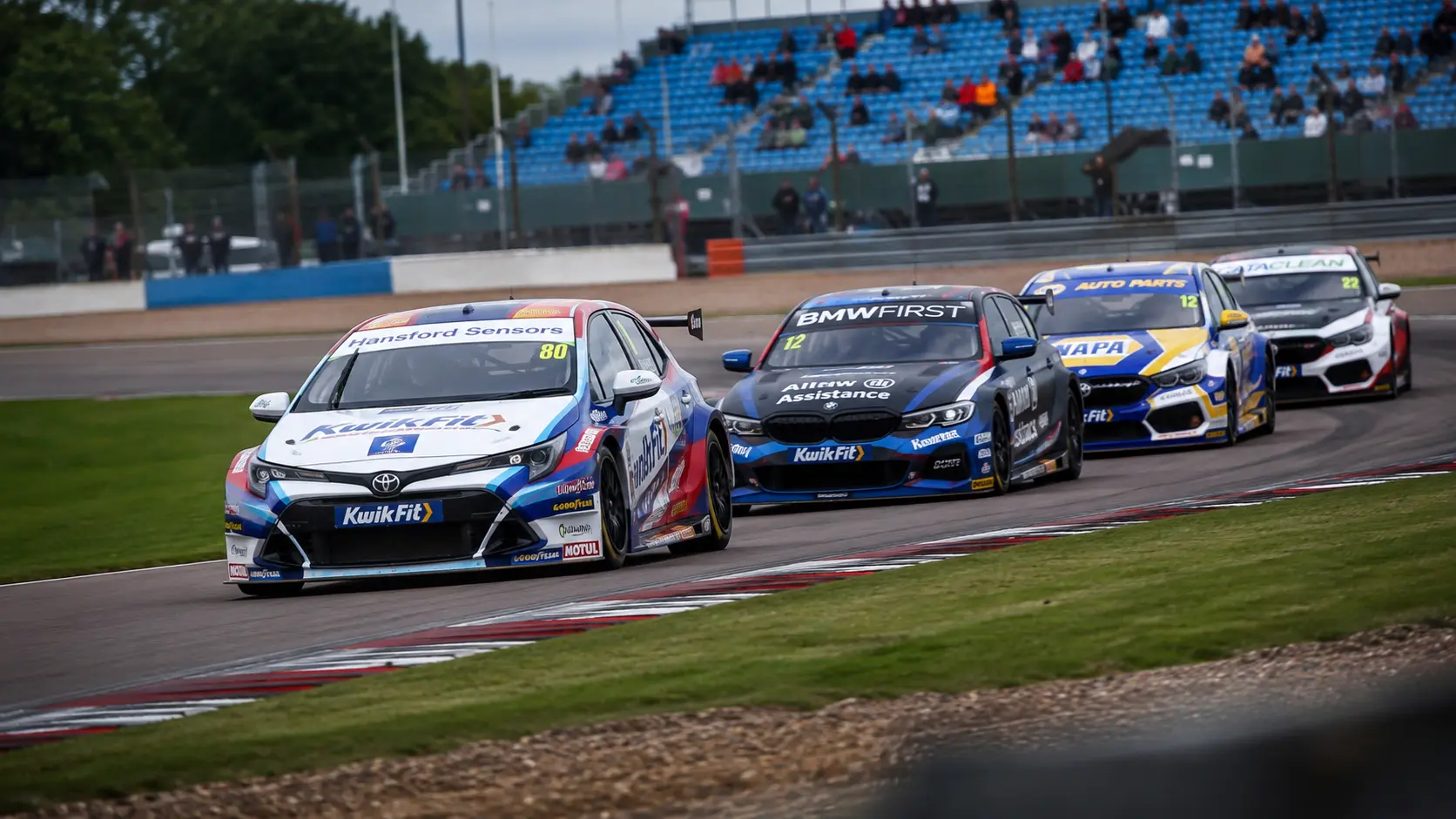
What are the BTCC car regulations designed to do?
The British Touring Car Championship uses a technical formula called NGTC, meaning Next Generation Touring Car. The regulations were introduced during the 2011 season and gradually became the championship’s universal technical standard.
NGTC was created to reduce the cost of designing, building and operating a touring car. Instead of allowing every manufacturer or team to develop a completely different racing machine, the regulations require competitors to use a large collection of common components.
The gearbox, differential, subframes, suspension architecture, brakes, steering, turbocharger, intercooler, electronics, wheels, fuel tank and many other systems are controlled. Teams can prepare and adjust those components, but they cannot replace them with unrestricted designs of their own.
The production car still matters because it provides the body shape, brand identity and permitted drivetrain layout. A Toyota Corolla, Hyundai i30, Ford Focus and BMW 3 Series look different, but much of the racing hardware underneath them follows the same NGTC specification.
This allows independent teams to compete against manufacturer-supported entries without needing the resources to develop an entire car. The engineering contest is based on extracting performance from a controlled package rather than constantly creating expensive new components.
What is an NGTC car?
An NGTC car begins with the bodyshell and visual identity of a production model, but it is not simply a road car fitted with a roll cage and racing tyres.
The interior is stripped, reinforced and converted for competition. Purpose-built front and rear subframes carry the engine, transmission, suspension and brakes. A comprehensive roll-cage structure protects the driver and provides controlled mounting points for the common racing components.
The suspension geometry is very different from the road car. Production suspension systems are replaced by RML-designed double-wishbone assemblies with adjustable coil-over dampers.
The body is widened to the championship’s common width, while approved wheel-arch extensions cover the large racing wheels. The front of the car receives a controlled aerodynamic assembly incorporating the floor, cooling openings and brake ducts. A specified rear-wing profile is fitted at the back.
The result is a purpose-built touring car that resembles the showroom model but shares much of its important racing hardware with every other car on the grid.
BTCC car specifications
| Area | Current NGTC specification | What it means |
|---|---|---|
| Eligible body | Two, three, four or five doors and at least 4.4 metres long | The car must be based on a qualifying production model. |
| Width | Equalised to 1,890 mm | Different production cars compete with a common overall racing width. |
| Engine | 2.0-litre turbocharged direct-injection engine | Every car produces more than 350 bhp. |
| Gearbox | Xtrac six-speed sequential transmission | All cars use a common gearbox and differential package. |
| Suspension | Double wishbones with Penske coil-over dampers | The road car’s original suspension is replaced by controlled racing hardware. |
| Wheels | Specified 18-inch centre-lock wheels | Every team uses the same basic wheel dimensions and attachment system. |
| Tyres | Goodyear hard, medium, soft and wet specifications | Compounds are selected for each event and used under controlled allocation rules. |
| Fuel tank | 80-litre ATL safety fuel cell | The tank is designed specifically for racing safety requirements. |
| Fuel | Hiperflo ECO102 R100 fossil-free sustainable fuel | Every car has used the same 100% fossil-free fuel since 2025. |
Which production cars are eligible?
Under the current regulations, the base model must be available through the manufacturer’s normal UK dealer network when the car is homologated for the championship.
The production model must be at least 4.4 metres long and can have two, three, four or five doors. A two- or three-door entry must share its basic body profile with an equivalent four- or five-door model.
The road car does not need to have a 2.0-litre turbocharged engine, a sequential gearbox or double-wishbone suspension. Those systems are replaced or adapted when the NGTC racing car is constructed.
The purpose of the production-car requirement is therefore mainly to preserve a recognisable body shape and manufacturer identity. It does not require the racing car to retain every mechanical characteristic of the vehicle sold to the public.
Once a new model is approved, its dimensions, aerodynamic components and technical installation are recorded through the homologation process. Teams cannot then alter the design freely during the season.
The 2.0-litre turbocharged engine
Every BTCC car uses a 2.0-litre turbocharged direct-injection engine producing more than 350 bhp. The throttle is controlled electronically through a fly-by-wire system.
Teams have two main engine routes. They can lease or purchase the unbranded TOCA engine prepared by M-Sport, or they can use an approved engine developed from the same broad manufacturer family as the production car.
A manufacturer-family engine does not have to be taken from the exact road model represented by the race car. It must, however, come from a qualifying engine family controlled by the relevant manufacturer or one of its subsidiary marques.
Whichever route a team chooses, every car uses the same approved Owen Developments turbocharger and wastegate. All cars also use a common PWR intercooler.
The common turbo hardware prevents a team from purchasing a major advantage by developing a more advanced turbocharger. Engine builders can still create differences through combustion, cylinder-head design, internal efficiency, calibration and installation within the permitted regulations.
The homologated engines entered a two-year development freeze on 1 April 2025. Further performance development is restricted throughout the 2025 and 2026 seasons, reducing costs while preserving the engines already approved for competition.
TOCA engine vs manufacturer-family engine
| Area | TOCA engine | Manufacturer-family engine |
|---|---|---|
| Supplier | Prepared by M-Sport for the championship | Developed by an approved team, manufacturer or engine builder |
| Branding | Unbranded common NGTC engine | Connected to the broad family of the represented manufacturer |
| Capacity | 2.0 litres | 2.0 litres |
| Induction | Common turbocharger, wastegate and intercooler | The same common turbocharger, wastegate and intercooler |
| Output | More than 350 bhp | Controlled to the championship’s competitive performance window |
| Current development | Frozen for the 2025 and 2026 seasons | Homologated specification frozen for the same period |
| Main advantage | Known costs, availability and technical support | Allows a manufacturer or engine builder to use its own approved design |
The TOCA engine provides a competitive option for teams without a dedicated manufacturer powertrain programme. A manufacturer-family engine creates additional technical identity, but it must still operate within the championship’s controlled performance limits.
Front-wheel drive and rear-wheel drive
BTCC cars can be front-wheel drive or rear-wheel drive. The permitted configuration is based on the layout of the production model.
A front-wheel-drive road car becomes a front-wheel-drive NGTC car, while a rear-wheel-drive model retains rear-wheel drive. A four-wheel-drive production car does not compete with four driven wheels; its original engine orientation is used to determine the permitted two-wheel-drive configuration.
Front-wheel drive combines steering and power delivery through the front tyres. This can create strong stability and predictable behaviour, but the front tyres must manage acceleration, braking and cornering forces at the same time.
Rear-wheel drive separates steering and power delivery between the axles. It can provide strong traction on corner exit and during race starts, although excessive throttle can make the rear tyres slide.
The two layouts receive different minimum weights. A front-wheel-drive car has a published minimum of 1,270 kg, while a rear-wheel-drive car has a minimum of 1,300 kg. Both figures include the driver and complete racing apparel.
TOCA can review the minimum mass and other performance parameters during the season. Rear-wheel-drive cars must also use an approved start strategy intended to control their potential traction advantage from a standing start.
Front-wheel drive vs rear-wheel drive
| Area | Front-wheel drive | Rear-wheel drive |
|---|---|---|
| Driven wheels | Front wheels | Rear wheels |
| Published minimum weight | 1,270 kg including driver | 1,300 kg including driver |
| Corner exit | The front tyres must steer while transferring power | The rear tyres provide acceleration while the front tyres steer |
| Common limitation | Front-tyre temperature, wheelspin and power understeer | Rear-tyre wheelspin and instability under aggressive throttle |
| Race starts | Can be limited by front-wheel traction | Uses a controlled RWD start strategy |
| Wet conditions | Can provide predictable traction with weight over the driven axle | Can reward careful throttle control and balanced setup |
Neither layout is automatically superior at every circuit. Tyre temperature, track conditions, corner types and setup all influence which characteristics are most useful.
The six-speed sequential gearbox
Every BTCC car uses an approved Xtrac six-speed sequential gearbox and differential. The transmission can be installed for either front-wheel-drive or rear-wheel-drive operation.
A sequential gearbox requires gears to be selected in order. The driver cannot move directly from sixth to third in the way that might be possible with a conventional H-pattern road-car gearbox.
Gear changes are controlled through a racing shift system, allowing the driver to move quickly through the ratios while keeping both hands close to the steering wheel.
The common gearbox prevents teams from developing lighter casings, alternative internal layouts or expensive bespoke transmissions. Permitted gear ratios and differential settings remain part of the controlled technical package.
The driver still has to manage the transmission carefully. Poorly timed downshifts can disturb the car under braking, while an incorrect gear choice can produce wheelspin or leave the engine outside its strongest operating range.
An AP Racing carbon clutch is used for standing starts and manoeuvring at low speed. Once the car is moving, normal racing gear changes do not require the driver to operate a conventional clutch pedal for every shift.
How TOCA Turbo Boost works
TOCA Turbo Boost, usually shortened to TTB, gives drivers access to a temporary increase in turbocharged engine performance.
The system is managed by the common Cosworth electronics. It replaces the hybrid-assisted boost used between 2022 and 2024, but retains the idea of giving drivers a limited additional-power resource.
TTB is also used to control the competitive advantage of drivers at the front of the championship or race order. Leading cars receive less boost time and must reach a higher minimum speed before the system becomes available.
During qualifying, the allocation is based on championship position from the second meeting of the season. The system limits the number of boost seconds available on each lap.
For Race 1, allocation is based on championship order. Race 2 and Race 3 allocations are based on the finishing orders of the preceding races before later judicial decisions are applied.
This means a driver who finishes near the front of Race 1 receives a more restrictive TTB allocation for Race 2. A driver further down the result receives more opportunities to use the additional power.
2026 TOCA Turbo Boost allocation
| Championship or race position | Minimum deployment speed | Qualifying boost per lap | Race laps with boost at A circuits | Race laps with boost at B circuits |
|---|---|---|---|---|
| 1st | 140 km/h | 1 second | 1 lap | 4 laps |
| 2nd | 135 km/h | 3 seconds | 2 laps | 5 laps |
| 3rd | 130 km/h | 5 seconds | 3 laps | 6 laps |
| 4th | 125 km/h | 7 seconds | 4 laps | 7 laps |
| 5th | 120 km/h | 9 seconds | 5 laps | 8 laps |
| 6th | 115 km/h | 11 seconds | 6 laps | 10 laps |
| 7th | 110 km/h | 15 seconds | 8 laps | 12 laps |
| 8th or lower | 105 km/h | 20 seconds | 10 laps | 14 laps |
The B circuits are Brands Hatch Indy, Knockhill and Silverstone. The other circuits are classified as A circuits. The scale can be amended through official championship bulletins.
The driver chooses where to use TTB on an eligible race lap. It can help complete an overtake, defend from a rival or recover speed after a poor corner exit.
Using boost early can gain track position, but it may leave the driver without the additional power during the final laps. The system is therefore both a performance-balancing measure and a strategic resource.
The detailed regulations also specify periods when TTB cannot be used, including the opening racing lap, while the Safety Car is deployed and whenever race control directs that the system must be disabled.
Why the BTCC no longer uses hybrid power
Hybrid power was introduced to the BTCC in 2022. A common electric motor and energy-storage system added temporary power alongside the turbocharged combustion engine.
The hybrid programme ended after the 2024 season. From 2025, the temporary additional power has been supplied entirely through increased turbo boost controlled by the TTB system.
Removing the electric motor, battery and associated equipment reduced the cars’ mass by approximately 55 kg. The lighter cars became more responsive during braking and changes of direction.
The change did not return the championship to unrestricted engine boost. Cosworth continues to manage the deployment system through the common electronics, ensuring that additional power remains limited and controlled.
The former hybrid indicator lights on the side windows are now used to show turbo-boost deployment to spectators and television viewers.
Suspension and subframes
Every NGTC car uses controlled front and rear subframes designed by RML. The subframes attach to specified points in the roll-cage structure and provide common mounting locations for the suspension and other mechanical systems.
The front subframe incorporates the suspension, brakes, steering and, where required, the engine and transmission installation. The rear subframe carries the rear suspension and associated components.
Both ends use multi-adjustable double-wishbone suspension with specified Penske coil-over dampers supplied through GXC. Hydraulic power steering is also part of the common technical package.
The use of common subframes means that a Toyota, BMW, Hyundai or Ford does not retain the suspension arrangement fitted to its production counterpart. This helps equalise the basic geometry and reduces the cost of designing separate systems for every model.
Teams can still adjust the approved hardware. Ride height, wheel alignment, spring settings, damper settings and anti-roll-bar behaviour all influence how the car handles.
What can BTCC teams actually adjust?
The most expensive designs are controlled, but teams have many ways to influence the car’s behaviour. The challenge is to find settings that suit the circuit, weather, tyres and driver.
| Area | What teams can adjust | What teams cannot do |
|---|---|---|
| Suspension | Ride height, springs, dampers, anti-roll bars and approved geometry settings | Replace the common subframes with a unique design |
| Wheel alignment | Camber and toe within the permitted ranges | Use unauthorised suspension mounting points |
| Differential | Approved settings to change corner-entry and traction behaviour | Install a self-designed differential |
| Aerodynamics | Prepare and configure homologated components within their legal settings | Design new wing profiles, floors or wheel-arch extensions |
| Cooling | Manage permitted radiator, intercooler and brake-cooling openings | Create unauthorised body openings or aerodynamic devices |
| Engine | Operate the approved controls and manage temperature and reliability | Modify sealed or homologated parts outside the regulations |
| Tyres | Set legal pressures and manage temperature through driving | Use tyre blankets, chemical treatments or another tyre manufacturer |
Ride height, camber and toe
Ride height determines how far the car sits above the circuit. Lowering the car can improve its centre of gravity and aerodynamic performance, but there must still be enough clearance for bumps, kerbs and suspension movement.
A car that runs too low may strike the track surface, damage its floor or fail the official ride-height check. Teams must find the lowest reliable legal position rather than simply lowering the car as far as possible.
Camber is the angle of a wheel when viewed from the front. Negative camber can improve cornering grip by helping the tyre maintain its contact patch under load.
Excessive camber can reduce braking performance and concentrate wear on the inner edge of the tyre. The ideal setting depends on the circuit and the amount of load placed on each wheel.
Toe describes whether the wheels point slightly inward or outward. Small toe adjustments can change turn-in response, straight-line stability, tyre temperature and drag.
These settings may appear minor, but the BTCC field is often separated by fractions of a second. A small improvement in tyre contact or driver confidence can therefore change several grid positions.
Goodyear tyre regulations
Goodyear is the BTCC’s sole tyre supplier. The available range includes hard, medium and soft slick tyres as well as a grooved wet-weather tyre.
The compounds selected for a weekend depend on the circuit. Most events use a standard dry tyre and at least one different option compound, creating a strategic difference between the races.
At selected events, all three dry compounds must be used across Sunday’s three races. At others, teams must use the nominated option tyre during at least one race.
Thruxton is treated differently because of its high speeds and abrasive surface. The hard tyre is used for the races, although the regulations can permit a limited use of another compound during qualifying.
The leading finishers from Race 1 must use the hardest available compound in Race 2. This can make it more difficult for them to remain at the front if rivals behind are using a faster tyre.
Option tyres are not permitted during the Saturday Qualifying Race. Cars must use the event’s standard slick tyre or the wet tyre when conditions require it.
BTCC tyre types compared
| Tyre | General characteristic | Main advantage | Main limitation |
|---|---|---|---|
| Soft | Fastest-wearing dry compound | Strong initial grip and rapid warm-up | Can overheat or degrade more quickly |
| Medium | Middle dry specification | Balance between performance and durability | May not match the soft tyre’s early pace or the hard tyre’s longevity |
| Hard | Most durable dry compound | Consistency and resistance to high loads | Usually takes longer to reach its best temperature |
| Wet | Grooved tyre designed to disperse water | Reduces aquaplaning on a wet circuit | Can overheat rapidly when the track dries |
Tyre-heating and heat-retention devices are prohibited. Teams cannot use blankets or another artificial method to raise the tyres above ambient temperature.
Chemical tyre treatments are also banned. Tyres may be inflated only with air or nitrogen, and wheel-mounted tyre-pressure or temperature sensors are not permitted.
Drivers must therefore generate temperature through braking, acceleration and cornering. Cold slicks provide much less grip, making the opening corners after leaving the pits especially challenging.
AP Racing brakes
Every NGTC car uses a specified AP Racing braking package and pedal box. Standardising the major components prevents teams from entering an expensive brake-development contest.
The driver can adjust brake balance to change the proportion of braking effort applied to the front and rear wheels.
Moving the balance forward generally improves stability but increases the possibility of locking a front tyre. Moving it rearward can help the car rotate into a corner but may make the rear axle unstable.
Brake cooling must also be managed carefully. A circuit containing repeated heavy braking zones requires more cooling than one where the brakes have long periods to recover.
Too little cooling can overheat the discs, pads and fluid. Excessive cooling can prevent the system from reaching its ideal operating temperature and may add unnecessary aerodynamic drag.
Aerodynamics
BTCC aerodynamics are much less open than Formula 1 or prototype racing. Teams cannot continuously develop new wings, floors and bodywork packages.
Each car uses a specified front aerodynamic device that includes a flat-floor section, radiator opening, intercooler openings, brake ducts and controlled side exits.
The rear wing also uses a specified profile. Stylised wheel-arch extensions widen the body to the common 1,890 mm measurement and help cover the racing tyres.
The body shape of the production model still creates some differences. A saloon, hatchback and fastback do not move air in exactly the same way, even when their main racing devices follow controlled specifications.
TOCA evaluates each model during homologation and can review performance parameters if a particular configuration develops an inappropriate advantage.
Aerodynamic downforce is useful, but BTCC cars rely heavily on mechanical grip. Their relatively modest aero sensitivity also helps drivers remain close together and race side by side.
Electronics and the Cosworth ECU
The electronic control system is built around the common Cosworth Antares 8 ECU. It manages the combustion engine and the controlled chassis functions, including TOCA Turbo Boost.
Every car also uses a common Cosworth wiring-loom design, power-management equipment, switch panels and external light panels.
This allows TOCA to monitor important functions consistently across the field. Engine boost, throttle operation and TTB deployment can be inspected through a common technical system.
Teams cannot replace the ECU with proprietary electronics or add unauthorised driver-assistance systems. Traction control, anti-lock braking and automatic driving aids are not part of the NGTC competition package.
Drivers must control wheelspin, brake locking and gear selection themselves. Engineers can analyse the recorded data, but they cannot create an electronic system that drives the car on the competitor’s behalf.
Every car also carries a judicial camera system. Its footage can be examined when officials investigate contact, track-limit violations or other incidents.
Fossil-free sustainable fuel
Since 2025, every BTCC car has used Hiperflo ECO102 R100, a 100% fossil-free sustainable racing fuel.
The fuel’s components come from synthetic and biological sources rather than newly extracted crude oil. It is designed to meet demanding FIA and sustainability-certification requirements while remaining compatible with the existing turbocharged engines.
The term fossil-free does not mean that the cars produce no exhaust gases while racing. The engine still burns liquid fuel through an internal-combustion process.
The environmental objective concerns the source and lifecycle of the fuel. Carbon used in its production is derived from non-crude sources rather than adding the same quantity of newly extracted fossil carbon to the fuel cycle.
Using one controlled fuel also protects competitive fairness. Teams cannot create separate fuel blends intended to deliver additional power or efficiency.
Weight and performance equalisation
The published minimum weights are 1,270 kg for front-wheel-drive cars and 1,300 kg for rear-wheel-drive cars. These measurements include the driver and complete racing clothing.
The regulations permit TOCA to review the base weight of an individual car during the championship. Officials can also review throttle-body size, engine restrictors, maximum engine speed and maximum turbo boost.
This is not exactly the same as the detailed Balance of Performance system used in GT3 racing. BTCC cars already share far more common hardware than GT3 models, reducing the amount of balancing required.
The adjustment powers are nevertheless important because production bodyshells, engine designs and drivetrain layouts are not completely identical. They allow the organiser to respond if one technical concept falls outside the intended performance range.
Any adjustment is communicated through an official bulletin. Teams cannot change their own weight or boost limits simply because they believe another car has an advantage.
Safety regulations
An NGTC car contains a substantial roll-cage structure integrated into the production-based bodyshell. The cage protects the cockpit and provides specified mounting points for the common front and rear subframes.
The driver uses a current FIA-homologated racing seat, multi-point harness, helmet, flame-resistant clothing and frontal-head-restraint equipment.
A safety fuel cell replaces the normal road-car tank. The 80-litre ATL unit is designed to reduce the risk of fuel leakage during a major impact.
A Lifeline fire-extinguisher system can discharge extinguishing agent around the cockpit and engine area. External controls allow marshals to activate safety systems if the driver cannot operate them.
The doors, side structure and cockpit area receive additional protection beyond that of the original road car. Window nets and other restraints help keep the driver safely inside the protected space during an accident.
Cars are inspected throughout the season, and damaged safety structures must be repaired according to approved procedures before the vehicle can return to competition.
Why common components do not make every car identical
A BTCC Toyota, Ford, BMW or Hyundai uses many of the same racing components, but it is not identical to every other car.
The production bodyshell changes the car’s dimensions, airflow, visibility and packaging. Front-wheel-drive and rear-wheel-drive models transfer power through different axles and have different minimum weights.
Teams can also choose between the TOCA engine and approved manufacturer-family engines. Although performance is controlled, the engines may differ in response, efficiency and installation.
Setup creates another major difference. Suspension settings that give one driver confidence may overwork the tyres for another. A car configured for qualifying may also become difficult to manage over a full race distance.
Mechanical preparation matters because the field is closely matched. Wheel alignment, damper settings, tyre pressures, cooling and component condition must all be controlled accurately.
The regulations standardise the foundations, but they do not standardise the quality of the engineering or driving.
Why BTCC cars race so closely
Common components prevent one team from gaining a huge advantage through an exclusive gearbox, suspension system or aerodynamic breakthrough.
The engines operate within the same general performance range, while TOCA retains the ability to review boost, weight and other parameters. The TTB allocation also gives the leading drivers a more restrictive temporary-power allowance.
The cars rely heavily on mechanical grip and are less aerodynamically sensitive than single-seaters. A driver can follow closely without losing the same proportion of cornering performance that a highly developed formula car might experience.
The bodywork also makes controlled contact less immediately destructive than it would be between exposed-wheel cars. Contact can still cause punctures, suspension damage and penalties, but light door-to-door racing is part of the category’s character.
Short races and closely matched lap times increase the importance of qualifying, race starts and track position. A small mistake can place a driver in the middle of a tightly packed group where recovering positions is difficult.
How the 2026 weekend format affects the cars
A 2026 BTCC weekend begins with one 40-minute Free Practice session. This gives teams limited time to evaluate suspension settings, tyre behaviour and changing track conditions.
Saturday qualifying is divided into two 15-minute groups. The results determine the grid for a short Qualifying Race, which awards championship points and sets the starting order for Sunday’s first full race.
Sunday contains three races of equal distance. Race 2 starts in the finishing order of Race 1, while Race 3 uses a partially reversed grid based on a random draw involving positions from the second race.
The limited practice time rewards teams that arrive with an effective starting setup. There may not be enough running to test several major alternatives before qualifying begins.
Cars must also work across four competitive races during the weekend. Setup choices have to account for tyre compounds, changing temperatures, TTB allocations and the possibility of starting from different areas of the grid.
What changes from 2027?
The existing NGTC concept will continue from 2027 rather than being replaced by an entirely new type of touring car. Current chassis and major components will remain eligible through their normal homologation periods.
The revised regulations will provide teams with greater freedom when selecting a production model. The represented brand must be sold in the UK, but the exact model will no longer need to be available through the UK dealer network.
Engine selection will also become more flexible. Any approved BTCC engine will be permitted in any homologated BTCC car rather than being tied to the family of the represented vehicle.
| Area | Current 2026 regulations | From 2027 |
|---|---|---|
| Technical foundation | Current NGTC architecture | NGTC continues as an evolution rather than a complete reset |
| Model availability | The base vehicle must be on normal sale in the UK when homologated | The brand must be sold in the UK, but the specific model can come from another market |
| Engine relationship | Manufacturer engines must come from the car brand’s broad family | Any homologated BTCC engine can be used in any homologated car |
| Existing cars | Eligible under the current homologation cycle | Remain eligible, protecting teams’ existing investment |
| TOCA engine | Available to all teams | Continues to be available across the grid |
The changes are intended to expand the range of possible cars and engines without making every team purchase a completely new technical package.
BTCC car regulations: the simple explanation
A British Touring Car Championship car retains the body shape and brand identity of a production model, but most of its important racing hardware is built to the common NGTC specification.
Every car uses a 2.0-litre turbocharged engine producing more than 350 bhp, an Xtrac six-speed sequential gearbox, RML subframes, double-wishbone suspension, AP Racing brakes, Cosworth electronics and 18-inch wheels with Goodyear tyres.
Teams can use the TOCA/M-Sport engine or an approved manufacturer-family engine. All cars use common turbocharger, wastegate and intercooler components, while the homologated engines are frozen for the 2025 and 2026 seasons.
Front-wheel-drive and rear-wheel-drive cars compete together. The base model determines the drivetrain, with different minimum weights and other controls used to manage their natural strengths.
The former hybrid system has been replaced by TOCA Turbo Boost. Leading drivers receive less temporary boost and must reach a higher speed before deploying it.
Teams cannot design unrestricted new wings, gearboxes or suspension systems, but they can adjust the approved components. Setup, tyre management, engine operation and mechanical preparation therefore remain major performance factors.
The NGTC regulations create the central BTCC compromise: the cars look different and retain individual characteristics, but enough of their engineering is shared to produce affordable and closely matched racing.
Related Articles
|
GT3 Explained: What Is a GT3 Car?
|
|
LMP3 Explained: What is an LMP3 Car?
|
|
LMP2 Explained: What is an LMP2 Car?
|
|
WEC vs IMSA: What’s the Difference?
|
|
NLS Starting Groups Explained
|
|
GT4 Explained: What Is a GT4 Car, and how is it different from GT3?
|
|
What Is the Difference Between GT3 and Cup 2?
|
|
Hypercar Explained: What Is a Hypercar in WEC, IMSA and Le Mans?
|
Related series

|
British Touring Car Championship
|