
Drifting Explained: The Cars, Scoring & Rules
A complete guide to understanding professional drifting, including qualifying, tandem battles, the roles of the lead and chase drivers, and the differences between Formula Drift, Formula Drift Japan, Drift Masters and D1 Grand Prix.

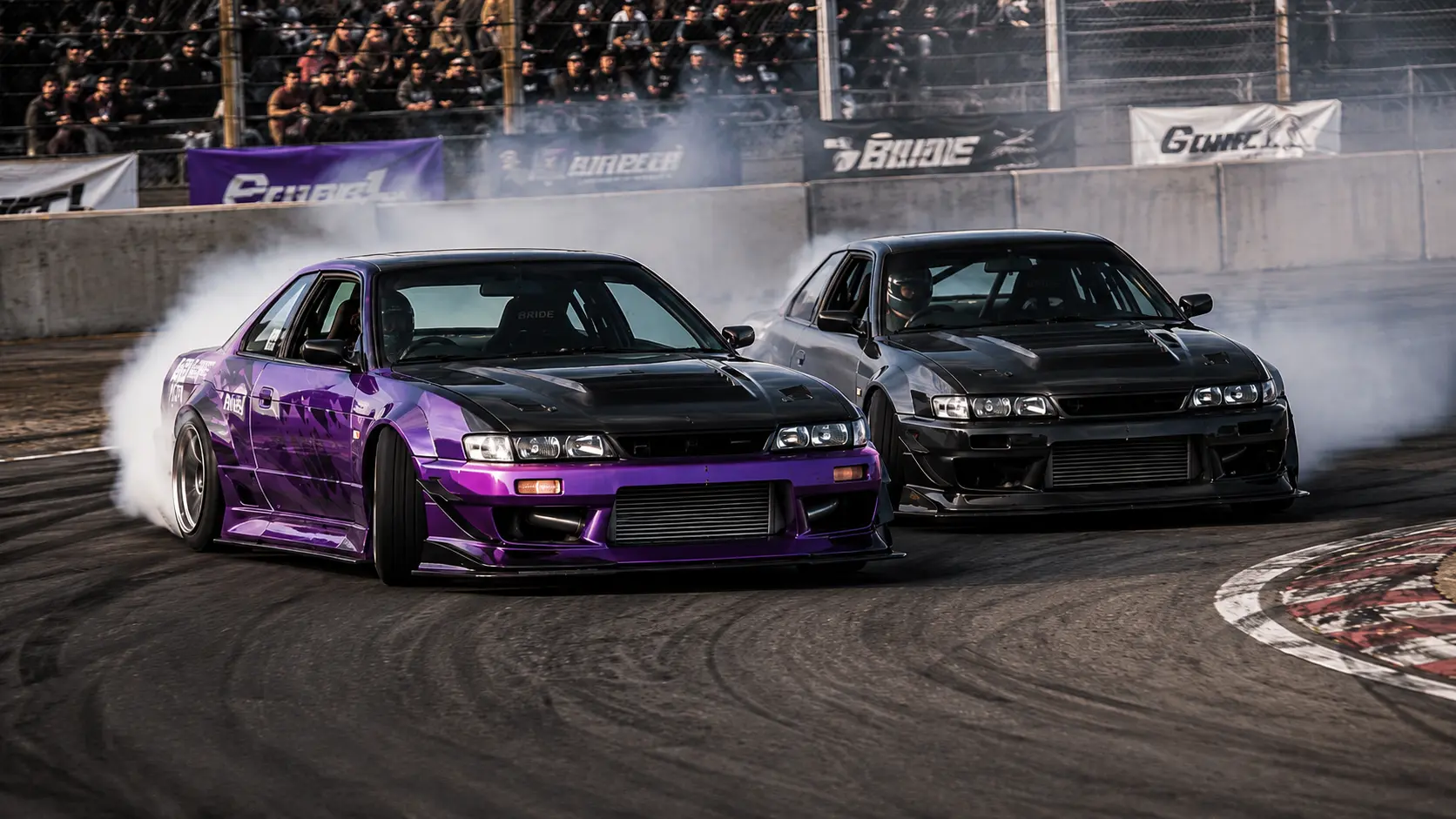
What is drifting?
Drifting is a driving technique in which the rear tyres deliberately lose grip while the driver keeps the car travelling along a controlled path.
The car points partly sideways, but it continues moving forward. The front wheels usually point in the opposite direction to the corner, a technique called countersteering.
A driver balances several forces at once. The accelerator controls rear-wheel speed, the steering controls direction, and the brakes, clutch and handbrake can change the car’s rotation or momentum.
A successful drift is not an accidental slide. The driver intentionally starts it, controls it through one or more corners and ends it at the correct point.
Professional drifting turns that technique into a judged competition. The winner is not necessarily the driver who travels through the course in the shortest time. The winner is the driver who best performs the route and behaviour requested by the judges.
Drifting is not the same as losing control
A normal road driver encountering oversteer may lift the accelerator and try to straighten the car. A drift competitor deliberately creates oversteer and then keeps it stable.
The difference is visible in the driver’s precision. A professional car should rotate quickly at the initiation point, settle at a large angle and follow the intended route without repeated corrections.
A burnout is also different. During a burnout, the driven tyres spin while the car is stationary or travelling mostly straight. During a drift, the car must combine wheelspin with cornering, speed and accurate positioning.
A powerslide normally describes the rear tyres breaking traction under power while leaving a corner. Competitive drifting can include power oversteer, but it also requires planned initiation, transitions and sustained sideways driving across a complete judged course.
How does the driver make the car slide?
Drivers can begin a drift in several ways. The best method depends on the car, the corner and the amount of speed required.
| Technique | What the driver does | What it does to the car |
|---|---|---|
| Clutch kick | Quickly disengages and releases the clutch while applying power | Suddenly increases rear-wheel speed and breaks rear grip. |
| Handbrake initiation | Briefly operates the hydraulic rear handbrake | Slows or locks the rear wheels so the car begins rotating. |
| Feint or flick | Turns slightly away from the corner before steering into it | Uses weight transfer to rotate the rear of the car. |
| Braking initiation | Brakes while turning into the corner | Moves weight toward the front and reduces rear grip. |
| Power oversteer | Applies enough accelerator to overcome rear-tyre grip | Spins the driven wheels and pushes the rear outward. |
Once the drift has started, the driver adjusts the steering and accelerator continuously. Too little power can allow the rear tyres to regain grip and straighten the car. Too much can create excessive wheelspin, push the car off line or cause a spin.
What does a drift course look like?
A drift competition normally uses a short section of a race circuit, temporary street course, stadium or purpose-built drift venue.
Before competition, the judges publish a course map and explain exactly where they expect the cars to travel. The map contains reference areas that are used to assess line.
| Course feature | Meaning | What the driver should do |
|---|---|---|
| Initiation point | The latest point at which the drift should begin | Have the car fully rotating and sideways by the required marker. |
| Outside zone | A marked area along the outside edge of a corner | Place the rear of the car deeply inside the zone. |
| Inner clipping point | A marker near the inside of a corner | Bring the front of the car close without significantly disturbing the run. |
| Touch-and-go | A shorter outside reference area | Place the car close to it briefly before moving toward the next feature. |
| Transition | The change from drifting in one direction to the other | Rotate quickly and smoothly without straightening between corners. |
| Acceleration or deceleration zone | An area where the judges expect a particular momentum change | Use the throttle and brakes predictably, especially when leading a tandem battle. |
A clipping point is a visual target, not normally an object the driver is supposed to hit. Contact with a wall may look dramatic, but hitting it hard enough to disturb the car will usually reduce the quality of the run.
The three basic judging areas
Most major championships describe solo qualifying through three broad concepts: line, angle and style.
Line
Line is the route the car follows. Drivers should fill the outside zones, approach the inner clipping points and connect the course features in the order requested by the judges.
A driver can have spectacular angle and smoke but still receive a poor score by drifting several metres away from the required zones.
Angle
Angle describes how far the car is rotated away from its direction of travel.
More angle is normally impressive, but only when the driver can maintain speed and line. Turning the car almost backward and then slowing dramatically is not automatically better than a slightly smaller but controlled angle.
Style
Style describes the quality and confidence of the complete run. Judges look for an early and decisive initiation, fast transitions, smooth movement, stable throttle use and commitment near walls or track edges.
Repeated steering corrections, hesitant acceleration and an untidy change of direction make the run appear less controlled.
Does speed matter?
Yes, but drifting is not simply a race against the clock.
Drivers are expected to carry substantial speed and momentum. A slow car can make it easier to reach the zones, but it will normally lose style, commitment and tandem performance.
The judges may also publish an acceleration and deceleration map. This tells the lead driver where slowing is acceptable and where the car should be accelerating or maintaining speed.
Predictable speed is especially important in tandem battles. The chase driver needs to know where the lead car is likely to accelerate, lift the throttle or brake.
Is tyre smoke part of the score?
Smoke is one of drifting’s most recognisable sights, but it is not normally a separate judging category.
Large amounts of smoke often indicate high rear-wheel speed and commitment. It can therefore accompany a strong run without directly earning points.
A car producing enormous smoke can still lose by missing zones, using insufficient angle or travelling too slowly.
Smoke can even make judging more difficult by hiding the chase car, which is why judges use several camera angles, replays and, in some championships, telemetry.
How qualifying works
Drivers normally complete two solo qualifying runs. The runs are separated so each competitor completes a first attempt before the order returns for the second.
The stronger run usually determines the driver’s qualifying position. A lower-ranked driver may need the second run after making a major mistake on the first.
Qualifying has two purposes. It decides which drivers enter the tandem competition and determines their position in the elimination bracket.
It also establishes the standard for a good lead run. In tandem competition, the lead driver is expected to perform something close to the ideal qualifying route.
Formula Drift, Formula Drift Japan and Drift Masters generally advance drivers into a Top 32 bracket. D1 Grand Prix can use a Top 16 or Top 24 structure depending on the event format.
What makes a qualifying run incomplete?
A small error usually causes a deduction. A major error can make the run incomplete, meaning it receives no useful score.
Common incomplete-run situations include spinning, completely stopping the drift, drifting in the wrong direction, leaving the defined course with too many wheels or allowing a bonnet or door to open.
A major straightening can also count as an incomplete. This happens when the rear tyres regain grip and the car stops drifting before the judged section has finished.
An incomplete is often called a zero by commentators, although individual rulebooks use slightly different language and procedures.
How tandem battles work
Tandem competition places two cars on the course together.
Each battle contains two runs. Driver A leads the first while Driver B chases. They then exchange positions, with Driver B leading and Driver A chasing.
The judges consider both runs before selecting the driver who performed better overall.
| Responsibility | Lead driver | Chase driver |
|---|---|---|
| Line | Follow the route described in the judging briefing | Copy the lead car’s route and transition timing |
| Angle | Produce a strong qualifying-style angle | Match or improve the lead car’s angle |
| Speed | Maintain predictable momentum | Stay close without relying on the lead car to make a mistake |
| Transitions | Change direction smoothly and consistently | Synchronise with the lead car |
| Proximity | Provide a run that can reasonably be chased | Remain as close as possible for as long as possible |
| Main risk | Running offline or slowing unpredictably | Falling behind or causing avoidable contact |
The lead driver is not trying to block the chase car. The lead must deliver a fast, accurate and predictable run.
The chase driver is not merely following the same general corner. The objective is to reproduce the lead car’s movement while remaining extremely close.
Why the chase run is so difficult
The chase driver begins with less visibility and less control over the situation.
The lead car produces tyre smoke, changes direction rapidly and can occupy most of the available road. The chase driver must anticipate those movements while maintaining a gap that may be only a few centimetres.
Remaining far behind is safe but competitively weak. Closing the gap creates a stronger chase but increases the risk of contact.
A skilled chase driver watches the lead car’s speed, angle and transition timing rather than staring only at its rear bumper.
The best chase runs look almost choreographed, with both cars rotating together and following nearly identical paths.
How is the tandem winner selected?
The judges compare the drivers’ complete performances in both positions.
A driver may gain an advantage through a cleaner lead run, a closer chase run or fewer mistakes across the battle.
There is not always a visible numerical score. In Formula Drift and Formula Drift Japan, judges normally vote for one driver or request another battle.
Drift Masters uses a more explicitly scored tandem structure, while D1 Grand Prix combines electronic DOSS information with human judging.
When the judges cannot separate the drivers, they can call One More Time, normally shortened to OMT. The drivers repeat both lead and chase runs.
The number of repetitions allowed varies. Drift Masters permits only one OMT per battle under its 2026 judging rules, after which a winner must be selected.
What happens when the cars touch?
Contact is not automatically permitted simply because the cars are close together.
The judges consider cause and effect. When the lead driver follows the correct route and speed pattern, the chase driver is normally responsible for avoiding contact.
The lead driver may be responsible when it leaves the expected line, straightens, slows heavily in an acceleration area or creates another unpredictable situation.
Very light contact that does not disturb either car may have little effect on the decision. Contact that causes a spin, course departure, broken suspension or incomplete run can decide the battle.
The innocent driver may receive repair time when the opponent caused the damage. Exact repair procedures differ between championships.
Can the chase car overtake?
Passing is possible in several major championships, but it is uncommon and tightly controlled.
The lead car normally has priority. A legal pass is generally possible only when the lead driver has moved offline or left the course, and the chase car passes safely on the inside near a clipping point.
Once the pass is complete, the original chase driver assumes the lead role and must finish the course correctly.
Drifting is not wheel-to-wheel racing in which every available gap should be attacked. Proximity and imitation are normally more important than overtaking.
What are professional drift cars?
Professional drift cars begin with recognisable production vehicles, but almost every performance-related component may be modified.
The central production bodyshell normally remains. A team cannot simply place road-car-shaped bodywork over an unrelated prototype chassis.
The car receives a welded roll cage, racing seat, multi-point harness, fire-suppression system, electrical cut-off and protected fuel system.
The engine can often be replaced with a completely different design. A Nissan body may use a Toyota inline-six or an American V8. Turbocharging, supercharging and extensive internal modifications are common.
Top cars frequently produce roughly 700-1,200 bhp, equivalent to around 522-895 kW, with some current Formula Drift cars officially listed above 1,200 bhp.
There is usually no single championship-wide power limit. Tyre dimensions, vehicle construction and the need for controllable performance prevent unlimited horsepower from being an automatic solution.
Why are the cars rear-wheel drive?
The front wheels need to steer while the rear wheels produce controlled wheelspin.
Separating those jobs makes rear-wheel drive the natural layout for drifting. Formula Drift, Formula Drift Japan and Drift Masters require rear-wheel propulsion.
The familiar D1 Grand Prix cars are also rear-wheel drive, although D1’s underlying technical regulations contain broader provisions than the other three series.
A production front-wheel-drive or four-wheel-drive car can sometimes be converted. The Formula Drift Japan GR Yaris pictured above, for example, began as a four-wheel-drive road car but competes as a specialised rear-wheel-drive drift machine.
The parts that make a drift car different
| Part | Drift-car modification | Why it is needed |
|---|---|---|
| Engine | Major internal development, engine swap or forced induction | Provides enough torque and wheel speed to maintain the drift. |
| Gearbox | Strong manual or sequential competition transmission | Survives repeated shock loads and allows rapid gear changes. |
| Differential | Locked or limited-slip competition unit | Ensures both rear wheels contribute predictably. |
| Steering | Modified rack, hubs, knuckles and suspension arms | Creates much more steering angle than a road car. |
| Hydraulic handbrake | Separate lever operating the rear brakes | Helps initiate or adjust the drift. |
| Suspension | Competition springs, dampers and adjustable geometry | Controls weight transfer and tyre contact while sideways. |
| Cooling | Larger or relocated radiators and additional coolers | Manages heat while the car travels sideways at high engine load. |
| Bodywork | Wide arches, lightweight panels and easily replaced bumpers | Provides wheel clearance and makes contact damage easier to repair. |
Why do drift cars need so much steering angle?
As the rear of the car rotates outward, the front wheels must continue pointing toward the intended direction of travel.
A normal road car may run out of steering lock while the body is still rotating. Once that happens, the driver may be unable to prevent a spin.
Professional steering systems allow dramatically greater wheel movement. They also change caster, camber, toe and Ackermann geometry so the tyres remain useful near full lock.
More steering angle is not automatically better. Poorly designed geometry can make the car slow, unstable or difficult to centre during transitions.
Tyres decide how the power reaches the ground
Drift tyres must spin while continuing to generate forward and sideways grip.
A tyre with too little grip creates smoke but poor acceleration. A tyre with too much grip can make the car difficult to rotate and place enormous stress on the gearbox, driveshafts and differential.
The major championships use treaded, commercially related tyres rather than conventional racing slicks. Width, approved models and event allocation are controlled.
The regulations differ between series. Formula Drift links available tyre width to vehicle weight. Drift Masters and Formula Drift Japan use a maximum width of approximately 285 mm in their premier categories. D1 Grand Prix uses a weight-linked choice between nominal 265 and 285 widths.
Tyre pressure, temperature and wear can completely change the car’s behaviour. A team may adjust the suspension or engine response to suit one particular tyre construction.
Formula Drift
Formula Drift is the leading North American professional championship. Its premier category is Formula Drift PRO, with PROSPEC acting as a development level.
The series uses solo qualifying followed by a Top 32 tandem-elimination bracket.
For 2026, Formula Drift qualifying is scored from 100 points. Line is worth 40 points and angle is worth 40, with both calculated through the Universal Drifting Scoring Method and Race Data Labs telemetry. Style remains a 20-point human-judged category.
The judges are still central to tandem competition. They compare each driver’s lead and chase runs, evaluate cause and effect when mistakes occur and vote for a winner or One More Time.
Formula Drift cars are among the world’s most powerful. The rules allow extensive engine substitution and development, while the weight-to-tyre-width system controls how much rear grip each vehicle can use.
Formula Drift Japan
Formula Drift Japan brought the Formula Drift format to Japan in 2015 and has operated as a championship series since 2016.
The premier category is officially called Formula Drift Japan or FDJ. The informal name FDJ1 is sometimes used to distinguish it from FDJ2, but it is not the championship’s formal title.
FDJ follows the familiar line, angle and style philosophy. Drivers complete up to two non-consecutive qualifying runs before entering the tandem bracket.
Lead drivers are expected to deliver a qualifying-style and chaseable run. Chase drivers should initiate with the leader, remain close, match or improve the angle and copy the transitions.
The wider Japanese ladder includes FDJ2 and FDJ3. These categories help drivers progress toward the premier championship through licences and results rather than through a simple horsepower classification.
Drift Masters
Drift Masters is Europe’s leading international drifting championship and visits permanent circuits, temporary courses and major stadium venues.
Its 2026 qualifying score is divided into 60 points for line, 20 for angle and 20 for style. The style score includes initiation, fluidity and commitment.
The larger line allocation means accurate placement in every outside zone and clipping point is especially important.
Tandem judges score the lead and chase performances before combining their assessments across both runs. A lead run should resemble a high-scoring qualifying pass, while the chase should reproduce it at close proximity.
Drift Masters permits one One More Time per battle under the 2026 regulations. A winner must then be selected.
The championship’s technical regulations require front-engined, rear-wheel-drive, production-based cars. Rear-tyre width is limited to a measured 285 mm.
D1 Grand Prix
D1 Grand Prix developed from Japan’s professional drifting movement and uses several Japanese terms.
Tansō means the solo-run competition. Tsuisō means the head-to-head chase or tandem competition.
D1GP differs from the other three championships through its use of the D1 Original Scoring System, known as DOSS.
The car carries electronic equipment that records its movement around the course. The course is divided into sectors, allowing the system to assess areas such as speed, drift angle, initiation and transitions.
Human judges remain involved. They apply penalties, assess proximity, decide responsibility for contact and interpret situations that electronic data cannot resolve by itself.
D1GP also provides greater freedom in areas such as suspension architecture than Formula Drift or Drift Masters. Its tyre rules link maximum width to vehicle weight, with lighter cars generally limited to a nominal 265 tyre and heavier cars allowed up to 285.
The four championships compared
| Area | Formula Drift | Formula Drift Japan | Drift Masters | D1 Grand Prix |
|---|---|---|---|---|
| Main region | North America | Japan | Europe | Japan |
| Solo competition | Qualifying | Qualifying | Qualifying | Tansō |
| Head-to-head competition | Tandem | Tandem | Tandem | Tsuisō |
| 2026 qualifying emphasis | 40 line, 40 angle and 20 style | Line, angle and style | 60 line, 20 angle and 20 style | DOSS data plus judge deductions |
| Electronic judging | Telemetry calculates qualifying line and angle | Primarily visual judging under FDJ regulations | Human scoring supported by video and event data | DOSS is central to solo and tandem evaluation |
| Typical final bracket | Top 32 | Top 32 | Top 32 | Top 16 or Top 24 depending on format |
| Tyre control | Width linked to vehicle weight | Maximum 285 in the premier category | Maximum measured 285 | 265 or 285 depending on weight |
| Car character | Extremely powerful production-based builds | Similar freedom with strong Japanese chassis variety | Front-engined international builds | Very open engineering and specialist suspension design |
The presentation differs, but the basic question is similar in every championship: which driver can produce the strongest solo-style lead and then follow the opponent most accurately and closely?
Common misunderstandings
| Misunderstanding | What actually matters |
|---|---|
| “The fastest car wins.” | Speed matters, but line, angle, style and tandem performance decide the result. |
| “The most smoke wins.” | Smoke is dramatic but is not normally a separate scoring category. |
| “The car with the biggest angle always wins.” | Angle must be combined with momentum and accurate placement. |
| “The lead driver should block.” | The lead driver must provide a correct, predictable and chaseable run. |
| “The chase driver just needs to stay close.” | Proximity is valuable only when the chase driver also matches line, angle and transitions. |
| “Any contact means the chase driver loses.” | Judges examine whether the lead car’s movement contributed to the collision. |
| “The judges reward a particular car or engine.” | Judging concerns the car’s visible behaviour, not its brand or engine choice. |
What to watch during your first event
Start by ignoring the smoke and watching the rear of the car. See whether it reaches the outside zones and remains close to the edge of the course.
Next, watch the angle. A strong driver establishes a large angle quickly and maintains it without repeatedly reducing and rebuilding the slide.
Listen to the engine. Smooth and committed throttle use usually sounds different from hesitant bursts caused by corrections.
During transitions, watch how rapidly the car changes direction. The body should rotate decisively without driving straight between the two drifts.
In tandem, compare the gap between the cars. Then look beyond proximity and ask whether the chase driver is copying the lead car’s route and timing.
Finally, consider which driver made the larger mistake. A small difference in proximity may matter less than a missed zone, major straightening or spin.
A quick glossary
| Term | Meaning |
|---|---|
| Angle | How far the car is rotated relative to its direction of travel. |
| Countersteer | Steering the front wheels in the opposite direction to the car’s rotation. |
| Initiation | The moment the driver starts the drift. |
| Transition | Changing from a drift in one direction to a drift in the other. |
| Correction | An extra steering or throttle adjustment needed to recover from imperfect movement. |
| Straightening | Losing drift angle and pointing too directly along the course. |
| Proximity | The distance between the chase car and lead car. |
| Incomplete | A run containing a major error such as a spin or complete loss of drift. |
| OMT | One More Time: a repeated battle when the judges cannot select a clear winner. |
| Debead | A tyre separating from the sealing surface of its wheel. |
| Spotter | A team member who studies opponents and communicates strategy to the driver. |
Drifting Summarised
Drifting is a judged motorsport in which drivers deliberately slide rear-wheel-drive cars through a marked course.
Solo qualifying rewards the correct line, a large and stable angle, smooth transitions and committed driving.
The leading qualifiers enter a tandem bracket. Each battle contains two runs so both drivers lead once and chase once.
The lead driver must perform a strong, predictable qualifying-style run. The chase driver must copy it while staying as close as possible.
Spins, straightening, missed zones and avoidable contact can decide a battle. When the judges cannot separate the drivers, they can request One More Time.
The cars are heavily modified production vehicles with rear-wheel drive, large steering angles, racing safety equipment and frequently more than 700 bhp.
Formula Drift, Formula Drift Japan and Drift Masters use variations of the familiar line-angle-style system. D1 Grand Prix adds its DOSS electronic scoring system to the human judging process.
The easiest way to understand your first event is to watch where the car goes, how sideways it remains, how smoothly it moves and how closely the chase driver can reproduce the lead run.
Related series

|
Drift Masters
|

|
D1 Grand Prix
|

|
Formula Drift Japan
|

|
Formula Drift
|