
Tags:
Formula 1 Tyre Compounds Explained
How the C1 to C5 slick tyres, intermediates and full wets differ, and how temperature, degradation, pit-stop loss and track position turn them into race strategy.

Why Formula 1 has several tyre compounds
A racing tyre has to perform two conflicting jobs.
It must be soft enough to grip the circuit, deform around the asphalt and produce a fast lap. It must also be strong enough to resist heat, wear and the enormous forces generated by an F1 car.
A softer compound normally produces more grip and heats up quickly, but it usually loses performance sooner. A harder compound normally lasts longer, but it takes more time and energy to reach its ideal temperature.
Formula 1 turns that compromise into strategy. A driver using a soft tyre may initially be faster but require an earlier pit stop. A driver on a hard tyre may be slower at first but gain time by extending the stint.
The quickest tyre over one lap is therefore not necessarily the quickest tyre over a complete Grand Prix.
The 2026 Pirelli tyre range
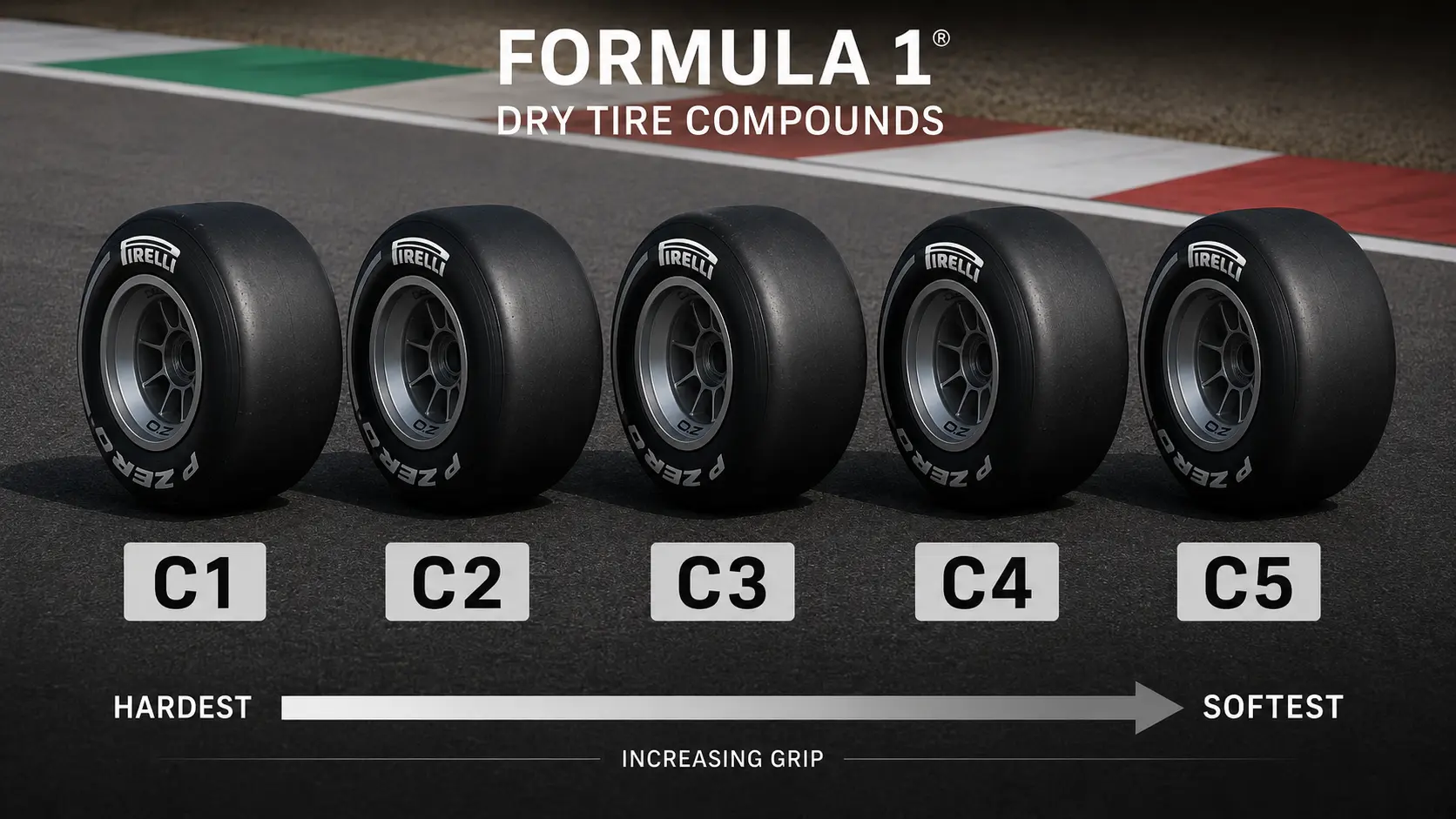
Formula 1 uses one official tyre supplier, Pirelli. The 2026 range contains five dry-weather slick compounds, numbered from C1 to C5.
The letter C means compound. A lower number indicates a harder tyre, while a higher number indicates a softer tyre.
The tyres continue to fit 18-inch wheels, but the 2026 generation is smaller than the 2025 design. Tread width has been reduced by 25 mm at the front and 30 mm at the rear, while the overall diameter has also decreased.
| Compound | Position in range | Warm-up | Peak grip | Durability | Typical use |
|---|---|---|---|---|---|
| C1 | Hardest | Slowest | Lowest of the slick range | Highest | High-speed circuits, heavy loads, hot conditions and long race stints |
| C2 | Second-hardest | Slow | Moderate | Very high | Abrasive surfaces, sustained high-speed corners and durable race strategies |
| C3 | Middle | Moderate | Balanced | Balanced | The most versatile compound; it can be Hard, Medium or Soft depending on the event |
| C4 | Second-softest | Fast | High | Lower | Low- or medium-severity circuits where quick warm-up is valuable |
| C5 | Softest | Fastest | Highest | Lowest | Smooth, low-wear circuits and qualifying laps requiring maximum mechanical grip |
C1 is not automatically a good race tyre simply because it is durable. At a cool or low-energy circuit, it may be so difficult to warm up that a softer tyre remains faster for almost the same stint length.
C5 is not automatically unsuitable for racing. At a smooth circuit with low loads, it can sometimes complete a useful race stint rather than serving only as a qualifying tyre.
Hard, Medium and Soft are relative names
One of the most important details is that the white Hard, yellow Medium and red Soft tyres do not always contain the same rubber compound.
Pirelli selects three compounds for each Grand Prix. The hardest of those three receives white markings, the middle compound receives yellow markings and the softest receives red markings.
That means a C3 can appear in any of the three colours.
| Weekend selection | White Hard | Yellow Medium | Red Soft | Likely circuit type |
|---|---|---|---|---|
| C1–C2–C3 | C1 | C2 | C3 | High tyre loads, fast corners or severe degradation |
| C2–C3–C4 | C2 | C3 | C4 | Medium-severity circuit requiring a balanced range |
| C3–C4–C5 | C3 | C4 | C5 | Smooth, low-severity circuit or street track |
For example, C3 was the red Soft when Pirelli selected C1, C2 and C3 for high-load venues such as Suzuka and Silverstone in 2026.
At events using C3, C4 and C5, the same C3 became the white Hard.
The television graphic may simply say Hard, Medium or Soft. To understand the tyre’s absolute position within the full range, viewers also need to know the C numbers selected for that weekend.
How Pirelli chooses the compounds for a Grand Prix
Pirelli studies previous races, circuit measurements, simulations, weather history and the expected loads from the current cars.
The FIA provides teams with the selected specifications no less than two weeks before the competition unless another arrangement has been approved.
| Factor | What Pirelli examines | Effect on selection |
|---|---|---|
| Asphalt abrasion | How aggressively the road surface removes tread rubber | Rougher asphalt generally pushes the choice toward harder compounds. |
| Lateral loading | Energy generated by long or fast corners | High-speed circuits usually require greater heat and load resistance. |
| Traction | Demand placed on the rear tyres during acceleration | Repeated slow-corner exits can create rear overheating and wheelspin. |
| Braking | Longitudinal loads placed on the front axle | Heavy braking can increase front wear, temperature and lock-up risk. |
| Track temperature | Expected surface temperature during each session | Hotter conditions can require harder compounds; cool conditions make warm-up more difficult. |
| Surface grip | Whether the asphalt is smooth, polished, dusty or heavily rubbered | Low-grip tracks may need softer compounds to generate useful mechanical grip. |
| Track evolution | How quickly rubber is deposited during the weekend | A street circuit can change dramatically between Friday practice and Sunday’s race. |
| Aerodynamic load | How much downforce pushes the car into the circuit | More load generates grip but also places additional energy into the tyres. |
Silverstone uses the C1–C2–C3 range because its fast corners generate sustained lateral loads above 5 g.
Australia, Miami, Montreal and Austria received the C3–C4–C5 selection during 2026 because their demands allowed the softer end of the range to be used.
The objective is not to make every race a guaranteed two-stop contest. Pirelli must first provide tyres capable of operating safely under the circuit’s expected loads.
How many tyres does each driver receive?
Teams cannot use an unlimited supply of new tyres.
On a standard Grand Prix weekend, each driver receives 13 sets of dry-weather tyres, five sets of intermediates and two sets of full wets.
A complete set means two front tyres and two rear tyres of the same specification.
| Weekend format | Hard sets | Medium sets | Soft sets | Intermediate sets | Full-wet sets |
|---|---|---|---|---|---|
| Standard weekend | 2 | 3 | 8 | 5 | 2 |
| Sprint weekend | 2 | 4 | 6 | 6 | 2 |
Most sets are Soft because drivers need several new sets for qualifying attempts. A set used for one flying lap is no longer perfectly fresh, but it can still be useful during practice or a race stint.
One Soft set is reserved for Q3. Drivers reaching Q3 must return a set of that specification afterward.
On a Sprint weekend, drivers must use a new Medium in SQ1 and SQ2 and a Soft in SQ3 when the session remains dry.
Why teams save tyres during practice
Tyres must be returned at several points during the weekend. A driver cannot simply complete every practice session and keep all the used sets for Sunday.
On a normal weekend, two sets are returned after FP1, two more after FP2 and another two after FP3. The regulations also protect specified race tyres from being returned prematurely.
This creates strategic decisions before the race has begun.
A team may avoid using a Hard tyre in practice because it wants two fresh Hard sets available in case the race becomes an unexpected two-stop contest.
Alternatively, it may need to use the Hard during Friday running because it has little historical data and must discover whether the compound can reach temperature.
Two drivers from the same team can reach Sunday with different tyre inventories because they followed different practice programmes or progressed to different qualifying sessions.
Tyre temperature and the operating window
A tyre produces its best grip only within a suitable temperature range.
Below that range, the rubber is too stiff and cannot conform properly to the asphalt. The car slides, which can tear the surface and create graining.
Above the range, the rubber becomes too hot. Grip falls, the surface moves excessively and lasting thermal degradation can occur.
Teams use tyre blankets under controlled conditions before the car leaves the garage, but this does not make the complete tyre instantly ready for a qualifying lap.
The driver still needs to place energy into the carcass and tread through braking, acceleration and cornering.
| Tyre state | Driver feels | Likely consequence |
|---|---|---|
| Too cold | Weak front response, wheelspin and sudden sliding | Poor opening laps, graining or an ineffective undercut |
| In the window | Predictable steering and stable grip | Best combination of lap time and tyre life |
| Too hot | Progressive sliding and reduced traction | Thermal degradation and rapidly increasing lap times |
Harder tyres generally take longer to warm up. This can make them vulnerable immediately after a pit stop.
Softer tyres heat rapidly, which is useful for qualifying and restarts, but they are also more likely to exceed their ideal temperature during a long stint.
How much faster is a softer compound?
There is no permanent lap-time difference between C1, C2, C3, C4 and C5.
The gap changes with circuit length, corner type, temperature, fuel load, car design and tyre condition.
A useful general expectation is approximately 0.3 to 0.8 seconds between adjacent compounds on a representative lap.
During several 2026 weekends, Pirelli measured differences of approximately four to six tenths between the nominated Medium and Soft compounds.
A very short lap can produce a smaller difference. A long circuit with several traction zones can produce a much larger one.
| Comparison | Typical fresh-tyre difference | Important qualification |
|---|---|---|
| Soft vs Medium | Soft approximately 0.3–0.8 seconds faster | The advantage can disappear quickly if the Soft overheats. |
| Medium vs Hard | Medium approximately 0.3–0.8 seconds faster | The Hard can become competitive once fuel burns off and it reaches temperature. |
| Soft vs Hard | Frequently around 0.7–1.5 seconds faster | The total gap is not always the simple sum of two adjacent differences. |
| C1 vs C5 | Potentially several seconds on the same car | They are rarely supplied together during a Grand Prix weekend. |
The softer tyre’s advantage is greatest when both sets are new, warm and driven at qualifying pace.
During a race, drivers manage temperature and wear. The difference between compounds is therefore normally smaller than it appears during qualifying runs.
What race lap times should you expect?
A race lap cannot be predicted from the compound alone.
The car begins the Grand Prix with a large fuel load, the driver may be following traffic and the tyres must survive an entire stint. Race laps are therefore much slower than qualifying laps at the beginning of the event.
As fuel burns off, the car becomes faster. At the same time, the tyres become older and the driver may need to manage their temperature.
The following table uses a fictional circuit where a new Medium can produce a 1 minute 30 second lap on low fuel. It is an illustration rather than a prediction for a real Grand Prix.
| Situation | Illustrative lap time | Why |
|---|---|---|
| New Soft, low fuel | 1:29.4–1:29.7 | Maximum grip and little need to preserve the tyre |
| New Medium, low fuel | 1:30.0 | Reference lap for the example |
| New Hard, low fuel | 1:30.4–1:31.0 | Lower peak grip and potentially slower warm-up |
| Opening race laps on Medium | Approximately 1:34–1:37 | Full fuel load, traffic and tyre management |
| Mid-race Medium stint | Approximately 1:32–1:35 | Lower fuel load partly offsets tyre degradation |
| Late-race new Soft | Approximately 1:29.5–1:31.5 | Low fuel and fresh grip, but traffic or management may still limit the lap |
This is why a driver’s lap times can remain almost constant during a stint. Fuel burn is making the car faster while tyre degradation is making it slower.
When degradation becomes greater than the benefit from decreasing fuel mass, the lap times begin to rise.
What tyre degradation actually means
Tyre degradation is a loss of performance with use.
It is normally measured in seconds per lap after engineers correct the data for fuel burn, traffic, track evolution and driver pace.
Degradation is not identical to physical wear. A tyre can retain plenty of rubber but become slower because it has overheated internally.
Another tyre can lose visible tread material while maintaining relatively consistent performance.
| Analytical description | Approximate corrected loss | Strategic meaning |
|---|---|---|
| Very low degradation | Less than about 0.03 seconds per lap | Long one-stop strategies become attractive. |
| Low degradation | About 0.03–0.07 seconds per lap | One stop is likely unless pit loss is unusually small. |
| Moderate degradation | About 0.07–0.15 seconds per lap | One- and two-stop strategies can be closely matched. |
| High degradation | About 0.15–0.25 seconds per lap | Shorter stints and two stops become more competitive. |
| Extreme degradation | More than about 0.25 seconds per lap | The tyre may require heavy management or an early pit stop. |
These ranges are analytical guides rather than FIA or Pirelli definitions. A television graphic may show a different estimate because each team uses its own model.
Wear, thermal degradation, graining and blistering
| Problem | Cause | What happens | Can it recover? |
|---|---|---|---|
| Wear | Rubber is physically removed by the asphalt | The tread becomes thinner and eventually loses performance or protection. | No; the lost rubber cannot return. |
| Thermal degradation | The tyre is operated above its ideal temperature | The rubber’s structure changes and grip falls progressively. | Cooling can help, but the original performance may not return. |
| Graining | A relatively cold surface slides across the asphalt | Small strips of rubber tear and stick back onto the tread, reducing contact. | Sometimes; the grained layer can wear away. |
| Blistering | Excessive internal heat creates local separation | Bubbles or damaged patches appear on the tread surface. | Rarely; significant blistering normally remains. |
| Flat spot | A wheel locks while braking | One section of the tyre is ground flat, creating vibration. | No; a severe flat spot requires a pit stop. |
| Pickup | The tyre collects discarded rubber away from the racing line | The car vibrates and temporarily loses grip. | Usually; the pickup can be removed through continued running. |
Graining is more common when tyres are too cold. Blistering and thermal degradation are associated more closely with excessive temperature.
A driver can experience both problems during the same weekend if weather or setup changes significantly.
How long does each compound last?
There is no fixed life for an F1 tyre.
A C5 can complete a long stint at Monaco, while a C2 can struggle after a small number of laps at a hot and abrasive circuit.
The following ranges show rough stint potential at a hypothetical medium-severity circuit with a 50- to 60-lap race. They should not be treated as safety limits or guaranteed strategy windows.
| Compound | Illustrative competitive stint | Main limitation |
|---|---|---|
| C1 | Approximately 30–50+ laps | Warm-up and low peak grip rather than wear |
| C2 | Approximately 25–45 laps | Can still overheat at very demanding circuits |
| C3 | Approximately 20–40 laps | Highly dependent on whether it is Hard, Medium or Soft for the weekend |
| C4 | Approximately 12–30 laps | Thermal degradation during long or high-load stints |
| C5 | Approximately 6–20 laps | Overheating and rapid performance loss at severe circuits |
A team does not wait until a tyre is physically destroyed. It pits when the expected time lost by remaining on track becomes greater than the time required for a stop and a fresh set.
The performance crossover
Suppose a Soft tyre begins a stint 0.5 seconds faster than a Medium.
If the Soft loses 0.12 seconds per lap while the Medium loses 0.05, the Soft’s advantage shrinks by 0.07 seconds each lap.
After approximately seven laps, their estimated pace becomes equal. Beyond that point, the Medium becomes faster even though it is the harder compound.
| Lap of stint | Soft advantage over Medium | Interpretation |
|---|---|---|
| Lap 1 | About 0.50 seconds | Soft is clearly faster. |
| Lap 4 | About 0.29 seconds | Soft still has a useful advantage. |
| Lap 7 | Approximately equal | The performance crossover has arrived. |
| Lap 12 | Soft about 0.35 seconds slower | The Medium is now the stronger race tyre. |
Real strategy software includes fuel use, track evolution, traffic, pit-stop loss and the changing degradation rate. The calculation above simply explains the principle.
How tyre compounds create race strategy
A pit stop supplies a faster tyre but costs time in the pit lane.
Depending on the circuit, a normal green-flag stop can cost approximately 18 to 30 seconds compared with remaining on track.
A two-stop strategy must therefore gain enough lap time from fresher tyres to recover the cost of one additional stop.
| Strategy | Strength | Weakness | When it works |
|---|---|---|---|
| Medium–Hard | Balanced and usually simple | Can be vulnerable to a late Safety Car | Low or moderate degradation with a large pit-stop loss |
| Soft–Hard | Strong launch and opening-lap grip | Early stop may create traffic | Soft can survive the first window and overtaking is difficult |
| Hard–Medium | Long first stint and flexible stop timing | Difficult warm-up at the start | Driver starts out of position or expects a Safety Car |
| Medium–Hard–Soft | Combines stable early stints with a fast finish | Requires a second pit stop | Degradation is high or a late neutralisation reduces pit loss |
| Soft–Medium–Medium | Maximum pace throughout the race | Consumes two strong race sets and needs clean air | Pit loss is low and overtaking is possible |
Track position often matters more than theoretical tyre pace. A driver on fresh tyres can lose the strategy by emerging behind several slower cars.
The undercut and overcut
An undercut occurs when the following driver pits first, uses the grip of new tyres and attempts to gain enough time to move ahead when the rival stops.
The undercut is powerful when the new tyre warms up quickly and the old tyre has heavy degradation.
It is weaker when the new Hard takes a complete lap or more to reach temperature.
An overcut occurs when the driver ahead remains on track. The team hopes that clear air, warm tyres and strong pace will produce more time than the rival gains from the new set.
The overcut can also work when the rival exits the pits into traffic.
| Condition | Favours undercut | Favours overcut |
|---|---|---|
| New-tyre warm-up | Very fast | Slow |
| Old-tyre degradation | High | Low |
| Pit-exit traffic | Clear track | Heavy traffic |
| Track evolution | Stable | Improving quickly |
| Driver’s current air | Trapped behind rival | Can produce fast laps after rival stops |
Safety Cars can transform tyre strategy
Cars travel more slowly behind a Safety Car or under a Virtual Safety Car. A driver entering the pits therefore loses less time relative to the field.
A well-timed neutralisation can turn a two-stop strategy into the quickest option or provide an almost free change to fresh tyres.
It can also hurt a driver who has just completed a green-flag pit stop before the neutralisation begins.
Teams sometimes preserve an additional fresh Hard or Medium specifically to cover an unexpected Safety Car late in the race.
A fresh Soft becomes particularly valuable near the finish because it heats quickly and provides strong grip during a short restart sprint.
How drivers protect their tyres
The driver can change the degradation rate without changing the tyre.
| Technique | Tyre benefit | Possible cost |
|---|---|---|
| Smoother steering | Reduces front sliding and surface temperature | Slightly slower corner entry |
| Gentler acceleration | Reduces rear wheelspin | Slower corner exit |
| Lift and coast | Reduces braking and corner-entry energy | Loses time before the braking zone |
| Use a wider line | Can reduce steering angle and lateral slip | Longer distance travelled |
| Leave turbulent air | Restores downforce and reduces sliding | Driver must increase the gap to the car ahead |
| Adjust controls | Brake balance and differential settings can protect one axle | May reduce performance elsewhere on the lap |
Following another car can increase degradation because the disturbed airflow reduces downforce. The tyres then slide more even though the driver is travelling at a slower speed.
Intermediate tyres
The green-marked intermediate is intended for a wet track without large amounts of standing water.
It has a tread pattern that clears water while retaining more rubber in contact with the circuit than a full wet.
The intermediate has an extremely broad operating range. It can work on a damp surface, in steady rain and on a track that is beginning to dry.
This versatility makes it the most commonly used rain tyre in modern Formula 1.
The blue full wet is designed for heavy rain and significant standing water.
Its deeper and more open tread channels move much more water than the intermediate and reduce the risk of aquaplaning.
The additional tread also makes the tyre slower and less precise when the track begins to dry. Its tread blocks move, generate heat and lose performance rapidly.
If a race starts or restarts behind the Safety Car under the relevant wet procedure, full-wet tyres can be compulsory until the Safety Car returns to the pit lane.
Teams normally switch to intermediates as soon as conditions safely allow because the green tyre is faster across most raceable wet conditions.
Slick, Intermediate and Full Wet compared
| Tyre | Sidewall colour | Surface | Best conditions | Main weakness |
|---|---|---|---|---|
| Slick | White, yellow or red | No tread | Dry circuit or a mostly dry racing line | Aquaplaning and extremely weak grip on standing water |
| Intermediate | Green | Moderate tread | Damp track, light rain or drying conditions | Overheats on a dry surface and cannot clear deep water as effectively as a wet |
| Full Wet | Blue | Deep, open tread | Heavy rain and standing water | Considerably slower and prone to overheating as the circuit dries |
The wet-weather crossover
The crossover is the point at which one type of tyre becomes quicker than another.
| Track change | Likely tyre switch | Decision |
|---|---|---|
| First rain reaches a dry circuit | Slick to Intermediate | Drivers balance the time lost on a damp slick against the cost of a pit stop. |
| Standing water increases | Intermediate to Full Wet | The wet becomes safer and may become faster when the intermediate begins to aquaplane. |
| Heavy rain reduces | Full Wet to Intermediate | The intermediate normally gains several seconds as water clears. |
| A dry line appears | Intermediate to Slick | The first driver to make the correct change can gain enormous time. |
Changing one lap too early can be disastrous if the new tyre cannot generate temperature. Changing one lap too late can cost several seconds at every corner.
The ideal decision also depends on whether more rain is approaching and how long the driver must wait before the next pit stop.
Why the Full Wet is used so rarely
The intermediate can operate in surprisingly heavy rain and is normally much faster than the full wet.
When the circuit contains enough standing water for the full wet to become clearly preferable, spray can make visibility unsafe.
The race may then be suspended or run behind the Safety Car rather than continuing at racing speed.
This creates a narrow practical window for the blue tyre. It may be technically capable of handling the water, but the drivers may be unable to see through the spray from the cars ahead.
Why the same compound behaves differently on different cars
Every team receives the same tyre specifications, but each car applies load differently.
A car with strong front downforce may place more energy into the front tyres and warm them quickly. Another car may protect the fronts but overheat its rear tyres during acceleration.
Suspension geometry, aerodynamic balance, brake temperatures, differential settings and power delivery all affect the tyre.
Drivers also use different techniques. A driver who carries high speed into corners can stress the front axle, while another who rotates the car early and accelerates aggressively may punish the rear tyres.
This is why one team can complete a comfortable one-stop race while another struggles with the same compounds and weather.
What to watch during a Grand Prix
| What you see | What it may mean |
|---|---|
| A driver suddenly drops back after a pit stop | The new Hard tyre may not have reached temperature. |
| Lap times remain stable for many laps | Fuel burn may be balancing tyre degradation. |
| A driver begins sliding at corner exits | The rear tyres may be overheating or wearing. |
| A driver leaves a larger gap to the car ahead | They may be cooling the tyres in cleaner air. |
| One team saves a new Medium in practice | It may be planning a Medium-based race strategy. |
| Drivers move off line during a wet race | They may be cooling overheating intermediates on the remaining water. |
| A late Safety Car appears | Drivers with a fresh Soft available may receive a major advantage. |
F1 tyre compounds summarised
Formula 1’s 2026 dry-tyre range runs from C1, the hardest compound, to C5, the softest.
Pirelli selects three compounds for each Grand Prix. The hardest selected tyre becomes the white Hard, the middle one becomes the yellow Medium and the softest becomes the red Soft.
This means C3 can be the Soft at one event, the Medium at another and the Hard somewhere else.
Softer tyres normally warm up faster and produce quicker laps, but they usually degrade sooner. Harder tyres normally last longer but produce less grip and can be difficult to warm.
A typical fresh-tyre difference between adjacent compounds is roughly 0.3 to 0.8 seconds per lap, although the real gap varies considerably.
In a dry race, a driver must normally use at least two different slick specifications. This guarantees at least one tyre change unless the race is interrupted before the requirement can be completed.
Strategy is a calculation between tyre pace and pit-stop loss. A one-stop strategy spends less time in the pits, while a two-stop strategy provides more laps on fresher tyres.
The green Intermediate is used for damp or moderately wet conditions. The blue Full Wet is designed for heavy rain and standing water.
The Intermediate is faster across most raceable wet conditions, while the Full Wet provides greater aquaplaning protection but creates more tread movement and heat as the track dries.
The winning tyre strategy is rarely the one with the fastest individual compound. It is the one that combines pace, tyre life, traffic and track position over the complete race.
Related Articles
|
F1, F2, F3 & F1 Academy: Cars Compared
|
|
Formula 1 reaches 50 years since a woman last raced in a Grand Prix
|
|
F1 & Formula E: Comparing The Differences Between Each Car
|
|
Super Formula Car Regulations Explained
|

|
IndyCar arrives at a brand-new Canadian street circuit
|
|
|
Formula E signs global Disney+ and ESPN streaming deal for GEN4 era
|
|
NASCAR Explained to an F1 Fan
|
|
|
Porsche Secures Back-To-Back Formula E Manufacturers’ Titles
|
Related series

|
Formula 1
|