
Tags:
IndyCar reveals lighter, more powerful IR-28 for 2028
The IR-28 is IndyCar’s all-new next-generation race car. It will make its competitive debut at the beginning of the 2028 season.

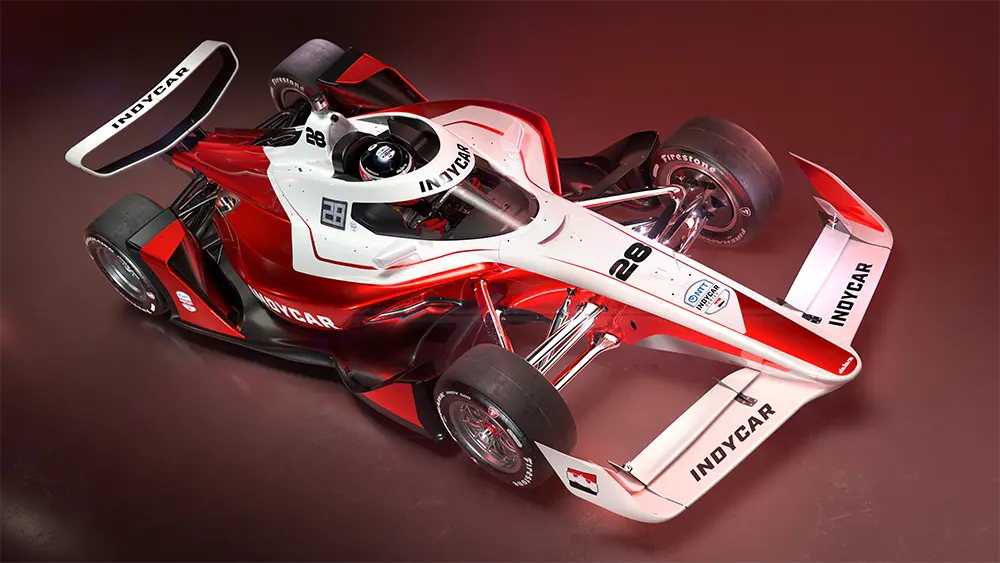
What IndyCar has unveiled
IndyCar has released the first renderings and technical details of the IR-28, the car that will lead the American open-wheel championship into its next major rules era. Designed with Dallara, it replaces the long-serving platform whose underlying chassis first appeared in 2012.
The new car retains a recognisable IndyCar silhouette but introduces a redesigned safety structure, revised aerodynamics and a more integrated aeroscreen. The package is expected to weigh roughly 100 pounds, or about 45 kilograms, less than the current car.
More power and a new hybrid system
Chevrolet and Honda will continue as engine manufacturers, supplying new 2.4-litre twin-turbocharged V6 engines. Combined output is expected to reach approximately 760 horsepower before additional hybrid deployment is considered.
The electrical system will move from a supercapacitor to a battery-based unit. The new system is designed to store considerably more energy while reducing weight, giving drivers a stronger and more strategically useful hybrid boost.
IndyCar also says the aerodynamics have been shaped to reduce turbulent air behind the car. That objective is especially important on road and street circuits, where drivers can struggle to follow closely without overheating tyres or losing front-end grip.
Why it matters
The IR-28 is more than a visual update. It is IndyCar’s attempt to address several long-running demands at once: reduce weight, increase power, modernise the hybrid package and preserve the close racing that defines the championship.
The long development window is equally important. Testing is scheduled to start at the Indianapolis Motor Speedway road course on 1 August 2026, with Álex Palou and Alexander Rossi set to drive. That gives IndyCar, Dallara, Chevrolet, Honda and Firestone almost two seasons to refine the package before it races.
What to watch next
- Early reliability: The first tests will show how well the new chassis, engine and battery-based hybrid system work together.
- Oval performance: IndyCar will need one platform to perform safely at Indianapolis, on short ovals and across road and street circuits.
- Following ability: Reduced turbulence must translate from simulation into genuinely closer racing on track.
Sources: INDYCAR release via FOX Sports, 28 July 2026; Autosport, 28 July 2026.
Related Articles
|
F1, F2, F3 & F1 Academy: Cars Compared
|

|
Formula 1 reaches 50 years since a woman last raced in a Grand Prix
|
|
F1 & Formula E: Comparing The Differences Between Each Car
|
|
Super Formula Car Regulations Explained
|
|
Formula 1 Tyre Compounds Explained
|

|
IndyCar arrives at a brand-new Canadian street circuit
|
|
|
Formula E signs global Disney+ and ESPN streaming deal for GEN4 era
|
|
NASCAR Explained to an F1 Fan
|
Related series

|
IndyCar
|