
LMP3 Explained: What is an LMP3 Car?
How the entry-level Le Mans Prototype category controls engines, chassis, aerodynamics, costs and driver line-ups-and why an LMP3 is much closer to an LMP2 car than a road-based GT.

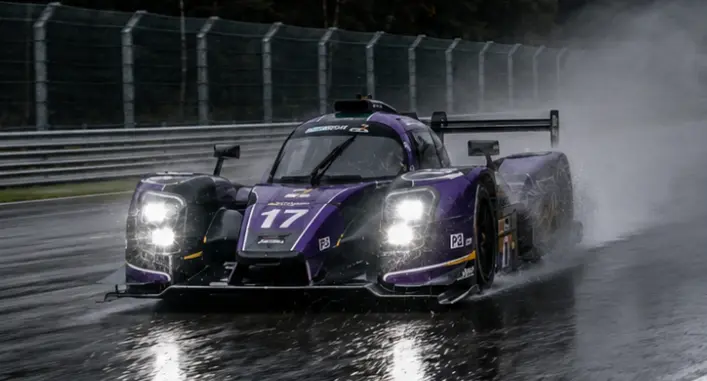
What is LMP3?
LMP3 means Le Mans Prototype 3. It is the entry level of the Automobile Club de l’Ouest’s prototype-racing system.
An LMP3 is a purpose-built racing prototype. It is not based on a road car, and a manufacturer does not need to produce a street-legal version.
The driver sits inside a closed carbon-fibre survival cell. The engine is mounted behind the cockpit, the wheels are enclosed by aerodynamic bodywork and a large rear wing produces downforce.
The category was created to give developing drivers, amateur competitors and smaller teams an affordable introduction to prototype endurance racing.
It teaches many of the skills required in LMP2 and Hypercar: driving a high-downforce car, managing traffic, sharing the vehicle with another driver, completing pit stops and maintaining consistent pace through a long race.
LMP3 was introduced in 2015. The third technical generation began in 2025 and is homologated through the end of 2029.
The current LMP3 specification
| Area | Current regulation |
|---|---|
| Homologation period | 2025–2029 |
| Engine | Toyota V35A 3.5-litre twin-turbocharged V6 prepared by ORECA |
| Power | Approximately 470 hp / 350 kW |
| Driven wheels | Rear-wheel drive |
| Gearbox | Six-speed sequential transmission with paddle shifting |
| Minimum weight | 1,000 kg |
| Maximum length | 4,650 mm |
| Overall width | Between 1,800 and 1,900 mm |
| Maximum bodywork height | 987 mm, with the engine intake permitted up to 1,050 mm |
| Fuel capacity | 100 litres |
| Brake discs | Steel, approximately 355.6 mm in diameter |
| Wheels | 18-inch diameter; approximately 12.5 inches wide at the front and 13 inches at the rear |
| Tyres in ELMS | Control Michelin tyres with one dry and one wet specification |
The third-generation LMP3 car
The 2025 regulations did not require manufacturers to design completely new cars.
Instead, the four approved constructors were allowed to update their second-generation chassis for the new engine, cooling package, electrical system and safety requirements.
This approach reduced costs. A team could buy a new car or, where the manufacturer offered the option, convert an eligible second-generation chassis using an approved upgrade package.
The outward appearance changed relatively little because most of the underlying monocoque, suspension architecture and aerodynamic concept remained.
The largest engineering challenge was replacing the naturally aspirated Nissan V8 with a twin-turbocharged Toyota V6. The new engine required different air intakes, intercoolers, radiators, exhaust routing and rear bodywork.
The four approved chassis constructors
Teams do not design their own LMP3 cars. They must purchase a model homologated by the ACO from one of four licensed constructors.
| Constructor | Third-generation model | Previous model |
|---|---|---|
| Ligier Automotive | Ligier JS P325 | Ligier JS P320 |
| Duqueine Automotive | Duqueine D09 | Duqueine D08 |
| Ginetta | Ginetta G61-LT-P325-EVO | Ginetta G61-LT-P3 |
| ADESS | ADESS AD25 | ADESS AD23 |
The four cars do not have identical monocoques, suspension geometry or bodywork. Each constructor developed its own interpretation of the regulations.
However, every car uses the same engine, gearbox family and controlled electronics. Development is heavily restricted, preventing a manufacturer from repeatedly introducing expensive aerodynamic upgrades.
Ligier has supplied the majority of recent European entries, but the regulations allow all four approved designs to compete.
Homologation controls development
Homologation means that the ACO approves one defined specification of each car.
The constructor submits drawings, dimensions, aerodynamic information, parts lists and safety-test results. Once approved, the car must remain in that specification.
A team cannot manufacture a more efficient front splitter, reshape the diffuser or create its own lighter suspension component simply because it believes the change would improve performance.
It may adjust components specifically identified as adjustable and replace parts with approved options. Repairs must restore the original function rather than secretly introduce an improvement.
If a reliability problem requires a redesigned component, the constructor must submit the change for approval and make it available fairly to its customers.
The purpose is to stop LMP3 becoming an expensive development contest. The ACO states that reliability, safety and low maintenance costs should take priority over continuous performance development.
The common Toyota V6 engine
Every current LMP3 uses a Toyota V35A engine supplied and prepared by ORECA.
The aluminium 3.5-litre twin-turbocharged V6 originates from a production-engine family used in Toyota and Lexus road vehicles, including the Lexus LS 500.
ORECA converts it for endurance racing. Changes include a dry-sump lubrication system, race-specific turbochargers, cooling equipment, electronics and installation hardware.
The racing engine produces approximately 470 hp, equivalent to around 350 kW. That is about 15 hp more than the Nissan V8 used by the previous generation.
The power increase is relatively small, but the method of delivery is different. The turbocharged engine produces strong torque at lower engine speeds, giving the driver more wheelspin to manage when accelerating from slow corners.
The V6 is also intended to use less fuel and produce less noise than the old 5.6-litre naturally aspirated V8.
Why every car uses the same engine
A common engine prevents wealthy teams or manufacturers from gaining an advantage through expensive power-unit development.
ORECA controls the specification, rebuild procedures, seals and electronic calibration. Teams cannot freely increase boost pressure, change internal components or create their own engine maps.
Using one powertrain also simplifies spare-parts supply and trackside technical support.
The competition is therefore concentrated on chassis characteristics, setup, reliability, pit work and driver performance rather than engine spending.
| Area | Common or controlled? | Team freedom |
|---|---|---|
| Engine | Common Toyota/ORECA specification | Maintenance and approved operational settings only |
| Gearbox | Common six-speed Xtrac-based package | Approved setup and servicing |
| Electronics | Controlled engine and gearbox systems | Permitted driver and setup adjustments |
| Chassis | One of four homologated designs | Setup changes, not structural redesign |
| Aerodynamics | Homologated by constructor | Approved wing and ride-height adjustments |
| Tyres | Controlled by championship | Pressure and setup within event limits |
Gearbox and drivetrain
The engine drives only the rear wheels through a six-speed sequential gearbox.
The driver changes gear using paddles behind the steering wheel. Pneumatic or electronically controlled equipment completes the shift, but the gearbox remains mechanically sequential rather than fully automatic.
The driver normally uses the clutch when leaving the pits, starting the car or recovering from very low speed. It is not required for every upshift.
The rear differential controls how torque is shared between the two driven wheels. Teams can adjust approved differential and traction-control settings to suit the driver and circuit.
LMP3 does not use hybrid assistance, front-wheel drive or regenerative braking. All propulsion comes from the combustion engine through the rear axle.
Carbon monocoque and closed cockpit
The central chassis is a carbon-composite monocoque. It forms the survival cell around the driver and carries the principal loads from the front crash structure, engine and suspension.
The cockpit is closed by a windscreen, roof and doors. This gives the car the appearance of a miniature Le Mans prototype rather than an open-wheel single-seater.
The bodywork covers the wheels, reducing the danger of tyre-to-tyre contact and allowing a large floor and diffuser to contribute downforce.
Zylon anti-intrusion panels protect the sides of the survival cell. The car also uses a front crash box, approved roll structure, energy-absorbing padding and a carbon racing seat.
The headrest is designed for use with a frontal head restraint, while cockpit ventilation helps control heat during long stints.
Weight and ballast
The third-generation minimum weight is 1,000 kg, an increase of 50 kg over the previous generation.
The additional mass reflects the new turbocharged powertrain, intercoolers, cooling equipment and safety updates.
When a car is naturally lighter than the minimum, ballast must be secured in approved positions. This allows the team to reach the required weight and can help it tune weight distribution.
Ballast cannot be removed during the race, and the car can be weighed during post-session technical inspection.
The exact weighing condition is set by the championship. In IMSA’s P3 regulations, for example, the car is measured as raced after subtracting the driver and fuel.
Aerodynamics
LMP3 cars produce significant downforce through a front splitter, shaped bodywork, flat floor, rear diffuser and adjustable rear wing.
The floor accelerates air beneath the car, while the diffuser allows that airflow to expand toward the rear. The resulting pressure difference pushes the car toward the circuit.
The rear wing provides additional stability and allows the aerodynamic balance to be adjusted.
Teams can normally change approved wing angles, ride heights and rake, but they cannot redesign the aerodynamic surfaces.
The homologated bodywork also limits expensive wind-tunnel and computational-fluid-dynamics programmes.
LMP3 uses no active aerodynamics or drag-reduction system. Every aerodynamic surface remains fixed while the car is moving.
Suspension and setup
The suspension uses double wishbones with pushrods connecting the wheel assemblies to inboard springs and dampers.
Teams can adjust spring rates, damper settings, anti-roll bars, ride height, wheel alignment and approved third-spring elements.
These adjustments change how the car responds to braking, cornering and kerbs.
| Adjustment | Main effect |
|---|---|
| Spring stiffness | Controls body movement, kerb behaviour and aerodynamic platform stability. |
| Dampers | Control how quickly the suspension compresses and returns. |
| Anti-roll bars | Change the front-to-rear balance during cornering. |
| Ride height | Changes underfloor performance and the risk of the car touching the circuit. |
| Camber | Changes how the tyre contacts the road while cornering. |
| Rear-wing angle | Trades straight-line speed against rear stability and cornering grip. |
The suspension is passive. Active ride-height control and computer-controlled suspension are prohibited.
Brakes and driver aids
LMP3 cars use large ventilated steel brake discs, normally with six-piston calipers at the front and rear.
Carbon discs would reduce weight and improve high-temperature performance, but steel is less expensive and easier for customer teams to maintain.
Unlike an LMGT3 car, an LMP3 does not use anti-lock braking. The driver must judge pedal pressure and reduce it as speed and aerodynamic downforce fall.
Locking a front wheel can damage the tyre and send the car beyond the corner. Locking the rear axle can make the car rotate suddenly.
Current electronics provide adjustable traction control to help manage rear-wheel slip, but the system does not remove the need for careful throttle control.
Power-assisted steering reduces physical effort, particularly during long stints, but it does not steer the car automatically.
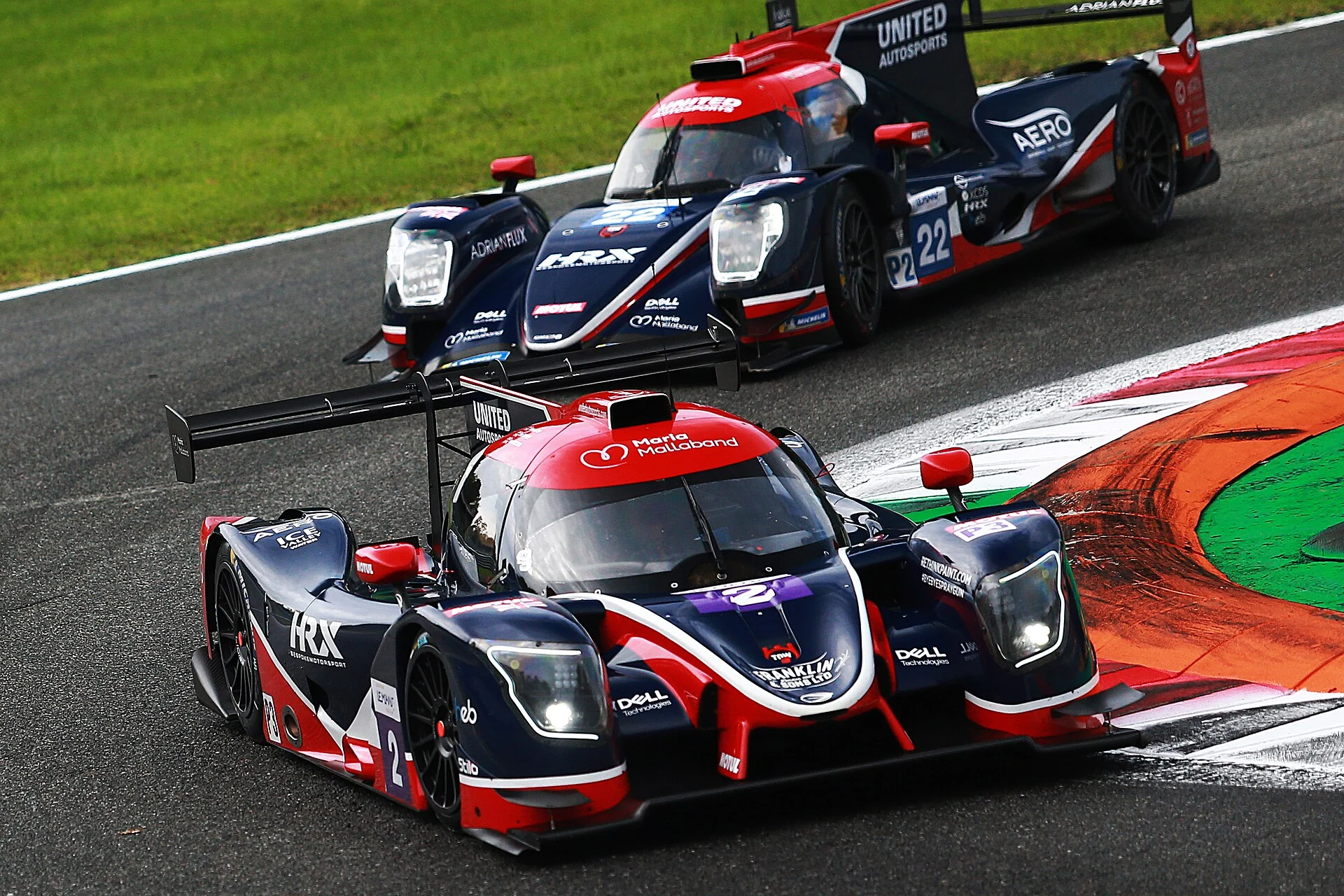
A second-generation Ligier JS P320 competing in the European Le Mans Series.
Tyres
Tyre regulations depend on the championship. In the European Le Mans Series, LMP3 uses Michelin control tyres.
Only one dry specification and one wet specification are available. Teams cannot choose between several compounds as they can in Formula 1.
Tyre-warming equipment is prohibited in ELMS. A driver leaving the pits must therefore bring cold tyres up to temperature through braking and cornering.
This makes the opening laps of a stint especially difficult. The car has limited grip at precisely the moment when the driver is rejoining traffic.
Tyre allocation is restricted, encouraging teams to manage sets throughout practice, qualifying and the race.
Fuel and endurance efficiency
The maximum fuel capacity is 100 litres.
The exact fuel depends on the championship. ELMS uses TotalEnergies Excellium Racing 100, a renewable racing fuel supplied to every category.
Teams cannot freely develop their own fuel blends. Using one official product removes another expensive area of competition.
Fuel consumption determines stint length and pit-stop timing. The new V6 was designed to be more efficient than the previous Nissan V8, but turbocharged performance still requires careful management.
Saving a small amount of fuel each lap can sometimes allow the car to complete one additional lap before stopping, producing a strategic advantage under a Safety Car or Full Course Yellow.
How much does an LMP3 cost?
Cost control was one of the category’s original purposes.
When the third-generation specification was introduced, the published price for a complete new race car was €299,000, with the powertrain package accounting for €89,200.
Those figures describe the regulated or published supply price rather than the cost of running a complete season.
A team must also pay for engineers, mechanics, transport, entry fees, tyres, fuel, testing, accident damage and engine or gearbox servicing.
LMP3 remains significantly less expensive than LMP2, but it is still a professional racing category rather than an inexpensive club formula.
The three generations compared
| Generation | Main period | Engine | Power | Minimum weight | Main change |
|---|---|---|---|---|---|
| Generation 1 | 2015–2019 | 5.0-litre Nissan VK50 naturally aspirated V8 | Approximately 420 hp / 313 kW | Approximately 930 kg | Established the affordable closed-cockpit prototype formula. |
| Generation 2 | 2020–2024 in principal ACO series | 5.6-litre Nissan VK56 naturally aspirated V8 | Approximately 455–460 hp / 339–343 kW | 950 kg | Improved power, safety and aerodynamic performance. |
| Generation 3 | 2025–2029 | 3.5-litre Toyota V35A twin-turbo V6 | Approximately 470 hp / 350 kW | 1,000 kg | Introduced turbo power, revised cooling, new electronics and safety updates. |
The third generation is not dramatically faster simply because it has more power. Its minimum weight increased, and organisers must preserve a sensible performance gap between LMP3, LMP2 and the GT classes.
LMP3 vs LMP2 vs LMGT3
| Area | LMP3 | LMP2 | LMGT3 |
|---|---|---|---|
| Basic vehicle | Entry-level prototype | Faster professional prototype | Production-based grand-touring car |
| Chassis | Purpose-built carbon monocoque | Purpose-built carbon monocoque | Derived from a road-car structure |
| Engine | Common 3.5-litre twin-turbo V6 | Common 4.2-litre naturally aspirated V8 in the current generation | Manufacturer-specific road-derived engine |
| Power | Approximately 470 hp / 350 kW | Higher than LMP3 | Adjusted through Balance of Performance |
| Minimum weight | 1,000 kg | Approximately 930 kg in ELMS | Approximately 1,200 kg before event adjustments |
| ABS | No | No | Yes |
| Aerodynamic performance | High compared with GT cars | Greater than LMP3 | Lower prototype-style downforce |
| Primary role | Driver and team development | Top customer prototype category | Manufacturer-representative GT racing |
LMP3 is normally faster than LMGT3 through medium- and high-speed corners because it is lighter and produces more downforce.
LMP2 is lighter, more powerful and aerodynamically more capable than LMP3, creating a clear step in performance and cost.
Does LMP3 race in the 24 Hours of Le Mans?
LMP3 is part of the Le Mans development system, but it is not a class in the main 24 Hours of Le Mans.
LMP3 cars race on the full Circuit de la Sarthe in Road to Le Mans, a Michelin Le Mans Cup support event held during Le Mans week.
This gives developing drivers experience of the long straights, high-speed corners and unusual procedures of the Le Mans circuit.
The European Le Mans Series LMP3 champion receives an invitation connected with the following Le Mans entry process, but that invitation is for the LMP2 category rather than an LMP3 entry.
The intended path is therefore LMP3, followed by LMP2 and potentially Hypercar or another top-level endurance programme.
Where LMP3 cars race
Eligibility differs between generations and championships, but LMP3 cars appear in several major endurance series.
| Series or event | Role of LMP3 |
|---|---|
| European Le Mans Series | Four-hour multiclass races alongside LMP2 and LMGT3. |
| Michelin Le Mans Cup | Shorter endurance races focused heavily on LMP3 and developing drivers. |
| Road to Le Mans | Special support races on the full Le Mans circuit. |
| Asian Le Mans Series | Regional endurance competition with generation eligibility defined by the season. |
| IMSA VP Racing SportsCar Challenge | North American sprint racing for second- and third-generation P3 cars under IMSA regulations. |
| Regional prototype series | Additional national and international championships can accept approved LMP3 generations. |
Driver line-ups
Driver categorisation is a sporting rule rather than a vehicle regulation, and it changes between championships.
In the 2026 European Le Mans Series, an LMP3 entry uses two or three drivers and must contain at least one Bronze-rated driver.
A two-driver crew can consist of one Bronze and one Silver driver or two Bronze drivers.
A three-driver crew can use one Gold and two Bronze drivers, two Silver drivers and one Bronze, or a combination of Bronze and Silver drivers containing at least one Bronze.
This prevents a team from filling the car entirely with elite professional drivers. LMP3 remains a Pro-Am and development-focused category.
How an LMP3 endurance race works
An ELMS race lasts four hours. Each car is shared by two or three drivers, with every driver required to complete a minimum amount of driving time.
The team must manage fuel, tyres, driver changes and mandatory pit-stop procedures while racing through traffic from three other classes.
LMP3 drivers are overtaken by the faster LMP2 cars while passing the slower LMGT3 field themselves.
That makes judgement in traffic one of the category’s most important lessons. Losing one second behind a GT car is preferable to damaging the prototype in an unnecessary collision.
Full Course Yellow, Virtual Safety Car and Safety Car periods can completely change pit strategy by reducing the time lost during a stop.
Reliability is equally important. A car that is a few tenths slower per lap can defeat a faster rival by avoiding contact, punctures and repair time.
Why the regulations produce close racing
Every car has almost identical engine performance, gearbox ratios, fuel capacity and tyre capability.
The chassis are homologated, limiting the advantage available from research and development.
Organisers can impose performance adjustments if one design gains an unintended advantage, although LMP3 does not operate as the same type of constantly adjusted road-car Balance of Performance formula used by LMGT3.
The remaining differences come from chassis characteristics, setup quality, pit work and drivers.
A team must therefore find performance through details: keeping the tyres in their operating window, setting the suspension correctly and helping every driver feel confident in the car.
LMP3 regulations explained in one minute
LMP3 is the entry-level Le Mans Prototype category. The cars are purpose-built closed-cockpit prototypes rather than modified road cars.
The current third generation runs from 2025 to 2029.
Four manufacturers are approved: Ligier, Duqueine, Ginetta and ADESS.
Every car uses the same ORECA-prepared Toyota V35A 3.5-litre twin-turbo V6, producing approximately 470 hp or 350 kW.
The cars weigh at least 1,000 kg, use six-speed sequential gearboxes and drive the rear wheels.
The chassis is a carbon monocoque protected by crash structures, Zylon side panels, padding and a homologated racing seat.
Teams can adjust suspension, ride height, wheel alignment, differential settings and rear-wing angle, but they cannot redesign homologated parts.
The cars use steel brakes without ABS, controlled electronics, 18-inch wheels and a 100-litre fuel tank.
LMP3 is faster and more aerodynamic than a GT3 car but slower and less expensive than LMP2.
It does not compete in the main 24 Hours of Le Mans. Instead, it provides a route toward LMP2 through championships such as ELMS, the Michelin Le Mans Cup and Road to Le Mans.
The regulations are designed to reward driving, setup, reliability and endurance-racing skill rather than unrestricted spending.
Related Articles
|
GT3 Explained: What Is a GT3 Car?
|
|
LMP2 Explained: What is an LMP2 Car?
|
|
First Time at Le Mans: Complete Beginner’s Guide
|
|
WEC vs IMSA: What’s the Difference?
|
|
NLS Starting Groups Explained
|
|
GT4 Explained: What Is a GT4 Car, and how is it different from GT3?
|
|
What Is the Difference Between GT3 and Cup 2?
|
|
Hypercar Explained: What Is a Hypercar in WEC, IMSA and Le Mans?
|
Related series

|
Asian Le Mans Series
|

|
European Le Mans Series
|

|
International Motor Sports Association
|

|
World Endurance Championship
|