
NLS Starting Groups Explained
Read why the Nürburgring Langstrecken-Serie divides its grid, how cars are assigned to the red, yellow and green groups, and the rules drivers must follow before each rolling start.

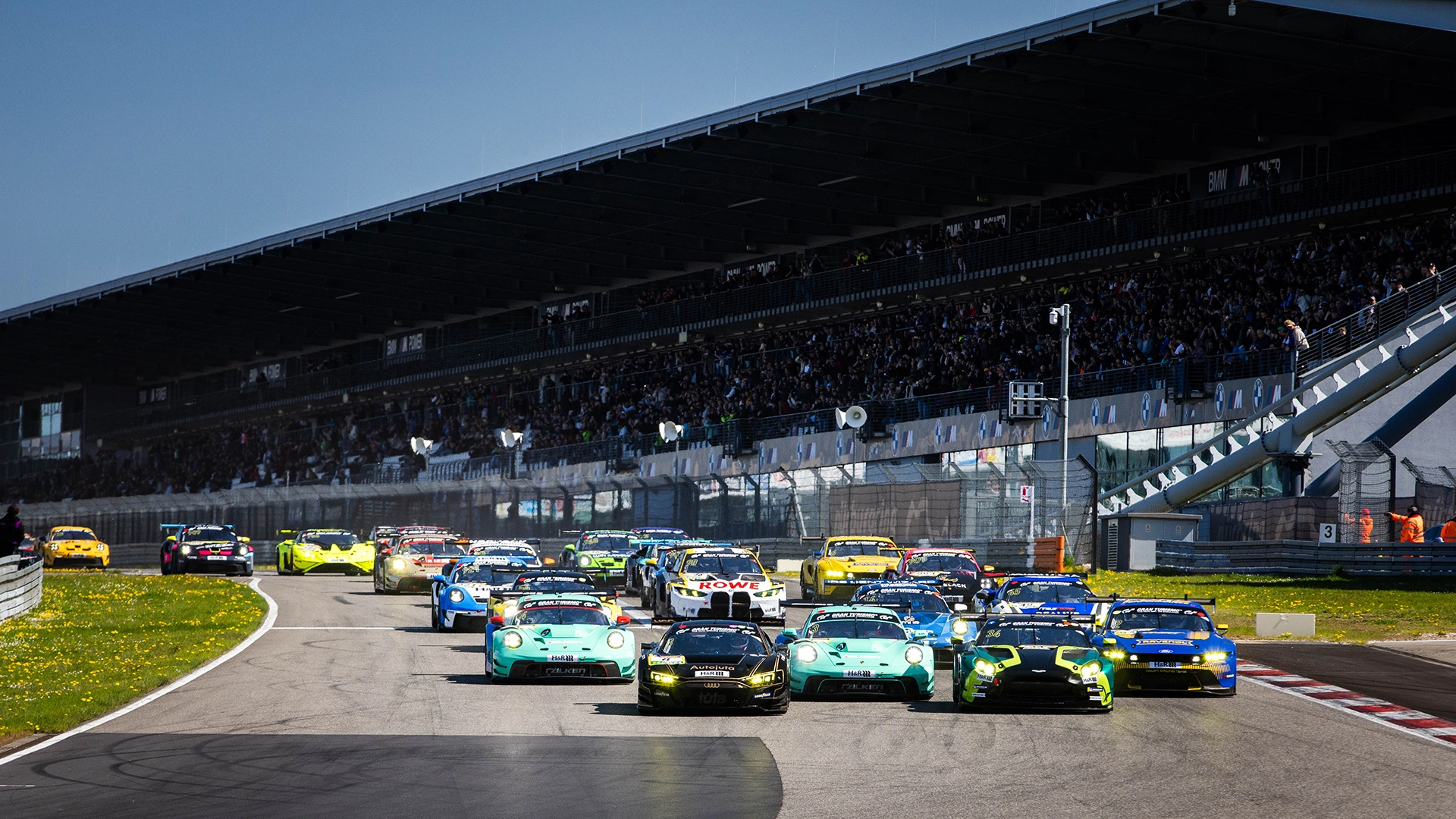
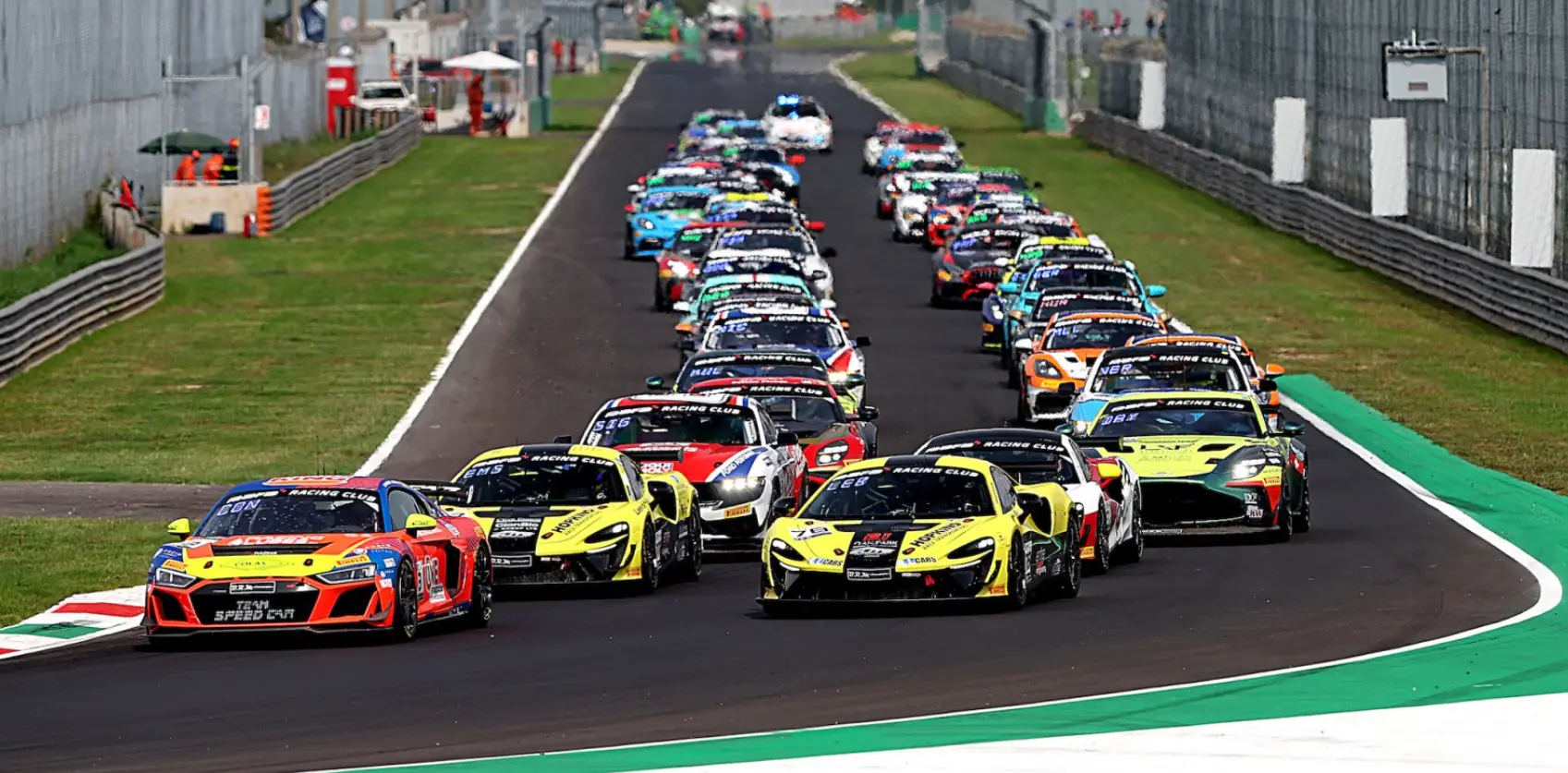
An NLS race start.
Why does the NLS need separate starting groups?
The Nürburgring Langstrecken-Serie can attract a field far larger and more varied than a conventional sprint championship. GT3 cars capable of fighting for the overall victory share the circuit with Porsche Cup cars, GT4 machinery, touring cars and production-based entries.
Starting every car in one tightly packed group would create an extremely long grid and place cars with very different acceleration, braking and cornering performance beside each other on the run toward the first corner.
The starting-group system breaks the field into smaller and more manageable sections. Faster classes normally appear toward the front, while progressively slower class groups begin behind them. This reduces the immediate performance difference between neighbouring cars and gives the field more room to organise itself before entering the Nordschleife.
The groups do not become separate races. Every car still competes in the same NLS event, appears in an overall classification and races for its own class result. The starting gaps are an organisational and safety measure rather than a handicap intended to equalise performance.
The red, yellow and green groups
| Starting group | Identification | Starting order | Maximum size |
|---|---|---|---|
| Start group 1 | Red sticker in the upper-left corner of the windscreen | Starts first and normally contains the fastest classes | 70 cars |
| Start group 2 | Yellow sticker in the upper-left corner of the windscreen | Starts approximately 2:30 minutes after group one | 70 cars |
| Start group 3 | Green sticker in the upper-left corner of the windscreen | Starts approximately 2:30 minutes after group two | 70 cars |
The colours identify the groups rather than a permanent performance category. A yellow sticker does not always represent exactly the same group of classes at every race.
The competitor and drivers are responsible for ensuring that the correct coloured sticker is fitted to the car. This allows marshals, officials and other drivers to identify which formation and starting procedure the car should follow.
The NLS track licence permits up to 210 race cars, divided into three groups of no more than 70. Smaller entries can be organised into only one or two groups if the Race Director considers that sufficient.
Who decides which class belongs in each group?
The allocation is made by the Clerk of the Course or Race Director. It depends on which classes are entered at the event and how many cars are competing in each class.
This flexibility is important because an NLS entry list is not identical at every round. One race might contain a particularly large GT3 or Porsche Cup entry, while another could have more production-based cars. Keeping every class in a fixed group throughout the year could create one oversized starting pack and another with relatively few cars.
The official starting-group allocation is published on the digital Official Notice Board for the relevant event. Teams should use that document rather than assuming that their class will remain in the same group as it was at the previous round.
As an example, the official allocation for NLS6 in June 2026 divided 110 cars as follows:
| Group | Number of cars | Classes included |
|---|---|---|
| Red group | 39 | SP7, SP9, SP10, AT1 and Cup 2 |
| Yellow group | 41 | SP4, SP3T, SP4T, TCR, BMW M240i, BMW M2 and Cup 3 |
| Green group | 30 | V3, V5, V6, VT2, SP2T and BMW 325i |
This is an example from one 2026 event, not a permanent class allocation. Later NLS rounds have used different divisions.
How qualifying sets the grid inside each group
Once the classes have been divided into their starting groups, the cars are ordered by their fastest qualifying laps.
The ordering is independent of class. Every car in the red group is compared with every other red-group car, even when the vehicles belong to different classes. The same process is applied separately to the yellow and green groups.
This means that the fastest GT4 car could start ahead of a slower car from another class assigned to the same group. It does not necessarily start beside or behind every other member of its own class.
A specific exception applies to certain SP-X cars based on current, proposed or expired FIA GT3 homologations. These cars are placed in the red group immediately behind the slowest SP9 GT3, with the remaining cars moved accordingly.
The fastest qualifier in each starting group is effectively the pole-sitter for that group. It controls the group after the pace car leaves and occupies the right-hand side of the first row.
How the cars reach the starting grid
The final starting grid is normally published approximately 30 minutes before the formation lap. The pit exit usually opens around 50 minutes before the race start and remains open for approximately 20 minutes.
Drivers leave the pits wearing their complete racing equipment with their safety belts fastened. They complete a lap of the Grand Prix circuit in the normal racing direction and proceed directly to the position assigned within their starting group.
Cars enter the grid at walking speed and stop their engines. They are positioned on the left and right sides, leaving a central lane clear so later arrivals can reach their places.
An empty individual grid position is not automatically filled by the car behind. The space remains empty during the formation lap and start. An entirely empty row can be closed by moving the following rows forward.
Tyre changes on the grid are normally prohibited. The Race Director can approve a limited exception, generally for one tyre per car, or permit broader tyre changes when changing weather makes them necessary.
The countdown to the formation lap
| Signal | Required action |
|---|---|
| Three-minute board | Every car must be standing on its wheels and may not be raised again. |
| One-minute board | Engines are started and all team personnel must leave the grid immediately. |
| 30-second board | Drivers prepare to move away in their assigned order. |
| Green flag | Each group begins its formation lap behind its own leading or pace car. |
Each starting group follows a pace car displaying a yellow flag or yellow flashing lights. Drivers must remain in their assigned order and keep the gap to the car ahead at no more than five car lengths.
Dropping back deliberately and practising starts are forbidden. Overtaking is only permitted when another car is delayed and the cars behind cannot avoid passing without disrupting the group.
A delayed car that has not been passed by its entire group may recover its original position before reaching the GRID sign. Once the complete group has passed it, the car must remain at the rear of that group.
If the pace car belonging to the following starting group passes the delayed car, it must join the rear of that later group instead.
After the GRID sign, sudden position changes and tyre-warming zigzags are prohibited. Breaches of these formation-lap rules can result in at least a drive-through penalty.
How each rolling start is released
As the group approaches the start, the pace car leaves the circuit and lowers its yellow flag or switches off its yellow lights. Drivers may not pass the pace car before that signal, even when it has already begun entering the pit lane.
The pole-sitter then leads the group toward the defined start corridor. The cars must form two orderly, closed rows and maintain a constant speed.
Once inside the start corridor, the group leader can choose when to accelerate. At that moment, the start lights change from red to green. Overtaking is permitted only once the green start signal has been given.
Before the signal, drivers may not accelerate, slow unnecessarily, leave their row or push toward the inside or outside. Each car must pass through the start boxes on the same side of the formation from which it approached.
The procedure is then repeated for the next group. Group two receives its start approximately two minutes and 30 seconds after group one, followed by group three at a similar interval.
What happens when a normal start is unsafe?
The Race Director can release a group with overtaking prohibited. In that situation, yellow flags and yellow flashing lights accompany the green start light. The cars cross the line in single file and remain under a no-overtaking rule until the first green flag is displayed.
A start can also be conducted under double-yellow conditions or Code 60 when necessary.
If the group cannot be released, the start lights remain red or red flags are displayed. Drivers pass the start area at reduced speed and complete an additional formation lap without overtaking.
If additional formation laps are required, the race is considered to have started at the end of the first formation lap. Should a proper start remain impossible, the Race Director can abandon the procedure and issue instructions for a new start and the remaining race duration.
What if a car misses its starting group?
A car that remains in the pit lane after the exit has closed cannot take its normal grid position. The Race Director may permit it to join the formation lap or the first race lap from the pit lane at the rear of its assigned group.
A car starting from the pit lane on the first race lap after the formation lap receives a one-minute time addition. A driver attempting to join later must first receive permission from the Race Director.
Starting without following the required procedure can produce a much more serious sporting penalty, including at least a penalty lap.
Do the later groups get extra racing time?
Each group is considered to have started when its own green signal is given. The cars are timed from their respective starts, but they remain part of one race rather than three independent events.
At the end of the scheduled four- or six-hour duration, the chequered flag is first shown to the overall leader and then to every following car crossing the timing line.
The later groups are therefore separated at the beginning for safety and traffic management, but they do not receive a completely separate four- or six-hour finish window. Overall and class results are determined through completed laps, recorded driving time and the normal classification requirements.
The gaps also begin to disappear during the race. The leading GT3 cars can catch the back of the slower groups during the opening laps, creating the multi-class traffic that defines NLS racing.
What happens after a red-flag stoppage?
If fewer than two racing laps have been completed by the leader when the race is suspended, the original start is treated as not having taken place. The race can restart using the original grid and group structure.
When more than two classified laps have been completed, a restart grid is created from the classification at the end of the last usable lap. Cars nevertheless remain within their original starting groups, as they did at the beginning of the race.
The Race Director may reduce the remaining four- or six-hour duration as part of the restart procedure.
What new fans should remember
The NLS starting groups are best understood as three smaller grids operating inside one enormous multi-class race.
Red, yellow and green identify the group to which a car has been assigned. They do not represent permanent class categories, and the class division can change at every event.
Qualifying decides the order inside each group, with cars ranked against all other cars in that group rather than only against their direct class rivals.
Each group completes its own formation and rolling-start procedure. Approximately two minutes and 30 seconds separate the green signals, giving the field more space while retaining the spectacle and competitive importance of a normal race start.
Drivers must remain close to the car ahead, protect their assigned position and avoid acceleration, weaving or overtaking before the permitted signals. The rules are strict because a badly organised group can create a major accident before the cars even reach the Nordschleife.
Starting-group allocations, start-corridor details and event procedures can be changed through the drivers’ briefing, bulletins and Official Notice Board. The documents issued for the relevant NLS event take priority over this general guide.
Related Articles
|
GT3 Explained: What Is a GT3 Car?
|

|
LMP3 Explained: What is an LMP3 Car?
|
|
LMP2 Explained: What is an LMP2 Car?
|

|
What Is the Difference Between GT3 and Cup 2?
|
|
Car Classes of NLS & 24 Hours of Nürburgring Explained
|
|
WEC vs IMSA: What’s the Difference?
|
|
GT4 Explained: What Is a GT4 Car, and how is it different from GT3?
|
|
Hypercar Explained: What Is a Hypercar in WEC, IMSA and Le Mans?
|
Related series
|
Nürburgring Langstrecken-Serie
|

|
Intercontinental GT Challenge
|
Related tracks
|
Nürburgring
|