
Tags:
Super Formula Car Regulations Explained
How the common Dallara SF23 chassis, Honda and Toyota turbo engines, fuel-flow controls, overtake system and Yokohama tyres create Japan’s fastest domestic racing cars.

What are the Super Formula technical regulations designed to do?
Super Formula is Japan’s leading single-seater championship. Its regulations are designed to place most competitors on the same mechanical foundation while retaining competition between Honda and Toyota engines.
Every team uses the Dallara SF23 chassis, common aerodynamic bodywork, Yokohama tyres, a Ricardo transmission and controlled braking components. A team cannot construct a different monocoque, floor or front wing.
The engines are supplied by Honda and Toyota. Both follow the same Nippon Race Engine regulations, but they remain independently designed and can differ in drivability, combustion, cooling, response and installation.
Teams create performance through suspension setup, aerodynamic settings, differential behaviour, tyre preparation, engine operation, data analysis and race strategy.
This makes Super Formula more technically controlled than Formula 1 but less uniform than a championship in which every car uses one identical engine.
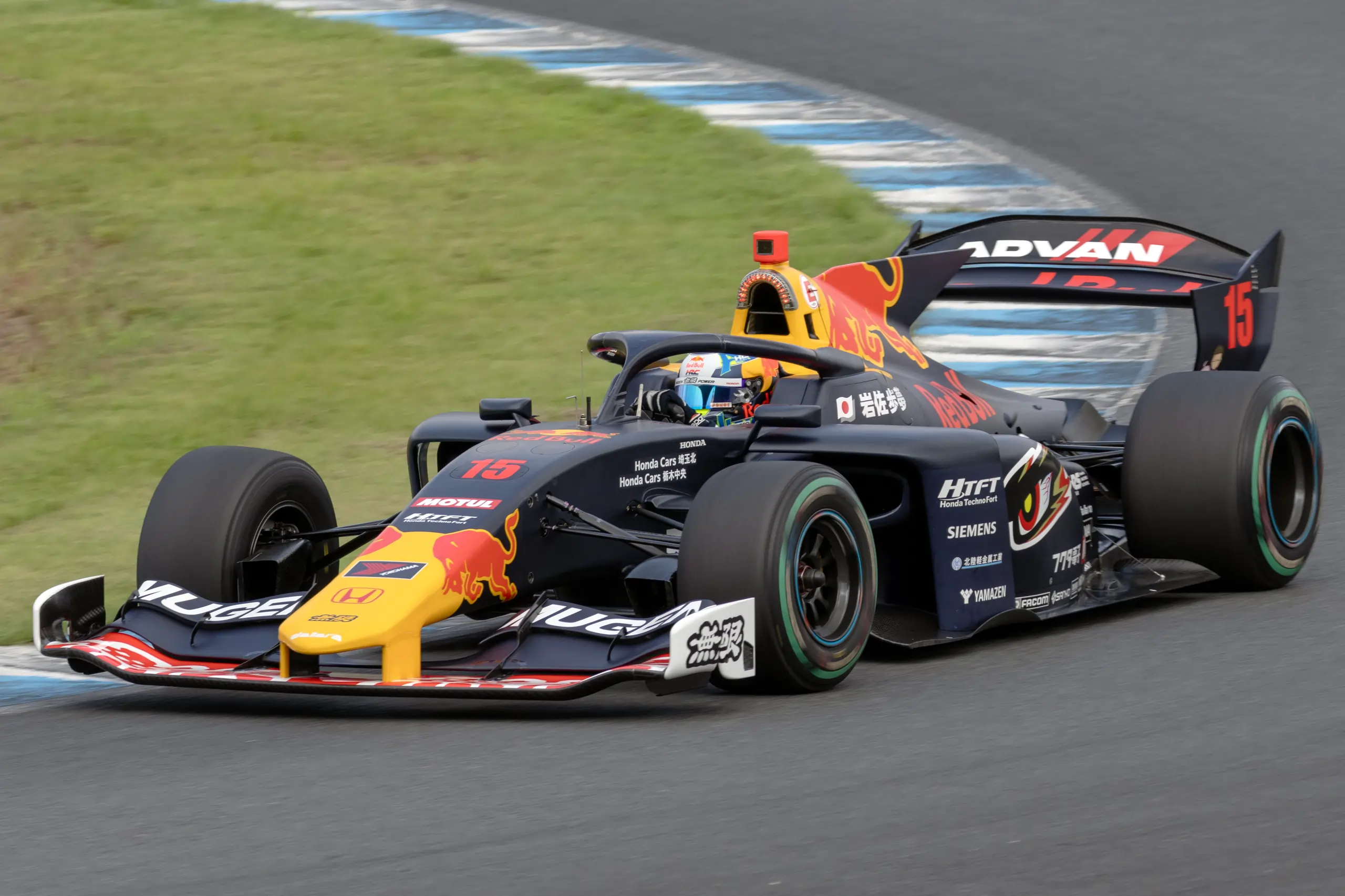
The Dallara SF23
The SF23 was introduced for the 2023 season. It was developed by Italian racing-car manufacturer Dallara as an evolution of the SF19 used between 2019 and 2022.
The basic philosophy is described as quick and light. The car combines low mass, substantial aerodynamic downforce and more than 550 bhp without the weight of a hybrid system.
The driver sits inside a carbon-composite survival cell. The engine is mounted behind the cockpit and acts as part of the structural connection between the monocoque and the transmission.
The SF23 is approximately 5,235 mm long, 1,920 mm wide including the tyres and 960 mm high. Its minimum weight is 677 kg with the driver.
These dimensions make it longer than many junior formula cars while remaining considerably lighter than modern Formula 1 and Formula 2 machinery.
SF23 technical specifications
| Area | Current specification | What it means |
|---|---|---|
| Chassis | Dallara SF23 | Every competitor uses the same basic survival cell and aerodynamic package. |
| Length | 5,235 mm | The long wheelbase and body provide high-speed stability. |
| Width | Approximately 1,920 mm including tyres | The wide track supports strong mechanical and aerodynamic grip. |
| Height | 960 mm | The low body reduces frontal area and centre-of-gravity height. |
| Minimum weight | 677 kg with driver | Ballast is required if the legal car-and-driver combination is too light. |
| Engine | Honda or Toyota 2.0-litre direct-injection turbo inline-four | Two manufacturers compete within one engine formula. |
| Power | At least 405 kW or approximately 550 PS | The power-to-weight ratio is one of the strongest in circuit racing. |
| Transmission | Ricardo six-speed sequential paddle-shift gearbox | The driver changes gear using paddles behind the steering wheel. |
| Differential | Mechanical limited-slip differential | There is no electronically active differential controlling the rear wheels. |
| Brakes | Brembo carbon ventilated discs | Carbon brakes provide strong stopping performance at high temperature. |
| Tyres | Yokohama ADVAN control tyres | Every team uses tyres supplied from the same official specification. |
A common chassis does not mean a simple car
The SF23 is a specification chassis, but it remains a sophisticated high-downforce racing car. The body contains a shaped floor, diffuser, front wing, rear wing and airflow-management surfaces.
Teams cannot redesign those components. Each part must conform to the approved Dallara specification, and unauthorised modifications intended to alter airflow are prohibited.
Engineers can still adjust the legal aerodynamic settings. Front- and rear-wing configurations are selected to balance cornering grip against straight-line drag.
A larger wing angle generally increases downforce but also increases air resistance. A lower-drag setup can improve speed on a straight while reducing braking and cornering stability.
Because the bodywork is common, the advantage comes from finding the best complete compromise rather than creating a new aerodynamic concept.
How the SF23 was designed to improve racing
The SF23’s aerodynamic package was developed to reduce the amount of damaging turbulent air left behind the car.
A single-seater normally creates a disturbed wake that reduces the downforce available to a following vehicle. The second driver can lose front grip and become unable to remain close through a fast corner.
Dallara revised the SF23’s wings, floor and body surfaces so that more of its wake is directed away from the areas used by a following car.
The dirty-air problem has not disappeared, but the objective is to make the car less sensitive when following and place greater emphasis on driver performance.
Teams are not permitted to develop private aerodynamic upgrades. Any category-wide bodywork revision must be introduced through the official technical process.
Bio-composite bodywork
Selected SF23 body panels use bio-composite material supplied through Bcomp. The material includes natural flax fibres and other lower-impact components.
The panels are designed to provide stiffness and mass comparable with conventional carbon-composite parts while reducing environmental impact during raw-material production and manufacturing.
Super Formula states that the material and production process reduce carbon-dioxide emissions by approximately 75% compared with the conventional construction being replaced.
The bio-composite is primarily used for replaceable bodywork rather than the central survival cell. The monocoque must continue to satisfy the high structural requirements expected of a top-level formula car.
The technology also gives manufacturers and suppliers an opportunity to evaluate natural-fibre composites under vibration, heat, impact and aerodynamic loads.
Honda and Toyota engines
Honda and Toyota supply engines to the championship. The current Honda unit is identified as the M-TEC HR-417E, while Toyota-powered teams use the TGR-D TRD01F.
Both are 2.0-litre inline-four engines with direct fuel injection and a single Garrett turbocharger. The minimum engine weight is approximately 85 kg.
The engines belong to Japan’s Nippon Race Engine, or NRE, concept. NRE was designed around compact turbocharged engines and controlled fuel flow rather than unrestricted capacity or boost.
Honda and Toyota do not use identical internal designs. Each manufacturer develops its own combustion system, cylinder head, turbo installation, cooling, engine maps and supporting systems within the regulations.
The two engines are intended to deliver comparable overall performance, but differences in response, drivability and efficiency can remain.
Honda vs Toyota engine regulations
| Area | Honda | Toyota |
|---|---|---|
| Current engine | M-TEC HR-417E | TGR-D TRD01F |
| Capacity | 2,000 cc | 2,000 cc |
| Configuration | Inline-four | Inline-four |
| Fuel system | Direct injection | Direct injection |
| Forced induction | Single Garrett turbocharger | Single Garrett turbocharger |
| Published output | At least 405 kW or approximately 550 PS | At least 405 kW or approximately 550 PS |
| Performance control | Fuel-flow restriction | Fuel-flow restriction |
| Team development | Teams cannot independently modify the engine internals | Teams cannot independently modify the engine internals |
The regulations aim to balance the engine manufacturers without forcing them to use one identical power unit. A particular circuit or setup may still suit the characteristics of one engine more than the other.
How the fuel-flow restrictor controls power
The NRE formula controls engine output through a physical fuel-flow restrictor. The restrictor limits the mass of fuel that can reach the engine during a given period.
Once the maximum flow has been reached, increasing engine speed does not provide an unlimited increase in fuel for combustion. This places a ceiling on the energy available and therefore on maximum power.
The method encourages manufacturers to improve thermal efficiency. An engine that extracts more useful work from the permitted fuel can deliver stronger performance without exceeding the flow limit.
It also allows two independently designed engines to compete under a common energy restriction rather than requiring identical internal components.
The restrictors are controlled by the championship. Teams cannot enlarge, alter or replace them with private equipment.
The Overtake System
Super Formula uses an Overtake System, normally shortened to OTS. The driver activates it with a button on the steering wheel.
When OTS is operating, the engine is temporarily allowed a greater fuel-flow rate. The additional fuel increases combustion energy and engine power.
Each driver receives a total of 200 seconds of OTS use during a race. The driver can divide that allowance into long or short activations rather than using it all at once.
After an activation, the system enters an event-specific lockout period before it can be used again. The lockout prevents a driver from repeatedly pressing the button in immediate succession.
The required waiting time is set according to the circuit and event regulations. Longer tracks can use a different lockout period from shorter circuits.
OTS is not the same as DRS
Super Formula does not use Formula 1-style Drag Reduction System bodywork. The rear wing remains fixed when OTS is activated.
The performance increase comes from the engine rather than from opening a wing flap to reduce drag.
OTS can be used to attack, defend or improve lap time. The driver does not need to be within one second of another car or wait for a designated detection point.
This freedom creates several strategic choices. A driver can use OTS to complete an overtake, prevent a rival from passing or produce a fast in-lap before a pit stop.
Using too much early in the race can leave the driver vulnerable during the closing laps. Saving all of it can also be a mistake if traffic prevents the driver from gaining track position.
| Area | Super Formula OTS | Traditional Formula 1 DRS |
|---|---|---|
| Performance method | Temporarily increases permitted engine fuel flow | Opens part of the rear wing to reduce drag |
| Total race use | 200 seconds | Not managed through one total time allowance |
| Proximity requirement | No one-second requirement | Historically depended on the gap at a detection point |
| Defensive use | Permitted | Historically unavailable to a leading defending car unless it was also following another vehicle |
| Wing movement | None | Rear-wing flap moved into a lower-drag position |
The OTS indicator light
A light assembly is mounted above and behind the driver. It allows observers to see an approximate indication of the car’s remaining OTS allowance.
A green display indicates that a meaningful quantity of OTS remains. The display changes to red as the remaining allowance approaches its final seconds and turns off when no time remains.
The light no longer gives a simple live signal proving that the driver is using OTS at that exact moment. A rival therefore cannot always react by copying the activation immediately.
Teams, viewers and commentators can follow more detailed information through official timing and the SFgo platform.
Hiding the exact activation from the driver ahead increases the strategic value of choosing when to deploy the system.
Six-speed paddle-shift transmission
Every SF23 uses a Ricardo six-speed sequential transmission with one reverse gear. The driver changes gear using paddles behind the steering wheel.
An electronic and pneumatic system coordinates the shift. During an upshift, engine torque is reduced briefly while the next gear engages.
The driver does not use a conventional clutch pedal during normal racing shifts. The clutch is mainly required when leaving the pits, performing a standing start or recovering from very low speed.
Teams cannot install a different gearbox. The casing, fundamental internal design and number of ratios are controlled.
The mechanical limited-slip differential influences how torque is distributed between the rear wheels. Legal differential settings can affect corner entry, rotation and acceleration traction.
Yokohama control tyres
Yokohama Rubber is the exclusive tyre supplier. Every car uses specially developed ADVAN racing tyres.
The front tyre is sized at 270/620R13, while the rear is 360/620R13. The wide rear tyre must transfer more than 550 bhp through two driven wheels.
Only one dry-weather compound is normally supplied. This differs from championships that offer soft, medium and hard slicks during the same weekend.
A grooved wet-weather tyre is provided for rain. It can be used when the session or race is declared wet under the sporting regulations.
Using one dry specification prevents teams from gaining track position simply by selecting a different compound. Performance instead depends on pressure, temperature, setup and driver management.
Sustainable tyre materials
Yokohama’s 2026 control tyres contain an average of approximately 46% renewable and recycled raw materials across the dry and wet range.
The materials include plant-derived oils, recycled rubber, recycled steel cord and silica produced from rice-husk ash.
The objective is to reduce dependence on newly extracted raw materials while maintaining the grip, durability and consistency required by a high-downforce racing car.
The tyres are also used as a development platform. Information gathered under racing loads can contribute to future road-tyre materials and production processes.
Yokohama’s exclusive supply agreement currently extends through the 2030 Super Formula season.
How tyre temperature affects the SF23
A racing slick produces its best grip within a limited temperature window. When the tyre is too cold, the rubber is less flexible and provides less adhesion.
A driver leaving the pits must generate temperature through braking, acceleration and cornering. Aggressive preparation can warm the tyre quickly but may also damage its surface.
Excessive temperature causes the rubber to lose performance and degrade more rapidly. Sliding the car or spinning the rear tyres increases that heat.
Because Super Formula uses one dry compound, teams cannot solve a temperature problem by selecting a permanently softer or harder tyre. They must change the suspension, pressures, aerodynamics and driving approach.
The way a team prepares and manages the common tyre is therefore one of the largest remaining performance differences.
Suspension setup
The SF23 uses a controlled Dallara suspension layout, but teams have extensive freedom to adjust its behaviour.
Ride height determines the distance between the car and the circuit. A lower car can improve aerodynamic performance but may strike the track surface over bumps and kerbs.
Camber describes the angle of the tyre relative to vertical. Negative camber can increase cornering grip but concentrate load and temperature on the tyre’s inner edge.
Toe describes whether the wheels point slightly inward or outward. Small changes affect steering response, stability, tyre temperature and straight-line resistance.
Springs, dampers and anti-roll bars control how the car moves under braking, acceleration and cornering. A stiff setup can give precise responses on a smooth track but become difficult over bumps.
A softer setup can improve mechanical grip while allowing the aerodynamic platform to move more. The best solution depends on the circuit and driver.
What can Super Formula teams change?
| Area | What teams can adjust | What teams cannot do |
|---|---|---|
| Chassis | Prepare, repair and set up the approved SF23 | Design a different monocoque or alter its structure |
| Aerodynamics | Use legal front- and rear-wing settings | Create new wings, floors, diffusers or bodywork |
| Suspension | Springs, dampers, ride height, anti-roll bars and approved geometry | Change the fundamental Dallara suspension layout |
| Wheel alignment | Camber and toe within permitted ranges | Use unauthorised mounting points or geometry |
| Differential | Legal mechanical differential settings | Install an active electronic differential |
| Engine | Work with Honda or Toyota on approved operation and calibration | Open or independently modify the supplied engine |
| Transmission | Prepare and operate the approved system | Install a different gearbox or add extra forward ratios |
| Tyres | Set legal pressures and manage temperature through setup and driving | Use a different manufacturer or chemical tyre treatment |
| Brakes | Adjust brake balance and manage cooling | Replace the approved system with an independent design |
Carbon brakes
The SF23 uses Brembo carbon ventilated brake discs at the front and rear. Carbon brakes combine low mass with the ability to tolerate extremely high temperatures.
The braking system works best when the discs and pads have reached their operating window. Cold carbon brakes can provide less initial response.
Repeated heavy braking can push temperatures too high. Teams use approved cooling configurations to balance heat retention against overheating.
The driver can adjust brake balance from the cockpit. Moving the balance forward generally improves stability but increases the risk of locking a front tyre.
Moving it rearward can help the car rotate into a corner but may make the rear axle unstable.
Anti-lock braking is not used. The driver must apply the correct pressure without electronic ABS intervention.
Low-carbon E10 racing fuel
The 2026 championship introduced a low-carbon E10 gasoline developed through cooperation between Japan Race Promotion, ENEOS and the raBit next-generation fuel research organisation.
E10 means that the gasoline contains approximately 10% ethanol. The ethanol used for the Super Formula programme is produced domestically from cellulose-based material rather than conventional food crops.
The fuel is designed to operate under the heat, vibration and fuel-flow demands of a high-output racing engine.
Changing the fuel affects combustion, energy content, injection requirements and engine calibration. Honda and Toyota therefore completed development testing before its competitive introduction.
The fuel is one part of the SF23 sustainability programme alongside bio-composite body panels and Yokohama tyres containing renewable and recycled materials.
Engine allocations
A driver can normally use no more than two engines during the championship season without receiving a regulatory penalty.
Engines are recorded and controlled so teams cannot install unlimited fresh units for qualifying or individual races.
Using an additional engine can result in a grid-position penalty, including a possible 10-place drop under the applicable regulations.
The limit requires Honda, Toyota and the teams to balance performance against durability. An aggressive engine setting is of little value when it creates a failure or forces an early replacement.
Reliability is particularly important during double-header weekends, when one engine may complete practice, qualifying and two races over a short period.
Safety regulations
The driver sits inside a carbon-composite survival cell designed to withstand major frontal, side and rollover impacts.
The cockpit is protected by a titanium halo. The structure helps prevent large objects, wheels or another car from striking the driver’s head.
Front, rear and side crash structures absorb energy before it reaches the central monocoque. Wheel tethers reduce the chance of a detached wheel travelling away from the car.
The driver wears an approved helmet, fire-resistant clothing, gloves, boots, harness and frontal-head-restraint system.
An onboard fire-extinguisher system and electrical-isolation controls can be activated by the driver or marshals.
Damaged safety structures must be inspected and repaired according to the approved procedures before the car returns to competition.
Super Formula vs Formula 1 vs Formula 2
| Area | Super Formula | Formula 1 | Formula 2 |
|---|---|---|---|
| Chassis | Common Dallara SF23 | Each constructor designs its own chassis | Common Dallara chassis |
| Engine competition | Honda and Toyota | Several constructor power-unit programmes | One common engine specification |
| Powertrain | 2.0-litre turbocharged combustion engine | Turbocharged hybrid power unit | Common turbocharged combustion engine |
| Hybrid system | No | Yes | No |
| Temporary overtaking power | Fuel-flow-based OTS | Electrical deployment and current FIA overtaking systems | Championship-controlled overtaking assistance |
| Aerodynamic development | Common bodywork with setup adjustments | Constructor-designed aerodynamics | Common bodywork with setup adjustments |
| Tyre supplier | Yokohama | Pirelli | Pirelli |
| Main engineering contest | Setup, engine operation, tyres and strategy | Design, development, power units and execution | Setup, tyres and driver development |
Super Formula is often compared with Formula 2 because both use Dallara specification chassis. The Honda and Toyota engine contest, low minimum weight and high power place Super Formula closer to a top-level professional formula than a conventional junior series.
Why identical SF23 chassis do not produce identical lap times
Every driver begins with the same basic chassis, but setup can transform the way the car behaves.
A low-downforce configuration can provide strong straight-line speed while making the car difficult through fast corners. A high-downforce setup can gain time in corners but leave the driver vulnerable on a long straight.
Suspension choices affect how quickly the tyres reach their operating temperature and how consistently they perform during a race.
Honda and Toyota engines operate within the same performance framework, but they can retain different response, cooling and drivability characteristics.
Driver style is another major variable. One driver may prefer a responsive front axle, while another needs rear stability before applying the throttle.
Pit timing, tyre management, OTS deployment and traffic can determine the result even when two cars have similar underlying pace.
Why Super Formula is so fast
The SF23 combines at least 550 bhp with a minimum car-and-driver weight of only 677 kg.
There is no heavy hybrid battery or road-car-based structure. The chassis is designed specifically for circuit racing and carries only the systems required for performance and safety.
Large wings and a developed floor generate substantial downforce. At high speed, the tyres are pressed into the circuit with far more force than the car’s static weight alone would create.
Carbon brakes allow the driver to brake late, while wide slick tyres provide strong mechanical grip.
Because the vehicle is light, changes in steering, braking and throttle produce immediate reactions. This makes the car extremely fast but also physically and technically demanding.
Super Formula car regulations: the simple explanation
Every Super Formula driver uses the Dallara SF23 chassis, common aerodynamic bodywork, a Ricardo six-speed gearbox, Brembo carbon brakes and Yokohama control tyres.
Teams choose between Honda’s M-TEC HR-417E engine and Toyota’s TGR-D TRD01F. Both are 2.0-litre direct-injection turbocharged inline-four engines producing at least 405 kW.
Engine output is controlled through a fuel-flow restrictor. The Overtake System temporarily increases the permitted fuel flow, giving every driver a total of 200 seconds of additional performance during a race.
OTS does not open the rear wing and does not require the driver to be within a specified distance of another car.
The car must weigh at least 677 kg with its driver. Teams cannot design new chassis or aerodynamic parts, but they can adjust wings, suspension, alignment, differential settings and brake balance.
Yokohama supplies one main dry compound and a separate wet-weather tyre. The 2026 tyres contain approximately 46% renewable and recycled raw materials on average.
The 2026 season also uses low-carbon E10 gasoline containing domestically produced cellulose-based ethanol.
The regulations therefore create a closely controlled chassis competition without eliminating engineering. Teams and drivers still have to extract performance through setup, tyre management, engine operation, OTS strategy and race execution.
Technical information is based on official Super Formula, Honda, Toyota, M-TEC, ENEOS and Yokohama material.
Related Articles
|
F1, F2, F3 & F1 Academy: Cars Compared
|
|
Formula 1 reaches 50 years since a woman last raced in a Grand Prix
|
|
F1 & Formula E: Comparing The Differences Between Each Car
|
|
Formula 1 Tyre Compounds Explained
|

|
IndyCar arrives at a brand-new Canadian street circuit
|
|
|
Formula E signs global Disney+ and ESPN streaming deal for GEN4 era
|

|
NASCAR Explained to an F1 Fan
|
|
|
Porsche Secures Back-To-Back Formula E Manufacturers’ Titles
|
Related series

|
Super Formula
|