
Tags:
Supercars: Car Regulations Explained
How Gen3 rules combine common chassis components, three different V8 engines and tightly controlled parity to create Australia’s premier touring cars.

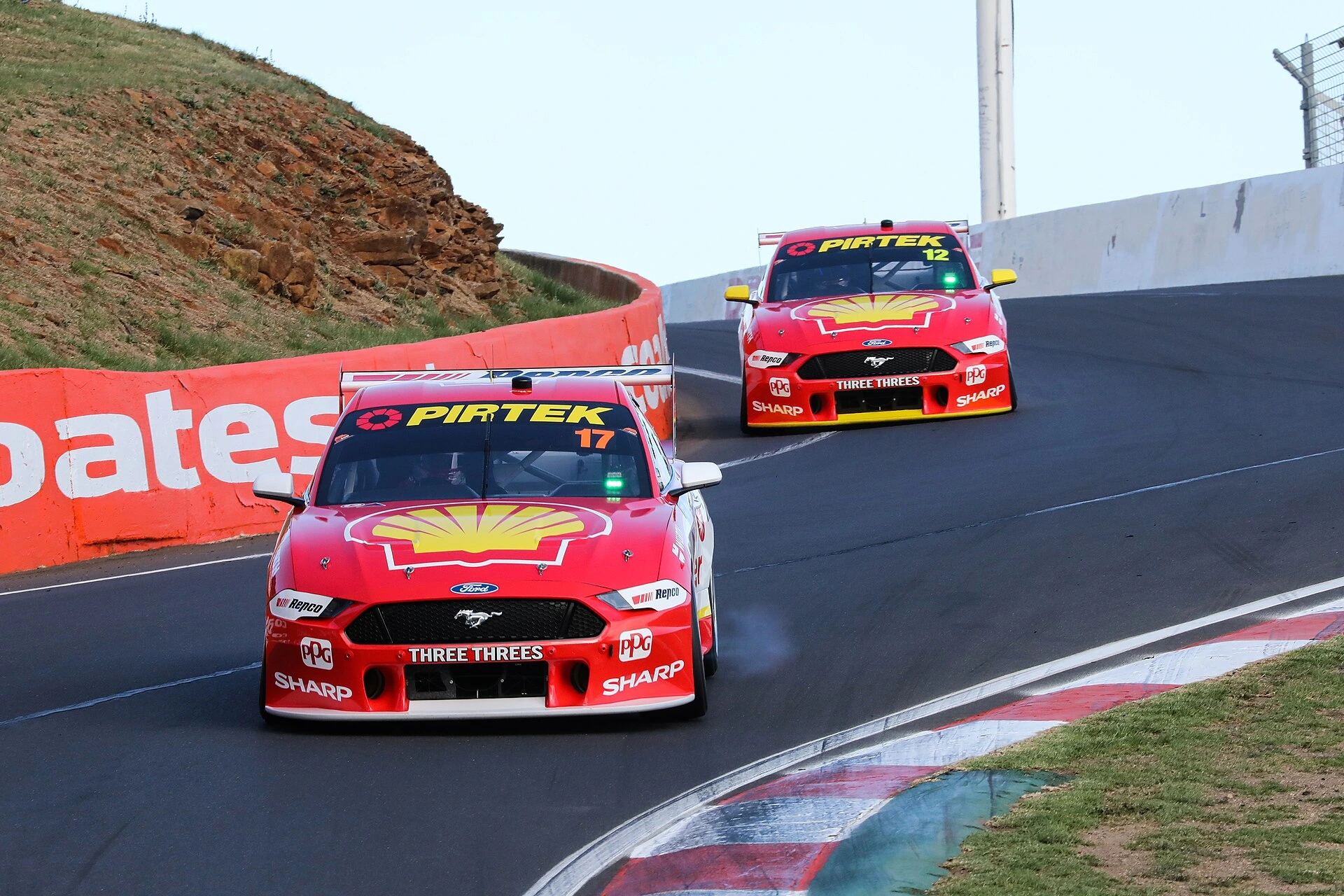
What are the Supercars Gen3 regulations designed to do?
The current Gen3 Supercars regulations were introduced for the 2023 season. They replaced the previous Gen2 machinery with cars designed to look more like their production counterparts, cost less to operate and produce closer racing.
Supercars is not a completely open constructor championship like Formula 1. A team cannot design its own survival cell, gearbox, suspension geometry or aerodynamic package. Many of the most important components are common across the field.
It is not a completely identical one-make championship either. Ford, Chevrolet and Toyota use different body shapes and different V8 engines. Each manufacturer works through an appointed homologation team that helps develop and maintain its approved vehicle specification.
The regulations therefore create a controlled engineering competition. Manufacturers retain visual identity and some mechanical character, but their cars must operate inside closely matched aerodynamic and engine-performance windows.
Once the vehicle specifications have been homologated, race teams concentrate on setup, data analysis, mechanical preparation, tyre management, pit stops and driver performance rather than creating major new parts throughout the season.
The three current Gen3 Supercars
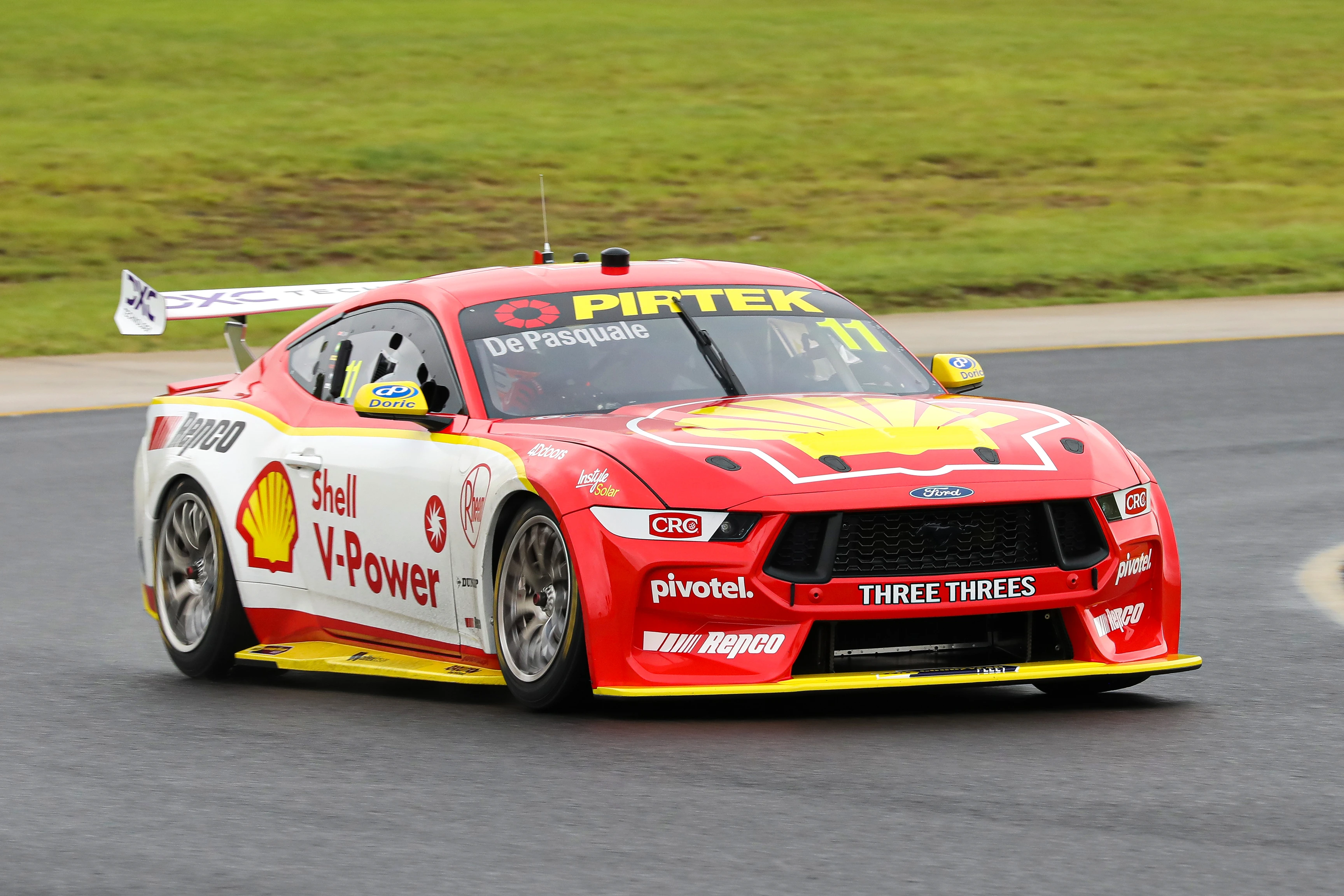
A Gen3 Ford Mustang during the 2023 Supercars test at Sydney Motorsport Park.
The 2026 championship contains three approved Gen3 models: the Ford Mustang GT, Chevrolet Camaro ZL1 and Toyota GR Supra.
Ford and Chevrolet introduced their Gen3 cars in 2023. The Mustang represents Ford’s globally recognised production coupe, while the Camaro replaced the Holden Commodore as General Motors’ Supercars model.
Toyota joined the championship with the GR Supra in 2026. Its arrival introduced a third engine design and required a fresh programme of wind-tunnel, dynamometer and circuit testing to place the car inside the existing parity system.
The three vehicles appear very different from the outside, but their published performance specifications are closely aligned. Supercars lists each model at approximately 600 hp, 1,350 kg, a maximum 7,500 rpm and a top speed of roughly 300 km/h.
| Model | Engine | Valve arrangement | Published power | 2026 homologation team |
|---|---|---|---|---|
| Ford Mustang GT | 5.4-litre Ford Coyote V8 | Quad camshaft, four valves per cylinder | Approximately 600 hp | Triple Eight Race Engineering |
| Chevrolet Camaro ZL1 | 5.7-litre General Motors V8 | Single camshaft, two valves per cylinder | Approximately 600 hp | Team 18 |
| Toyota GR Supra | 5.2-litre Toyota 2UR-GSE-based V8 | Quad camshaft with hydraulic variable valve timing | Approximately 600 hp | Walkinshaw TWG Racing |
The cars have different engine capacities and architectures, but engine and vehicle parity measures are used to place them within the same competitive window.
How closely related are Supercars to road cars?
Gen3 cars are designed to look substantially more like their production counterparts than the previous generation. Key areas such as the doors, roof, windows and bonnet follow the proportions and appearance of the relevant road model.
The resemblance does not mean a Supercar is a modified production vehicle. Underneath the outer panels is a purpose-built racing structure containing a control chassis, roll cage, racing suspension, transaxle gearbox and safety fuel cell.
The production Mustang, Camaro and Supra also use different platforms and dimensions. The Gen3 chassis was designed to accept a wider range of coupe body shapes while maintaining common suspension and mechanical mounting points.
The engines retain a manufacturer connection, but they are specialised racing units. A Supercars GR Supra does not use the turbocharged six-cylinder engine fitted to the production Supra, and the Camaro and Mustang engines are also prepared specifically for endurance racing.
The simplest way to understand the road-car connection is that the production model provides the appearance and brand identity, while the approved Gen3 package provides the racing structure underneath it.
The common Gen3 chassis
Every current Supercar is built around the same basic control-chassis design. The central structure contains a substantial steel roll cage that protects the driver and provides mounting points for the front and rear mechanical assemblies.
The smaller Gen3 chassis was created to accommodate a broader range of production-car shapes. This was important because the previous platform had been designed primarily around larger four-door saloons.
Common mounting points help ensure that each manufacturer begins with similar suspension geometry, wheelbase and weight-distribution possibilities. A manufacturer cannot move the engine or suspension to an unrestricted position simply to gain performance.
The chassis also controls the position of important safety systems, including the seat, harness, side-impact protection and fuel cell. Repairs must follow approved procedures so that the structure retains its intended strength.
Teams can transfer an existing chassis between manufacturers by replacing the engine, body panels and other model-specific components. This was demonstrated when several existing Ford and Chevrolet chassis were converted into Toyota GR Supras for 2026.
The naturally aspirated V8 engines
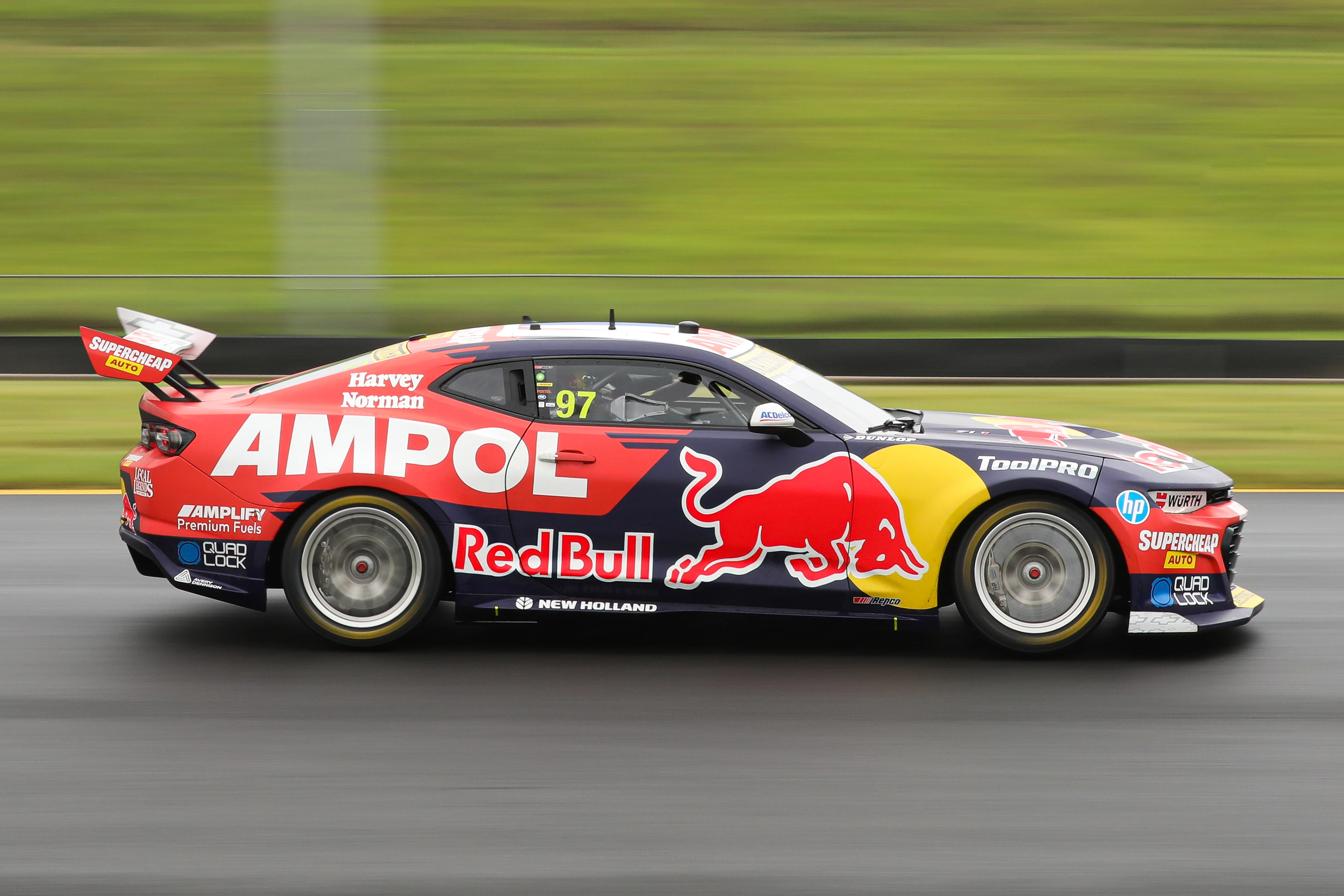
A Gen3 Chevrolet Camaro during the 2023 Supercars test at Sydney Motorsport Park.
Every Gen3 Supercar uses a front-mounted, naturally aspirated V8. There are no turbochargers, superchargers or hybrid motors contributing additional power.
The Ford, Chevrolet and Toyota engines do not share one basic design. Ford and Toyota use quad-camshaft layouts with four valves per cylinder, while Chevrolet uses a traditional pushrod-style arrangement with a single camshaft and two valves per cylinder.
Engine capacity is permitted between 5.0 and 5.7 litres. Ford uses a 5.4-litre Coyote-based unit, Chevrolet uses a 5.7-litre engine and Toyota uses a 5.2-litre development of its 2UR-GSE V8.
The different architectures naturally produce different torque curves, engine-braking characteristics, vibration and packaging requirements. The parity process is intended to control the overall performance without making each engine mechanically identical.
All three engines operate on the category’s control fuel and within prescribed power and engine-speed limits. The published specification lists a maximum of 7,500 rpm and approximately 600 hp.
The engines must survive much longer distances than an unrestricted qualifying engine. Reliability, fuel efficiency and rebuild costs are central parts of the regulations because teams contest sprint races as well as long events such as the Bathurst 1000.
Why different engine sizes can race together
Matching three different V8 engines requires more than comparing their peak horsepower figures. An engine with strong low-speed torque can accelerate quickly out of slower corners even if its maximum output is similar to that of a rival.
Supercars therefore evaluates performance across a wider operating range. Static and transient dynamometer testing measures how an engine accelerates, responds to the throttle and delivers torque through the drivetrain.
Torque sensors can also be installed in cars to measure the powertrain’s output in real operating conditions. The information can then be compared with the controlled dynamometer results.
Officials can manage areas such as throttle response, torque delivery, engine calibration, shift recovery and other approved parameters to bring the different units into the intended window.
Parity does not mean the engines must sound or feel identical. A Chevrolet pushrod V8 can retain a different character from a Ford or Toyota quad-cam engine. The objective is to prevent one design from holding a meaningful overall performance advantage.
The six-speed sequential transaxle
Every Gen3 car sends power to the rear wheels through a six-speed sequential transaxle. The gearbox is positioned at the rear of the car rather than being attached directly behind the engine at the front.
Placing the transmission at the rear helps distribute mass between the axles. A torque tube and driveshaft carry power from the engine to the transaxle.
The driver changes gear with a mechanical sequential lever rather than steering-wheel paddles. Pulling or pushing the lever selects the next ratio in order.
Supercars does not use automatic gear changes. The driver must select the correct gear and coordinate the shift with the throttle and braking process.
Teams cannot install a self-designed gearbox or choose a completely different transmission concept. Gear ratios, internal components and servicing requirements are controlled through the category regulations.
The transaxle also contains the differential, which affects how torque is distributed between the rear wheels. Permitted differential settings can influence corner entry, rotation and traction.
No traction control, ABS or paddle shifting
Modern road cars use electronic systems to help drivers control braking, wheelspin and stability. Gen3 Supercars deliberately remove many of those aids.
There is no traction control. The driver must control rear-wheel spin with the throttle, particularly on worn tyres or a wet circuit.
There is also no anti-lock braking system. Braking too aggressively can lock a tyre, reduce steering control and create a flat spot in the rubber.
Gear changes are made with the sequential lever rather than automatic paddles. The steering is power assisted, but the driver still has to manage a heavy touring car through bumps, kerbs and close contact.
Removing these systems places more responsibility on the driver. Smooth throttle application, controlled braking and accurate downshifts can create meaningful lap-time and tyre-life differences.
Aerodynamics and the Gen3 parity process
Gen3 cars produce considerably less aerodynamic downforce than the previous generation. The reduction was intended to make the cars less dependent on clean air and easier to follow closely.
Each manufacturer has its own approved bodywork, including the front splitter, undertray, side skirts and rear wing. Those parts must reflect the identity of the production model while producing performance comparable with the other cars.
Supercars uses full-scale wind-tunnel testing to measure downforce and drag. The measurements are combined into a defined aerodynamic parity window sometimes described as the parity box.
The process also studies aerodynamic sensitivity. Two cars may produce the same total downforce at one ride height but react differently as the nose rises, falls or moves through a corner.
For 2026, the Mustang, Camaro and GR Supra were tested together at the Windshear facility in the United States. The final homologated specifications aligned all three cars at a 10-degree rear-wing angle while also addressing differences in ride-height sensitivity.
Race teams cannot introduce their own aerodynamic upgrades. Changes to a model’s approved specification must pass through the official homologation and parity process.
What can teams change?
Although the major designs are controlled, teams have a wide range of legal setup adjustments. These allow engineers to adapt the car to fast permanent circuits, narrow street tracks, changing weather and individual driver preferences.
| Area | What teams can adjust | What teams cannot do |
|---|---|---|
| Aerodynamics | Use permitted settings and prepare the homologated components | Design new wings, splitters, floors or body panels |
| Suspension | Adjust ride height, springs, dampers and anti-roll bars | Create different basic suspension geometry or mounting points |
| Wheel alignment | Set camber and toe within the legal ranges | Use unauthorised suspension components |
| Differential | Select approved preload and locking characteristics | Install a different transaxle or differential design |
| Engine | Operate approved calibrations and manage temperature and reliability | Modify sealed internals or exceed the homologated specification |
| Cooling | Configure approved openings and ducting for the conditions | Create unauthorised aerodynamic cooling devices |
| Tyres | Set legal pressures and manage temperature through driving | Use tyre blankets, chemical treatments or another manufacturer |
Suspension setup
Gen3 cars use double-wishbone independent suspension. The common architecture helps ensure that the Mustang, Camaro and Supra begin with comparable mechanical possibilities.
Ride height changes the distance between the car and the circuit. Running lower can improve the centre of gravity and aerodynamic performance, but the floor must still clear bumps and kerbs.
Camber describes the angle of a wheel when viewed from the front. Negative camber can improve cornering grip, but excessive camber may reduce braking performance and overwork the inner edge of the tyre.
Toe describes whether the wheels point slightly inward or outward. Small changes can affect steering response, stability, tyre temperature and straight-line drag.
Springs and anti-roll bars control how weight moves around the car. A stiff setup may produce a sharp response on a smooth track but struggle over bumps. A softer car can generate mechanical grip while moving more under braking and acceleration.
Dampers control the speed of suspension movement. Their preparation and adjustment are major areas of engineering because they influence kerb behaviour, tyre contact and the stability of the aerodynamic platform.
Weight and centre-of-gravity controls
The published 2026 Gen3 specification lists a weight of approximately 1,350 kg. The measured figure and included fluids or driver equipment are defined precisely by the current Operations Manual.
Minimum weight prevents teams from spending heavily to manufacture increasingly light components. A car below the legal limit must carry approved ballast in controlled locations.
Total weight is only part of the performance equation. The position of that mass affects braking, cornering and tyre use, so Supercars also studies the cars’ centre-of-gravity height and front-to-rear distribution.
If one model has an unavoidable centre-of-gravity advantage because of its engine architecture or body installation, controlled ballast placement can be used to align it more closely with the others.
The driver’s weight is also considered. Ballast procedures prevent a particularly light driver from gaining an uncontrolled advantage while ensuring a heavier driver is not excessively penalised.
Cars are weighed during race weekends, and officials can inspect the location and quantity of ballast. A vehicle that finishes below the minimum can be excluded from the results.
Dunlop control tyres
Dunlop is the exclusive tyre supplier for the championship. All cars use the same basic Dunlop Sport Maxx control tyres, preventing manufacturers and teams from developing private tyre programmes.
The current dry-weather range contains Soft and Super Soft specifications. A separate grooved Wet Weather tyre is available when the circuit contains sufficient water.
The Super Soft generally offers stronger immediate grip but wears more quickly. The Soft is designed to provide greater durability and consistency over a longer stint.
Unlike Formula 1, only one dry compound is used in a particular race. Different compounds can still be assigned to separate races during the same weekend, forcing teams to adapt their setups quickly.
| Tyre | Design | Main advantage | Main challenge |
|---|---|---|---|
| Soft | Durable dry-weather specification | Consistent performance over a longer stint | May take longer to reach its strongest operating window |
| Super Soft | Higher-grip dry-weather specification | Strong qualifying and early-stint performance | Greater heat sensitivity and degradation |
| Wet Weather | Grooved tread designed to disperse water | Reduces aquaplaning on a wet circuit | Can overheat rapidly as the racing line dries |
Tyre-heating devices are prohibited. Drivers must build temperature through braking, acceleration and cornering after leaving the pits.
Tyre pressure is tightly controlled for safety. Running too low can produce additional grip for a short period but places excessive stress on the sidewall and internal construction.
Because every car uses the same tyres, managing their temperature and degradation is one of the clearest ways for a driver and engineer to outperform their rivals.
Brakes and brake balance
Supercars use powerful racing brakes designed to slow a 1,350 kg car repeatedly from speeds approaching 300 km/h.
The major brake components are controlled, preventing individual teams from developing unrestricted callipers, discs and pad materials.
The driver can adjust brake balance from the cockpit. Moving the balance forward generally improves stability but increases the chance of locking a front tyre.
Moving the balance rearward can help the car rotate into a corner, but excessive rear braking may make the car unstable or lock a rear wheel.
Brake cooling is another important setup consideration. Street circuits with frequent heavy stops require substantial airflow, while excessive cooling may prevent the brakes from reaching their ideal temperature.
Long-distance races create an additional durability challenge. At Bathurst, teams must manage the brakes through repeated stops from high speed while also preparing for possible pad or rotor servicing during pit stops.
Renewable control fuel
For 2026, the championship introduced bp Ultimate Supercars Racing fuel. The control blend is made from 85% ethanol and 15% bio-gasoline sourced from certified renewable feedstocks.
The fuel is used by every manufacturer. A team cannot create its own blend to gain additional power, improve fuel economy or change the engine’s combustion characteristics.
The high ethanol content provides strong resistance to knock, which is valuable in a high-performance naturally aspirated engine. It also requires the fuel system, engine calibration and materials to be designed for the properties of the blend.
The term renewable does not mean the engines produce no exhaust emissions while racing. It refers to the source of the fuel’s components rather than claiming that combustion itself is emission-free.
The standard published fuel-cell capacity is approximately 135 litres. Event rules can restrict usable capacity, with the 2026 regulations reducing it to 121 litres for the Enduro Cup and Finals events.
Fuel capacity and pit-stop strategy
Fuel strategy is a major part of Supercars because race distances range from short sprints to the 1,000 km Bathurst enduro.
At many sprint events, compulsory pit-stop rules require teams to change tyres and add a specified amount of fuel. Drivers can gain track position by taking less fuel at one stop and completing a longer fill later.
Longer races use traditional refuelling towers. The speed of the fuel flow means tyre changes and driver changes can often be completed while refuelling is still taking place.
Reducing the permitted fuel capacity for endurance and Finals races shortens the maximum stint length. This creates more pit stops and prevents teams from completing unusually long fuel-saving runs.
A Safety Car can transform the strategy. Stopping while the field is travelling slowly may reduce the relative time lost, but several teammates arriving together can cause a costly queue in the pit lane.
Fuel saving is performed through throttle management, earlier gear changes and lifting before braking zones. Saving enough fuel without losing too much lap time is one of the most important skills in the championship.
The Toyota GR Supra and the 2026 parity challenge
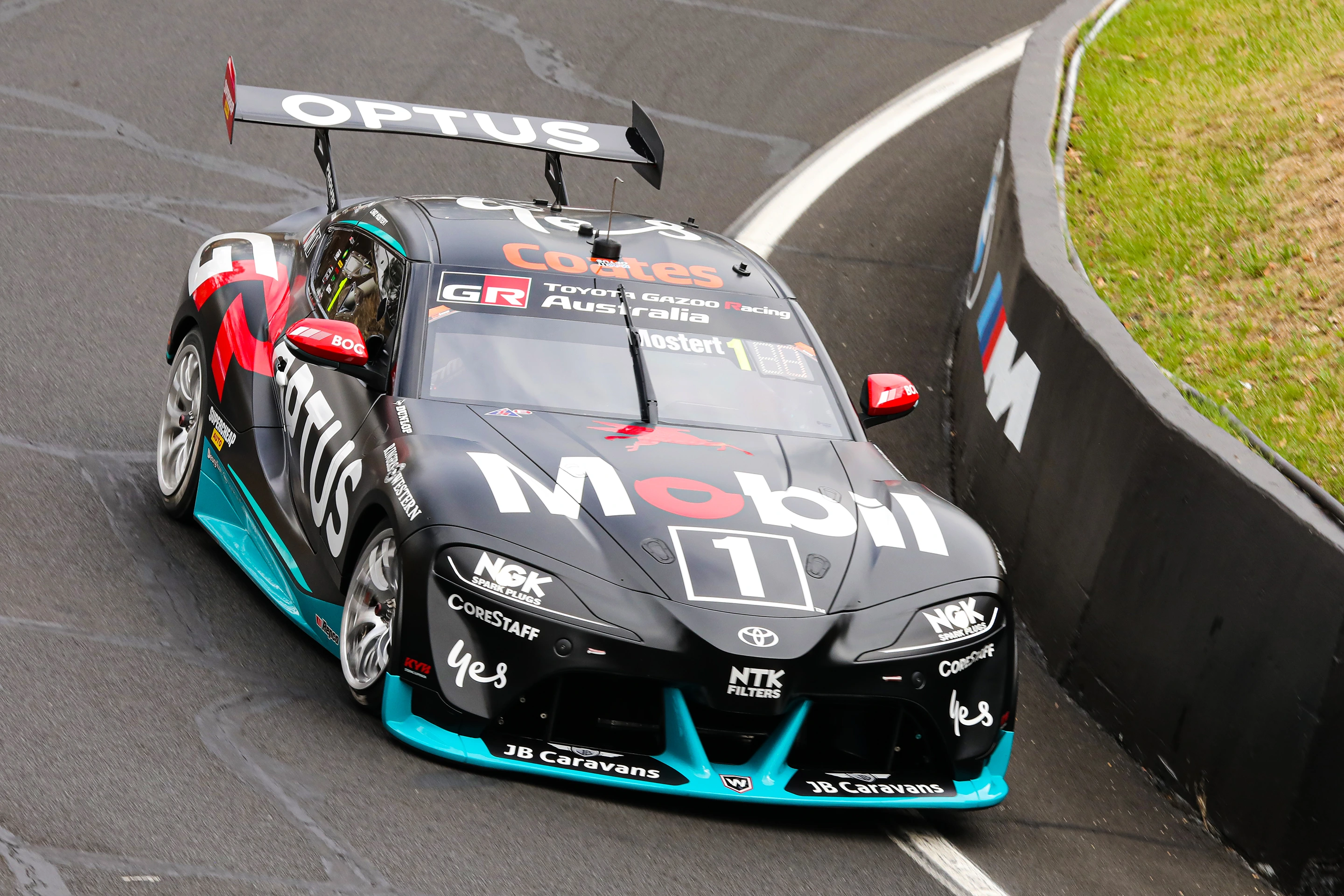
A Toyota GR Supra Supercar testing at Mount Panorama before its 2026 championship debut.
Adding Toyota was more complicated than fitting Supra-shaped panels to an existing chassis. The car required an approved body package, cooling installation, engine programme and complete Vehicle Specification Document.
The Supra’s aerodynamic development included scale modelling, circuit running and full-size wind-tunnel testing alongside the Mustang and Camaro.
Its 5.2-litre V8 was also tested against the established Chevrolet and Ford engines. Dynamometer work examined power, torque, response and operation through the complete drivetrain.
Once the static targets had been achieved, the three models completed further circuit testing to confirm that the cars behaved comparably in real conditions.
The finished Supra retains the compact coupe appearance of the production model while using the same underlying Gen3 racing concept as its rivals.
Its arrival demonstrates one of the principal aims of the control chassis: a new manufacturer can enter without designing an entire racing platform from the beginning.
Homologation teams and Vehicle Specification Documents
Each manufacturer appoints a homologation team. That organisation acts as the technical link between the manufacturer, Supercars and the other teams racing the same model.
The homologation team helps develop the approved bodywork, engine installation and manufacturer-specific components. It also supports parity testing and prepares proposed updates when required.
The legal specification is recorded in a Vehicle Specification Document, often shortened to VSD. The document defines the components, dimensions and settings approved for that model.
A customer team cannot independently alter its car because it believes a different splitter, mirror or engine setting would be faster. Any model-wide change must be assessed and added to the VSD through the official process.
This keeps every Mustang, Camaro or Supra on the same manufacturer specification. Differences between teams should come from setup and execution rather than one organisation secretly racing an upgraded body package.
How ongoing parity reviews work
Parity is not treated as a one-time test that can never be reconsidered. Supercars monitors performance during the season and can investigate when the data reaches defined trigger points.
The 2026 process uses a rolling calculation based on multiple cars from each manufacturer across a six-race period. This is intended to identify a consistent technical pattern rather than reacting to one unusually strong or weak result.
Reaching a trigger requires an investigation, but it does not automatically mean a car will be changed. Officials must determine whether the difference comes from vehicle performance, team execution, circuit characteristics or another factor.
Available evidence can include lap times, acceleration data, engine measurements, aerodynamic information and the performance of several teams using the same model.
If a technical difference is confirmed, Supercars can approve a controlled alteration to the relevant Vehicle Specification Document. Changes may affect bodywork, engine operation, weight distribution or another parity-related area.
The purpose is not to ensure that all three manufacturers win the same number of races. It is to give each approved vehicle a comparable underlying opportunity when prepared and driven effectively.
Safety regulations
The steel roll-cage structure forms the central safety cell around the driver. It must withstand major frontal, side and rollover loads while providing sufficient space for extraction after an accident.
The driver sits well inside the car behind substantial side-impact protection. Energy-absorbing structures and controlled bodywork help manage the forces produced during a collision.
A racing seat, multi-point harness, helmet, flame-resistant clothing and frontal-head-restraint device are compulsory. The seat and harness installation must comply with the approved safety requirements.
The fuel is carried inside a protected safety cell rather than the production model’s road tank. Dry-break refuelling equipment reduces the risk of fuel escaping during a pit stop.
An onboard fire-suppression system can discharge into the cockpit and engine area. External controls allow marshals to activate the electrical isolation and extinguisher systems.
The driver’s side of the cockpit includes substantial protection, but visibility and heat remain significant challenges. Teams use approved cooling systems, ventilation and drink equipment to help drivers complete long races in extremely high cockpit temperatures.
Gen2 vs Gen3 Supercars
| Area | Previous Gen2 cars | Current Gen3 cars |
|---|---|---|
| Introduction | Gen2 rules began in 2017 on the existing Car of the Future platform | Introduced for the 2023 season |
| Road-car resemblance | Body proportions were adapted to a platform developed around larger saloons | Key panels and dimensions more closely follow the represented production coupe |
| Chassis | Larger control structure | Smaller chassis designed to accept a wider variety of models |
| Aerodynamics | Higher downforce and greater dependence on clean air | Substantially reduced downforce to improve following and driver influence |
| Engine philosophy | Highly developed V8 engines with higher operating costs | Production-based V8 architecture with greater emphasis on life and cost control |
| Manufacturers represented | Ford and Holden during the final seasons | Ford, Chevrolet and Toyota from 2026 |
| Parity testing | Primarily track and technical testing methods | Expanded use of full-scale wind tunnels, transient dynamometers and torque sensors |
Gen3 was not intended to make the cars slower for its own sake. The reduced downforce, longer-life engines and controlled components were designed to move the focus toward racing, driver skill and sustainable operating costs.
Why closely controlled cars do not produce identical lap times
Parity gives the Mustang, Camaro and Supra comparable technical potential, but it does not guarantee that every car will perform identically.
Teams differ in their understanding of suspension settings, dampers, tyres and aerodynamic balance. One organisation may find the correct setup window quickly, while another struggles throughout the weekend.
Drivers also use the car differently. Braking style, steering input, throttle application and gear selection all affect tyre temperature and degradation.
Mechanical preparation matters because the field is often separated by fractions of a second. A small alignment error, cooling problem or slow gear change can cost several grid positions.
The three engine designs can retain different characteristics even when their overall performance is balanced. A particular circuit may temporarily suit one torque curve, cooling layout or fuel-use pattern.
Strategy adds another variable. A fast car can lose through a poorly timed pit stop, slow tyre change, Safety Car interruption or excessive fuel consumption.
The regulations are intended to prevent an unfair design advantage, not to remove the need for teams and drivers to perform.
Supercars regulations: the simple explanation
Every current Supercar uses the Gen3 technical platform. The cars share a common chassis concept, six-speed sequential transaxle, rear-wheel drive, control tyres and many standard mechanical components.
Ford, Chevrolet and Toyota retain their own body shapes and V8 engines. The Mustang uses a 5.4-litre quad-cam engine, the Camaro uses a 5.7-litre single-cam V8 and the GR Supra uses a 5.2-litre quad-cam unit.
The three engines are controlled to approximately 600 hp, while aerodynamic wind-tunnel testing places the different body designs inside a common downforce and drag window.
Teams cannot design new wings, chassis or gearboxes, but they can adjust suspension, dampers, wheel alignment, differential settings, cooling and tyre pressures within the rules.
The drivers have no traction control, ABS or automatic paddle shift. They must manage wheelspin, brake locking, sequential gear changes and tyre degradation themselves.
Parity testing is used to provide comparable technical potential, while race results are still decided by setup, preparation, driving, pit stops and strategy.
That is the central idea behind Gen3: three recognisably different V8 racing cars operating within one closely controlled technical formula.
Technical information is based on the published 2026 Supercars regulations and official Gen3 technical material.
Related Articles
|
GT3 Explained: What Is a GT3 Car?
|
|
LMP3 Explained: What is an LMP3 Car?
|
|
LMP2 Explained: What is an LMP2 Car?
|
|
WEC vs IMSA: What’s the Difference?
|
|
NLS Starting Groups Explained
|
|
GT4 Explained: What Is a GT4 Car, and how is it different from GT3?
|
|
What Is the Difference Between GT3 and Cup 2?
|
|
Hypercar Explained: What Is a Hypercar in WEC, IMSA and Le Mans?
|
Related series

|
Supercars
|