
Tags:
World Rally-Raid Championship Technical Regulations Explained
How Ultimate prototypes, production-based Stock vehicles, lightweight Challenger cars and side-by-side SSVs compete across deserts, dunes and long off-road stages.

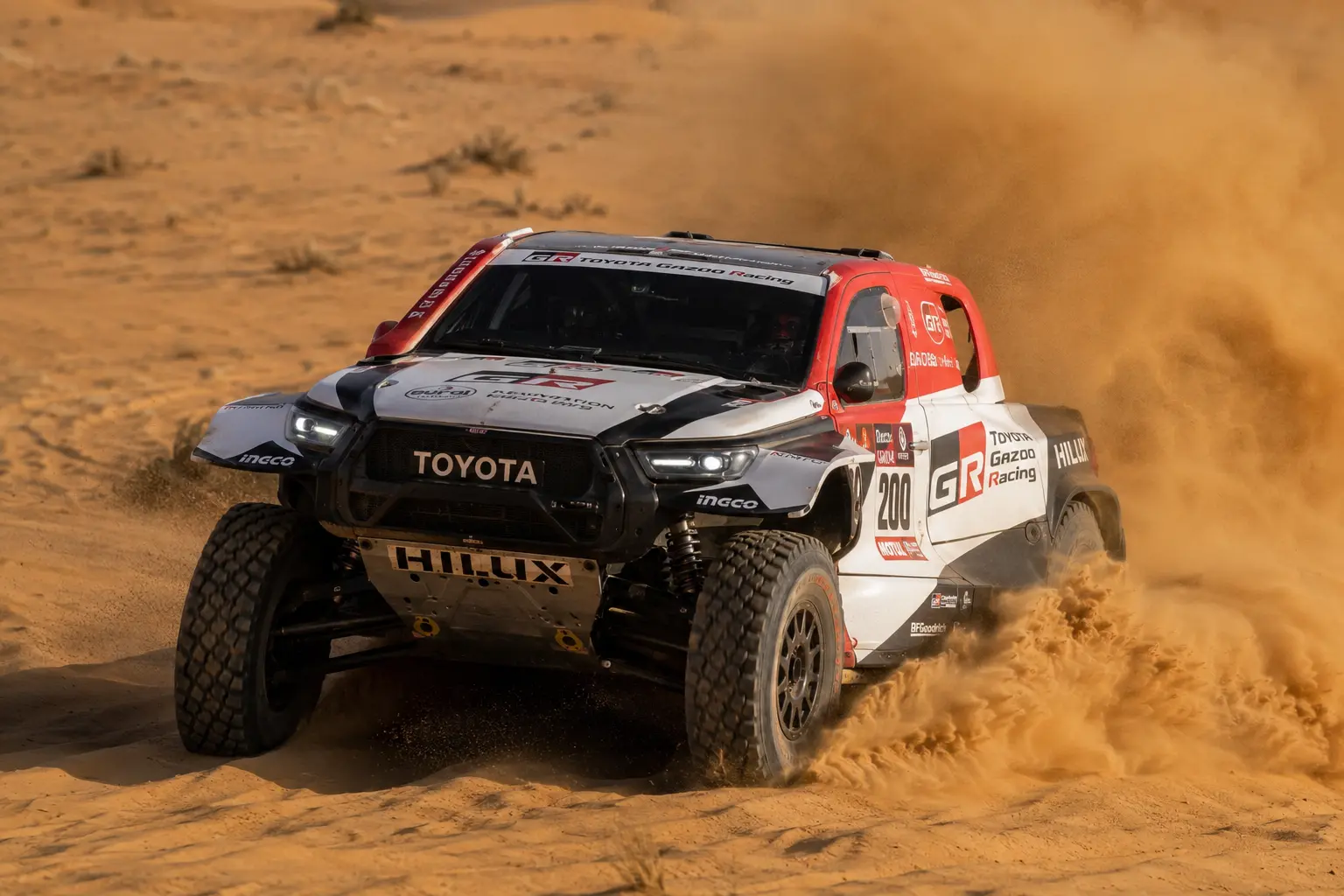
How the World Rally-Raid Championship class system works
The FIA World Rally-Raid Championship, usually shortened to W2RC, is an off-road championship containing events such as the Dakar Rally and shorter cross-country rallies. Crews race against the clock over long selective sections while navigating through deserts, dunes, rocky tracks and open terrain.
The main car groups are Ultimate, Stock, Challenger and SSV. The names replaced the older T1, T2, T3 and T4 public terminology, although technical class codes such as T1+ and legacy T4 still appear in the regulations.
Ultimate contains the fastest purpose-built cars. Stock is for vehicles that remain closely connected to series-production models. Challenger contains lightweight prototypes, while SSV covers production-derived side-by-side vehicles.
Trucks are governed by their own FIA technical group. They can compete at eligible cross-country rallies, but they are not included in the combined Car classification formed by Ultimate, Stock, Challenger and SSV.
The groups do not simply separate vehicles by engine power. Construction method, drivetrain, production origin, suspension, minimum weight, fuel capacity and maximum speed all help determine where a vehicle belongs.
W2RC classes: basic comparison
| Group | Traditional code | Vehicle concept | Maximum speed | Typical role |
|---|---|---|---|---|
| Ultimate | T1 and T1+ | Purpose-built prototype or highly specialised competition vehicle | 170 km/h | Overall rally victory |
| Stock | STK and legacy T2 | Series-production-based off-road vehicle | 170 km/h | Production-car relevance and durability |
| Challenger | T3 and CHG | Lightweight purpose-built prototype | 135 km/h | Lower-cost prototype competition and driver development |
| SSV | T4, SSV1 and SSV2 | Series-production-derived side-by-side vehicle | 125 km/h | Accessible rally-raid competition |
| Truck | T5 | Heavy racing or race-service truck | 135 km/h, or 125 km/h for T5.2 | Separate heavy-vehicle competition and support |
Ultimate is the headline W2RC category and normally supplies the overall winner. These cars may resemble production pick-ups or SUVs, but the leading vehicles are purpose-built competition prototypes underneath their manufacturer-specific bodywork.
The group includes several technical classes. T1+ is the main modern four-wheel-drive category. The regulations also identify T1.1 four-wheel-drive prototypes, T1.2 two-wheel-drive prototypes and ULTS vehicles derived from SCORE-style regulations.
A T1+ car uses a tubular competition structure, long-travel suspension, large off-road tyres and specialised racing systems. Manufacturers can use petrol or diesel powertrains, but engine output is controlled through FIA measures rather than left unrestricted.
The body shape helps identify the manufacturer, but it does not mean the vehicle shares a production chassis with the road model. A rally-raid prototype is designed around high-speed off-road impacts, large suspension movement, multiple spare wheels and long periods of operation away from conventional circuits.
Key T1+ regulations
| Area | Current T1+ rule | What it means |
|---|---|---|
| Drivetrain | Four-wheel drive only | Engine torque can be delivered through both axles. |
| Maximum body width | 2,300 mm | The wide body accommodates large tyres and substantial suspension travel. |
| Minimum weight | 2,010 kg for petrol and 2,040 kg for supercharged diesel | Diesel and petrol vehicles are given separate weight requirements. |
| Suspension travel | Maximum 350 mm vertical travel | The wheels can move much farther than those of a circuit-racing car. |
| Maximum speed | 170 km/h | Speed is electronically monitored during selective sections. |
| Driver aids | ABS, traction control and electronic stability control prohibited | The crew must manage braking and wheelspin without road-car assistance systems. |
T1+ dimensional, weight, suspension and drivetrain requirements are defined in FIA Appendix J Article 285. The wider Ultimate regulations also prohibit systems such as ABS, traction control and electronic stability control.
Why Ultimate cars are not separated by one horsepower figure
Ultimate vehicles can use different engine layouts and fuel types. A manufacturer may choose a turbocharged petrol engine, a naturally aspirated engine or a supercharged diesel, depending on the homologated technical concept.
Comparing only peak power would not create an accurate picture of performance. Torque delivery, throttle response, vehicle mass, cooling, fuel consumption and operation at high altitude all influence how quickly a car crosses a rally-raid stage.
The FIA can control performance through air restrictors, turbocharger boost, engine-speed limits, fuel-related parameters and other technical or sporting measures. Vehicles also carry data-logging and monitoring equipment that allows officials to inspect their operation.
The sporting regulations expressly allow the FIA to introduce performance-control or balancing measures when required. These controls are intended to keep different technical concepts competitive without forcing every manufacturer to build the same engine.
Stock: the production-based category
Stock is the W2RC category with the closest connection to vehicles available to customers. Its new technical framework became a major part of the championship structure for 2026.
A Stock entry must conform to an FIA-approved homologation based on a series-production model. Modifications that are not expressly permitted are forbidden, preventing a team from gradually converting the car into an unrestricted prototype.
The regulations still allow extensive safety and durability preparation. The vehicle can receive a roll cage, racing suspension components, underbody protection, a safety fuel system, navigation equipment and cooling changes defined by its homologation.
Unlike T1+, Stock does not have one universal minimum-weight figure for every model. Each vehicle’s minimum is recorded on its homologation form. In rally condition, the car must weigh at least that homologated figure plus 40 kg, carrying two spare wheels and no crew. Ballast cannot be used simply to bring an underweight Stock vehicle up to the requirement.
The Defender Dakar D7X-R is an example of the new category. It retains the production vehicle’s D7x architecture, transmission and driveline layout, together with a 4.4-litre twin-turbocharged V8, while adding specialised suspension, cooling, safety and rally-raid equipment.
Ultimate vs Stock
| Area | Ultimate | Stock |
|---|---|---|
| Basic construction | Purpose-built competition prototype | Closely based on a homologated production vehicle |
| Production chassis | Not required | Production architecture remains central to the car |
| Technical freedom | Greater freedom within the prototype regulations | Only specifically authorised modifications are permitted |
| Minimum weight | Defined by technical class and powertrain | Defined on each model’s homologation form |
| Maximum speed | 170 km/h | 170 km/h |
| Main appeal | Maximum rally-raid performance | Road-vehicle relevance and extreme durability |
The identical speed limit does not mean the two groups have equal stage performance. Ultimate prototypes generally accelerate, brake and travel across difficult terrain more effectively because they are designed specifically for competition.
Challenger: lightweight rally-raid prototypes
Challenger sits below Ultimate in the rally-raid performance hierarchy. The cars are lightweight purpose-built prototypes, often using compact turbocharged engines and simpler systems than the leading T1+ machinery.
The current class structure contains CHG1 for turbocharged engines up to 1,050 cc and CHG2 for naturally aspirated engines up to 1,050 cc. T3.U covers approved high-voltage or alternative-energy Challenger vehicles, while CHGS accommodates certain SCORE-derived concepts.
The combustion engine must originate from a mass-produced vehicle manufacturer and meet the category’s availability requirements. The base engine is tightly controlled, reducing the opportunity for an expensive bespoke power-unit programme.
Minimum weight is 920 kg for a turbocharged Challenger and 800 kg for a naturally aspirated version, measured without fuel and with one spare wheel. Cross-country rally running adds 30 kg to the minimum racing-condition requirement.
The maximum fuel capacity is 130 litres, while the maximum permitted speed is 135 km/h. Challenger cars are therefore substantially lighter than Ultimate machines but operate under a lower speed ceiling.
Challenger technical overview
| Area | CHG1 turbo | CHG2 naturally aspirated |
|---|---|---|
| Maximum engine capacity | 1,050 cc | 1,050 cc |
| Forced induction | Turbocharger permitted | Not permitted |
| Technical minimum weight | 920 kg | 800 kg |
| Rally-condition addition | 30 kg | 30 kg |
| Spare wheels at weighing | One | One |
| Maximum fuel capacity | 130 litres | 130 litres |
| Maximum speed | 135 km/h | 135 km/h |
SSV means Side-by-Side Vehicle. These machines are based much more closely on commercially produced recreational or utility vehicles than Challenger prototypes.
An SSV must be identifiable through its FIA homologation form. Approved SSV-KIT components can replace certain production parts, but any modification that is not expressly permitted remains forbidden.
The 2026 structure includes SSV1 for turbocharged engines up to 1,050 cc and naturally aspirated engines from 1,050 to 2,000 cc. SSV2 covers naturally aspirated engines up to 1,050 cc. Legacy T4 vehicles may continue when their technical passport was issued before the end of 2025.
Unlike Challenger, current SSV1 and SSV2 vehicles do not share one universal base minimum weight. The figure is established through the model’s homologation. For cross-country rally running, the minimum racing-condition weight is the homologated value plus 30 kg, with one spare wheel and no fuel.
SSVs are limited to 125 km/h. Their appeal comes from relatively accessible costs, recognisable production origins and the challenge of maintaining momentum over difficult terrain with less performance than a prototype.
Challenger vs SSV
| Area | Challenger | SSV |
|---|---|---|
| Vehicle concept | Purpose-built lightweight prototype | Series-production-derived side-by-side |
| Construction freedom | Greater freedom within prototype regulations | Closely tied to the homologated production vehicle and approved kit |
| Maximum speed | 135 km/h | 125 km/h |
| Base minimum weight | Set directly by engine type | Set through each vehicle’s homologation |
| Spare wheels at weighing | One | One |
| Main competitive focus | Prototype pace and development | Production-based affordability and reliability |
FIA Group Truck covers vehicles weighing more than 3,500 kg. They are governed separately from the four car groups and use their own Appendix J regulations.
T5.1 contains race trucks built to compete for performance. T5.U provides a route for approved alternative-energy or high-voltage vehicles. T5.2 covers race-service trucks that carry equipment and can support another competing crew.
Current minimum weight depends on engine capacity. A truck with an engine above 10 litres must weigh at least 8,760 kg, while a truck using an engine of 10 litres or less has a 6,760 kg minimum. Additional crew-related mass is included according to whether the truck carries two or three people.
Most competition trucks are limited to 135 km/h. T5.2 race-service trucks are limited to 125 km/h because their role includes carrying support equipment rather than operating purely as lightweight racing vehicles.
Why rally-raid vehicles have maximum-speed limits
Rally-raid stages can contain open desert, hidden crests, dunes, rocks, vegetation, animals and changes of surface that are difficult to identify from the cockpit. The crew may also be following navigation instructions rather than a permanently marked circuit.
The category speed limits reduce the incentive to pursue unrestricted top speed and help separate vehicles with very different construction and safety characteristics.
Speed is monitored through mandatory electronic equipment. Exceeding a group’s authorised limit can produce sporting penalties even when the crew gains no obvious position on the road.
The limit is not a target that every vehicle reaches continuously. Soft dunes, steep climbs and rocky terrain may reduce speeds dramatically, while the fastest sections can bring a car close to its electronic ceiling.
| Group | Maximum speed | Equivalent in mph |
|---|---|---|
| Ultimate | 170 km/h | Approximately 106 mph |
| Stock | 170 km/h | Approximately 106 mph |
| Challenger | 135 km/h | Approximately 84 mph |
| SSV | 125 km/h | Approximately 78 mph |
| T5.1 and T5.U Truck | 135 km/h | Approximately 84 mph |
| T5.2 Truck | 125 km/h | Approximately 78 mph |
Official maximum speeds are defined in the FIA Cross-Country Rally Sporting Regulations. Mile-per-hour values are approximate conversions.
Alternative-energy and high-voltage vehicles
The regulations provide technical routes for alternative-energy rally-raid vehicles. Challenger includes the T3.U class, while Truck includes T5.U.
These entries can use high-voltage or alternative powertrain systems approved under their respective regulations. Additional safety procedures apply because damaged electrical components can create risks that do not exist in a conventional combustion vehicle.
High-voltage vehicles require approved isolation systems, warning markings and trained personnel. The crew, marshals and recovery teams must be able to identify the vehicle’s electrical state after an accident.
Alternative-energy eligibility does not remove the need for sporting control. Weight, speed, stored energy, performance and safety remain regulated so that the vehicle can compete within the wider group.
Suspension travel and off-road setup
Rally-raid suspension must absorb impacts that would severely damage a conventional circuit car. Dunes, rocks, compressions and concealed holes can use the entire available suspension movement in a single event.
A soft setup can help the tyres follow rough ground, improving traction and protecting the chassis. Excessive softness may allow the vehicle to pitch, roll or strike its underbody during high-speed compressions.
A stiffer setup can improve precision on fast tracks but transfer greater impact forces into the tyres, wheels and crew. Engineers therefore choose springs, dampers, ride height and bump-stop behaviour according to the expected terrain.
T1+ permits up to 350 mm of vertical suspension travel. Other groups follow their own technical or homologated limits, reflecting the different construction of a prototype, production vehicle or side-by-side.
The setup must also remain effective as fuel is consumed and spare wheels are removed or replaced. A vehicle carrying hundreds of litres of fuel can change significantly between the beginning and end of a long stage.
Tyres, pressure and spare wheels
Rally-raid tyres use strong constructions and deep tread patterns to survive sand, gravel, rocks and repeated impacts. The ideal tyre must provide traction without becoming so soft that it overheats or suffers frequent punctures.
Lower pressure enlarges the contact patch and can help a vehicle float across soft sand. If the pressure becomes too low on rocky terrain, the tyre can deform excessively and expose the wheel or sidewall to damage.
Higher pressure offers greater protection from impacts but reduces the contact area and can make the vehicle sink more easily in dunes. Crews and engineers choose pressures according to the route and expected temperature.
Spare-wheel rules differ by group. T1+ and Stock vehicles normally carry at least two spares under their relevant weight procedures, while Challenger and current SSV categories are measured with one.
A puncture is not automatically race-ending, but changing a wheel in deep sand or on uneven ground can cost several minutes. A crew may also need to decide whether a damaged tyre can safely reach a better location before stopping.
Navigation is part of the car regulations
Unlike a circuit race, a rally-raid crew does not follow a permanently defined lap. The navigator uses an official roadbook containing headings, distances, junctions and hazard information.
Mandatory navigation and tracking devices are installed according to the sporting regulations. These systems can record the route, warn crews about controlled zones and allow organisers to monitor a vehicle’s position.
Competitors cannot use unrestricted navigation equipment to reveal the complete course in advance. The objective is to test the crew’s ability to interpret the official information rather than simply follow a commercial map.
The driver and navigator sit side by side. The navigator communicates headings and hazards while also monitoring the roadbook, trip distances and official instruments.
A mechanically perfect vehicle can lose substantial time through a navigation error. Missing a hidden waypoint may require the crew to turn around, search for the correct route and accept a sporting penalty.
Service, bivouacs and marathon stages
After a normal stage, crews return to a bivouac where mechanics can inspect and repair the vehicle within the event regulations. The team may replace damaged parts, service the engine and prepare the car for the following day.
Rally-raid vehicles are designed to make this work practical. Body panels, suspension assemblies and mechanical components must be accessible enough for repairs to be completed in temporary desert service areas.
Marathon stages create an additional challenge by restricting or prohibiting outside assistance between selected days. Crews may need to inspect and repair their own vehicle using the tools and parts carried on board or assistance permitted between competitors.
This changes the correct driving approach. A crew protecting the car may lose a small amount of time during the stage but gain hours by avoiding damage that cannot be repaired before the next start.
Safety regulations
Every competition vehicle requires an approved safety structure appropriate to its group. Prototype cars use purpose-built frames, while production-based entries receive extensive roll-cage and reinforcement systems.
The crew use FIA-approved seats, multi-point harnesses, helmets, flame-resistant clothing and frontal-head-restraint equipment. Seats and harnesses must remain within their homologation and service-life requirements.
Fuel is carried in protected racing tanks or homologated fuel systems designed to reduce leakage after a major impact. Underbody protection shields important components from rocks and hard landings.
Mandatory tracking and communication equipment allows race control to locate a stopped vehicle. Crews can issue an emergency alert, while approaching competitors can receive warnings about an accident or stationary car.
High-voltage vehicles require additional electrical isolation and warning systems. Trucks use separate safety requirements reflecting their much greater mass and the possibility of carrying a three-person crew.
The relevant construction and safety regulations are distributed across FIA Appendix J Articles 281 to 287, covering definitions, general requirements, safety and the individual vehicle groups.
Technical passports, homologation and scrutineering
Each vehicle must have the technical documentation required for its group. This can include an FIA technical passport, homologation form and records of approved components.
Officials inspect the vehicle before and during an event. They can check weight, dimensions, safety equipment, restrictors, electronic data and compliance with the declared specification.
Engines, turbochargers or other important components may be sealed. Breaking a seal without the required authorisation can trigger additional inspection or a sporting penalty.
Production-based Stock and SSV entries are checked against their homologation documents. Ultimate and Challenger prototypes are measured against their Appendix J requirements and approved technical specifications.
A car that is safe and fast can still be excluded when it does not comply with the regulations. Rally-raid endurance does not reduce the requirement for technical legality.
W2RC vs the World Rally Championship
| Area | World Rally-Raid Championship | World Rally Championship |
|---|---|---|
| Route type | Long open-terrain selective sections requiring navigation | Closed and pre-defined special stages |
| Main vehicle structure | Several groups ranging from prototypes to production-based vehicles | Rally cars divided through the FIA Rally pyramid |
| Crew | Driver and navigator seated side by side; trucks can carry a third crew member | Driver and co-driver seated side by side |
| Navigation | Finding the route is a central competitive task | The co-driver follows detailed pace notes for a known road |
| Stage length | Can extend for hundreds of kilometres | Generally much shorter individual stages |
| Maximum speed | Explicit group limits from 125 to 170 km/h | Controlled through rally regulations and route design rather than the same W2RC group limits |
| Mechanical priority | Range, cooling, suspension travel and survival over extreme distances | Maximum performance over repeated closed-road stages |
Both championships test a driver and navigator against the clock, but the technical demands are different. A W2RC car must combine speed with range, navigation equipment, spare parts and the ability to survive extended operation far from a conventional service park.
Who can score W2RC championship points?
Registered crews in Ultimate, Stock, Challenger and SSV can be eligible for the FIA World Rally-Raid Championship for Drivers and Navigators under the current sporting structure.
Stock, Challenger and SSV also have their own category championships, allowing crews to compete for meaningful honours without needing to defeat the faster Ultimate prototypes on overall time.
This means the timing screen contains several competitions at once. An SSV may be far behind the leading Ultimate car overall while still fighting for a category victory and championship points.
The overall result remains important, but comparing a Challenger directly with a T1+ car does not explain whether the Challenger crew is performing well. Its true rivals are the other vehicles built to the same category regulations.
Why a slower category can appear ahead of a faster car
The category hierarchy describes performance potential rather than guaranteeing the order at every moment. An Ultimate car can lose hours through mechanical damage, navigation errors or repeated punctures.
A well-driven Challenger or SSV may therefore appear ahead of a troubled Ultimate entry in the overall classification. Reliability is especially influential during multi-day rallies in which a single major repair can destroy an otherwise competitive result.
Starting order can also mix the groups. Penalties, previous-stage results and event-specific procedures can place a nominally slower vehicle ahead of a faster one on the road.
Terrain changes the relative strengths of each design. A lighter vehicle may perform strongly in soft dunes, while a heavier and more powerful prototype may gain more time on fast tracks.
The most successful crew is not always the one with the highest peak speed. Navigation, mechanical sympathy, tyre management and avoiding stoppages are equally important parts of rally-raid performance.
World Rally-Raid Championship regulations: the simple explanation
Ultimate contains the fastest prototype cars. T1+ vehicles are four-wheel drive, can be up to 2,300 mm wide, use as much as 350 mm of suspension travel and are limited to 170 km/h.
Stock is based closely on production vehicles. Each model follows an FIA homologation, and modifications that are not specifically authorised are prohibited.
Challenger contains lightweight prototypes with engines up to 1,050 cc. Turbocharged vehicles have a 920 kg technical minimum, naturally aspirated cars have an 800 kg minimum and both are limited to 135 km/h.
SSV contains homologated production-derived side-by-side vehicles. Their minimum weight depends on the model, and their maximum speed is 125 km/h.
Truck is a separate FIA group for heavy racing and race-service vehicles. Most competition trucks are limited to 135 km/h, while T5.2 service trucks are limited to 125 km/h.
The FIA controls performance through homologation, minimum weights, engine restrictions, electronic monitoring and speed limits. Teams and manufacturers can still improve reliability, setup and execution within those rules.
Related Articles
|
Different Types of Rally Stages Explained: What Happens During a Rally Weekend?
|
|
All Major Rally Car Classes Explained
|
Related series

|
World Rally-Raid Championship
|